
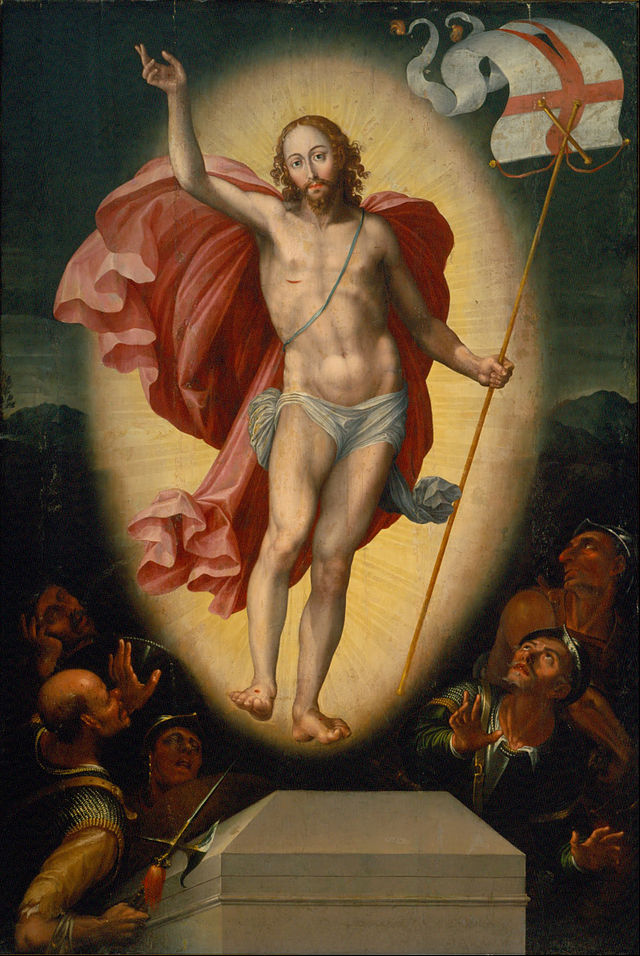
(Image Courtesy: Wikipedia)
16th-century depiction of Christ’s resurrection, by artist Alonso Lopez de Herrera
By K.P. Sander
There are many depictions of Easter. Some have to do with a large, well-dressed rabbit, who mythically delivers baskets with chocolate versions of himself at some point during the night, a la Santa Clause. Other versions have children searching the great outdoors in a mad dash to find plastic eggs filled with treats. Despite these fun rituals of springtime and fertility, there is a much more important truth behind the meaning of Easter.
Easter is all about the resurrection of Jesus Christ from the dead, three days after his crucifixion by the Romans at Calvary around 30 AD, according to the New Testament.
The 40 days preceding Easter – the Lenten season – are a reminder of the 40 days Christ spent in the wilderness, fasting and praying with the knowledge of what was to come.
In the week immediately prior to his crucifixion, Christ entered the city of Jerusalem, and was welcomed by the people (Palm Sunday). They waved palm branches and declared Hosanna! as He rode in on a donkey. During that week the people’s views changed as Pontius Pilate – who initially found no reason to prosecute him – turned him over to the crowds who wanted to kill him because He claimed to be God.
Maundy (or Holy) Thursday, the day before his death, is celebrated in commemoration of the Last Supper, where Christ washed the feet of his disciples, Judas Iscariot’s betrayal was revealed, and He reminded the disciples of what was to come. Easter is linked to Passover and the Exodus from Egypt, with Christ becoming the Passover lamb to be sacrificed. At the Last Supper, Christ told his followers that the bread was a reminder of his body, soon to be sacrificed; and the wine symbolized his blood, soon to be shed.
Good Friday, a remembrance of the day Christ was put to death, is a somber occasion, and it broke the hearts of those that loved and followed him. They didn’t believe what He had been telling them all along, and they were shocked by His death and His resurrection. Over 500 people gave eyewitness accounts of seeing Jesus after his death.
In the book of Matthew, Chapter 28:5-8, as Mary’s mother and Mary Magdalene went to visit Jesus’ tomb after his burial, they noticed the stone had been rolled away from the door, and an angel of the Lord spoke to the women.
“But the angel answered and said to the women, ‘Do not be afraid, for I know that you seek Jesus who was crucified. He is not here; for He is risen, as He said. Come, see the place where the Lord lay. And go quickly and tell His disciples that He is risen from the dead, and indeed He is going before you into Galilee; there you will see Him. Behold, I have told you.’ So they went out quickly from the tomb with fear and great joy, and ran to bring His disciples word.”
Easter is an event central to Christian beliefs, and in fact, is the very foundation of Christianity.
 ABC PR -Community News, Public Relations and Advertising Services