
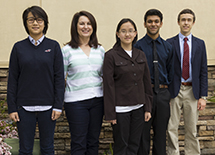
Photo Courtesy: wecanchange.com
WHS team, ET (Energy Team), were one of the State Finalists in the Siemens We Can Change The World Challenge.
By Kimberley Sander SGV – Walnut High School, Diamond Bar High School, and Wilson High School, were among those named as State Finalists in the Siemens We Can Change the World Challenge. The Siemens Foundation, which provides more than $7 million in annual support of U.S. education initiatives for math, science, engineering and technology, sponsored this new program, which encourages students to develop innovative green solutions for today’s environmental concerns. According to their website, the Siemens Foundation wants to “support outstanding students today, and recognize the teachers and schools that inspire their excellence, helping to nurture tomorrow’s scientists and engineers.” The challenge is open to high school students (grades 9-12), who must select an environmental topic relating to energy, biodiversity, land management, water conservation, or air/climate cleanup. The teams are made up of two to four students, and an advisor/mentor. The challenge took place from September 13, 2012 to March 5, 2013. Team ET (Energy Team) from Walnut High School, under the direction of teacher/mentor Jeri Braviroff, proposed to the Walnut City Council that installing LED (Light Emitting Diodes) street lights throughout the City would be a great ecological idea. Reports state that the Walnut City Council listened to the team’s proposal and said they would have their staff look into the idea. According to Team ET, as described on the Siemens Foundation website, “Our goal is to educate the public and our city on the implementation of the light-emitting diode, or LEDs, into city street lights. This phasing in of LEDs will reduce energy consumption and the probability of mercury poisoning among civilians and surrounding landscapes, reduce the amount of mercury that is released into the air through the burning of coal, and increase the environmental benefits. Subjective testing was done using CFLs, incandescents, and LEDs, comparing the general brightness and color output of the bulb. A positive relationship was found between the usage of less wattage and general brightness and color output.” Under the direction of teacher/mentor Jinasha Udeshi, Team Wildcats of Wilson High School in Hacienda Heights was also a finalist. They proposed to install a grass roofing to buildings which will reduce their carbon footprint and decrease energy usage via better insulation. The green roof would also reduce costs and improve the surrounding air quality through photosynthesis. “A green roof provides a win-win situation for the environment and the user, possibly making it one of the best ways to have everyone help contribute to the fight against global warming,” said Team Wildcats. Finally, Diamond Bar High School had four team finalists, all under the direction of teacher/mentor David Hong. Team Bagsters placed collection boxes next to school trash cans for hard-to-recycle materials, like potato chip bags, to determine if awareness and knowledge affects whether people recycle or not. “Our team will compare the amount of potato chip bags recycled before and after an awareness campaign on recycling potato chip bags. The campaign will include a survey of 100 students on campus to determine if they know what products are recyclable, and if given a convenient way to recycle, would they, and campus announcements,” said members of Team Bagsters. The second DBHS team, Eco Friends, developed special recycling bin tops that fit only bottles in an effort to prevent trash from mixing in to recycling. “This would make it easier for our school to sort through the bottles, if it decides to recycle them for money,” said Team Eco Friends. Team AQ2, the third DBHS team, installed water bottle refilling stations around the school, and encouraged the use of reusable bottles versus plastic. “By reducing our school’s overall plastic bottle usage and reliance, we can save an estimated amount of 12,500 plastic bottles from our school every year,” said Team AQ2. And finally, the last DBHS team, Steampunk Machiavellians, determined the school could reduce energy for metal and aluminum production by using fewer staplers. “We want to reduce the amount of metal used in our school by persuading teachers to use fewer staplers. By doing so, we believe that we can change the world by reducing the amount of energy used for metal production and for processing of the aluminum used in staplers and staples. If all goes well, then our impact in the school will be significant and that’s the change we would love to see,” said the Steampunk Machiavellians. Congratulations to all of our local high school finalists. Your eco-friendly ideas will definitely help to make positive changes in our world.
 ABC PR -Community News, Public Relations and Advertising Services