
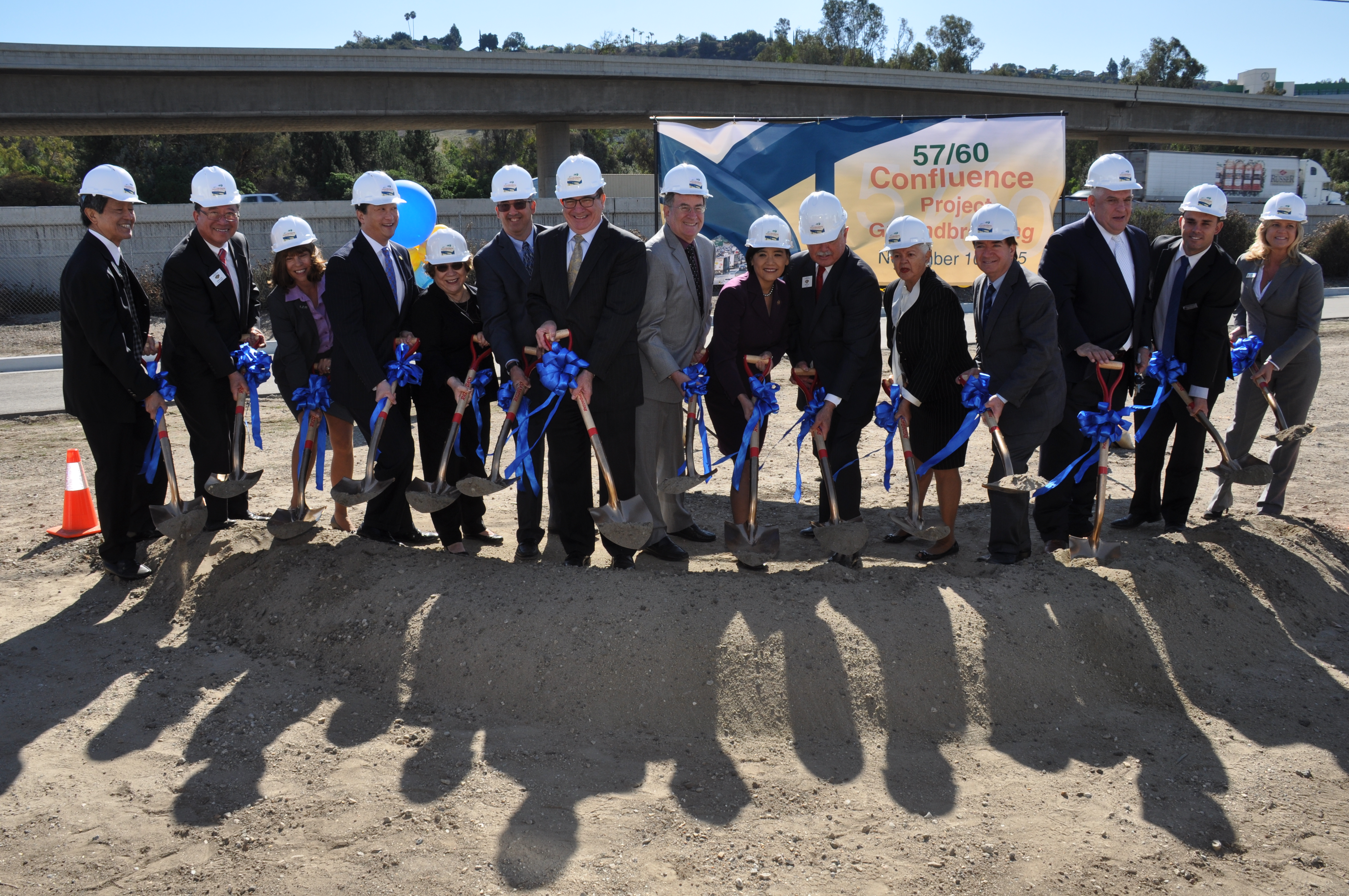
Photo Courtesy: City of Diamond Bar
City officials and local dignitaries officially break ground on the first phase of the long-anticipated 57/60 Confluence Project.
Traffic relief draws near for one of California’s worst bottlenecks
By Monique Valadez
DIAMOND BAR – Deemed the eighth worst bottleneck in the nation by the American Transportation Research Institute, the two-mile stretch where the 57 Freeway and 60 Freeway merge is on the fast track for a face lift that is set to begin in January 2016.
Last Tuesday, Nov. 10, city officials from cities of Diamond Bar and Industry were joined by the U.S. Department of Transportation’s Federal Highway Administration (FHWA) and other dignitaries to help break ground on the first phase of the two-mile stretch, referred to as the 57/60 Confluence Project.
“We applaud Los Angeles County for moving this project forward,” Federal Highway Administrator Gregory Nadeau said. “It is tremendously important to the economy of California and, by extension, to the nation as a whole.”
During both the morning and afternoon grind, commuters attempt to weave across multiple lanes where 17 lanes of traffic condense sharply into just 14 lanes, resulting in a traffic choke hold on both freeways and frequent accidents. The $256-million freeway facelift promises to alleviate this problem with three major phases of improvements.
The first phase of the project calls for construction of the westbound freeway on-ramp from Grand Avenue. Phase two will include two series of improvements: Street widening in the vicinity of Grand Avenue and Golden Springs Drive and construction of the westbound freeway off-ramp and secondary lane to Grand Avenue.
The third and largest phase will bring improvements to the freeway mainline and bypass connectors. Funding is yet to be identified for this phase.
The project will be funded with a mix of funds from local, State and Federal sources. Similar projects nationwide are not moving forward due to the lack of funding, according to federal officials.
Senator Bob Huff (R-San Dimas) who represents the project area says that the nearly 40 year old freeway redesign is long overdue.
“The Southern California Association of Governments (SCAG) estimates about 356,000 vehicles, including 26,000 big rig trucks, travel on the 57/60 Confluence every day,” said Huff. “During rush hours, peak traffic generally last for three to four hours on a typical weekday. Nearly ten thousand vehicles travel this stretch nearly every hour of the day.”
U.S. Transportation Secretary Anthony Foxx says that the interstate redesign project will make a big difference in the quality of life.
“This project is a win for businesses and people living in Los Angeles County,” said Foxx. “Not only will it improve the efficient movement of freight, which is an important priority for the economy, it will also improve the quality of life for people who have experienced the frustration of waiting in rush hour traffic.”
The proposed improvements would result in a reduction of at least 162 accidents per year, or nearly 3,300 less accidents over the next 20 years, and likely reduce accidents that cause injury or fatality by at least 1,000 occurrences over the next 20 years, according to project planners.
This freeway fix is expected to be completed in about two years depending on weather.

Photo courtesy: City of Diamond Bar
Traffic relief draws near for one of California’s worst bottlenecks.
 ABC PR -Community News, Public Relations and Advertising Services