Tag Archives: History 101

History 101

Photo courtesy: google images

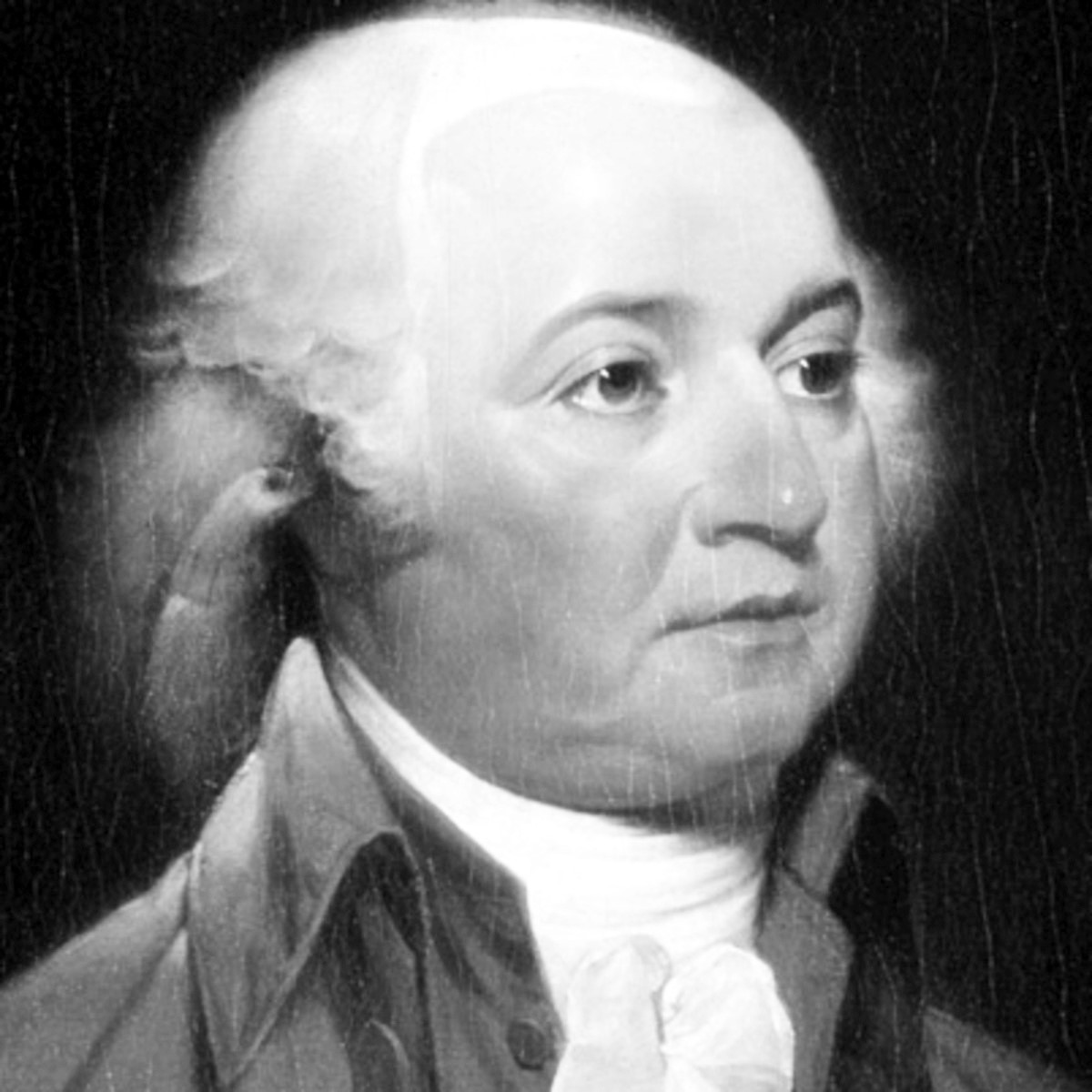
SEPTEMBER 27, 1779 : JOHN ADAMS APPOINTED TO NEGOTIATE PEACE TERMS WITH BRITISH

By History.com

On this day in 1779, the Continental Congress appoints John Adams to travel to France as minister plenipotentiary in charge of negotiating treaties of peace and commerce with Great Britain during the Revolutionary War.

Adams had traveled to Paris in 1778 to negotiate an alliance with France, but had been unceremoniously dismissed when Congress chose Benjamin Franklin as sole commissioner. Soon after returning to Massachusetts in mid-1779, Adams was elected as a delegate to the state convention to draw up a new constitution; he was involved in these duties when he learned of his new diplomatic commission. Accompanied by his young sons John Quincy and Charles, Adams sailed for Europe that November aboard the French ship Sensible, which sprang a leak early in the voyage and missed its original destination (Brest), instead landing at El Ferrol, in northwestern Spain. After an arduous journey by mule train across the Pyrenees and into France, Adams and his group reached Paris in early February 1780.

While in Paris, Adams wrote to Congress almost daily (sometimes several letters a day) sharing news about British politics, British and French naval activities and his general perspective on European affairs. Conditions were unfavorable for peace at the time, as the war was going badly for the Continental Army, and the blunt and sometimes confrontational Adams clashed with the French government, especially the powerful Foreign Minister Charles Gravier, Comte de Vergennes. In mid-June, Adams began a correspondence with Vergennes in which he pushed for French naval assistance, antagonizing both Vergennes and Franklin, who brought the matter to the attention of Congress.

By that time, Adams had departed France for Holland, where he was attempting to negotiate a loan from the Dutch. Before the end of the year, he was named American minister to the Netherlands, replacing Henry Laurens, who was captured at sea by the British. In June 1781, capitulating to pressure from Vergennes and other French diplomats, Congress acted to revoke Adams’ sole powers as peacemaker with Britain, appointing Franklin, Thomas Jefferson, John Jay and Laurens to negotiate alongside him.

The tide of the war was turning in America’s favor, and Adams returned to Paris in October 1782 to take up his part in the peace negotiations. As Jefferson didn’t travel to Europe and Laurens was in failing health after his release from the Tower of London, it was left to Adams, Jay and Franklin to represent American interests. Adams and Jay both distrusted the French government (in contrast with Franklin), but their differences of opinion and diplomatic styles allowed the team to negotiate favorable terms in the Peace of Paris (1783). The following year, Jefferson arrived to take Adams’ place as American minister to France, forming a lifelong bond with Adams and his family before the latter left to take up his new post as American ambassador to London and continue his distinguished record of foreign service on behalf of the new nation.
 

History 101

September 11, 2001: Attack on America

 By History.com

At 8:45 a.m. on a clear Tuesday morning, an American Airlines Boeing 767 loaded with 20,000 gallons of jet fuel crashes into the north tower of the World Trade Center in New York City. The impact left a gaping, burning hole near the 80th floor of the 110-story skyscraper, instantly killing hundreds of people and trapping hundreds more in higher floors. As the evacuation of the tower and its twin got underway, television cameras broadcasted live images of what initially appeared to be a freak accident. Then, 18 minutes after the first plane hit, a second Boeing 767–United Airlines Flight 175–appeared out of the sky, turned sharply toward the World Trade Center, and sliced into the south tower at about the 60th floor. The collision caused a massive explosion that showered burning debris over surrounding buildings and the streets below. America was under attack.

The attackers were Islamic terrorists from Saudi Arabia and several other Arab nations. Reportedly financed by Saudi fugitive Osama bin Laden’s al Qaeda terrorist organization, they were allegedly acting in retaliation for America’s support of Israel, its involvement in the Persian Gulf War, and its continued military presence in the Middle East. Some of the terrorists had lived in the United States for more than a year and had taken flying lessons at American commercial flight schools. Others had slipped into the U.S. in the months before September 11 and acted as the “muscle” in the operation. The 19 terrorists easily smuggled box-cutters and knives through security at three East Coast airports and boarded four flights bound for California, chosen because the planes were loaded with fuel for the long transcontinental journey. Soon after takeoff, the terrorists commandeered the four planes and took the controls, transforming the ordinary commuter jets into guided missiles.

As millions watched in horror the events unfolding in New York, American Airlines Flight 77 circled over downtown Washington and slammed into the west side of the Pentagon military headquarters at 9:45 a.m. Jet fuel from the Boeing 757 caused a devastating inferno that led to a structural collapse of a portion of the giant concrete building. All told, 125 military personnel and civilians were killed in the Pentagon along with all 64 people aboard the airliner.

Less than 15 minutes after the terrorists struck the nerve center of the U.S. military, the horror in New York took a catastrophic turn for the worse when the south tower of the World Trade Center collapsed in a massive cloud of dust and smoke. The structural steel of the skyscraper, built to withstand winds in excess of 200 mph and a large conventional fire, could not withstand the tremendous heat generated by the burning jet fuel. At 10:30 a.m., the other Trade Center tower collapsed. Close to 3,000 people died in the World Trade Center and its vicinity, including a staggering 343 firefighters and paramedics, 23 New York City police officers, and 37 Port Authority police officers who were struggling to complete an evacuation of the buildings and save the office workers trapped on higher floors. Only six people in the World Trade Center towers at the time of their collapse survived. Almost 10,000 other people were treated for injuries, many severe.

Meanwhile, a fourth California-bound plane–United Flight 93–was hijacked about 40 minutes after leaving Newark International Airport in New Jersey. Because the plane had been delayed in taking off, passengers on board learned of events in New York and Washington via cell phone and Airfone calls to the ground. Knowing that the aircraft was not returning to an airport as the hijackers claimed, a group of passengers and flight attendants planned an insurrection. One of the passengers, Thomas Burnett, Jr., told his wife over the phone that “I know we’re all going to die. There’s three of us who are going to do something about it. I love you, honey.” Another passenger–Todd Beamer–was heard saying “Are you guys ready? Let’s roll” over an open line. Sandy Bradshaw, a flight attendant, called her husband and explained that she had slipped into a galley and was filling pitchers with boiling water. Her last words to him were “Everyone’s running to first class. I’ve got to go. Bye.”

The passengers fought the four hijackers and are suspected to have attacked the cockpit with a fire extinguisher. The plane then flipped over and sped toward the ground at upwards of 500 miles per hour, crashing in a rural field in western Pennsylvania at 10:10 a.m. All 45 people aboard were killed. Its intended target is not known, but theories include the White House, the U.S. Capitol, the Camp David presidential retreat in Maryland, or one of several nuclear power plants along the eastern seaboard.

At 7 p.m., President George W. Bush, who had spent the day being shuttled around the country because of security concerns, returned to the White House. At 9 p.m., he delivered a televised address from the Oval Office, declaring “Terrorist attacks can shake the foundations of our biggest buildings, but they cannot touch the foundation of America. These acts shatter steel, but they cannot dent the steel of American resolve.” In a reference to the eventual U.S. military response he declared: “We will make no distinction between the terrorists who committed these acts and those who harbor them.”

Operation Enduring Freedom, the U.S.-led international effort to oust the Taliban regime in Afghanistan and destroy Osama bin Laden’s terrorist network based there, began on October 7, 2001. Bin Laden was killed during a raid of his compound in Pakistan by U.S. forces on May 2, 2011.

History 101

Photo courtesy: Google Images

September 04, 1886: Geronimo Surrenders


By History.com

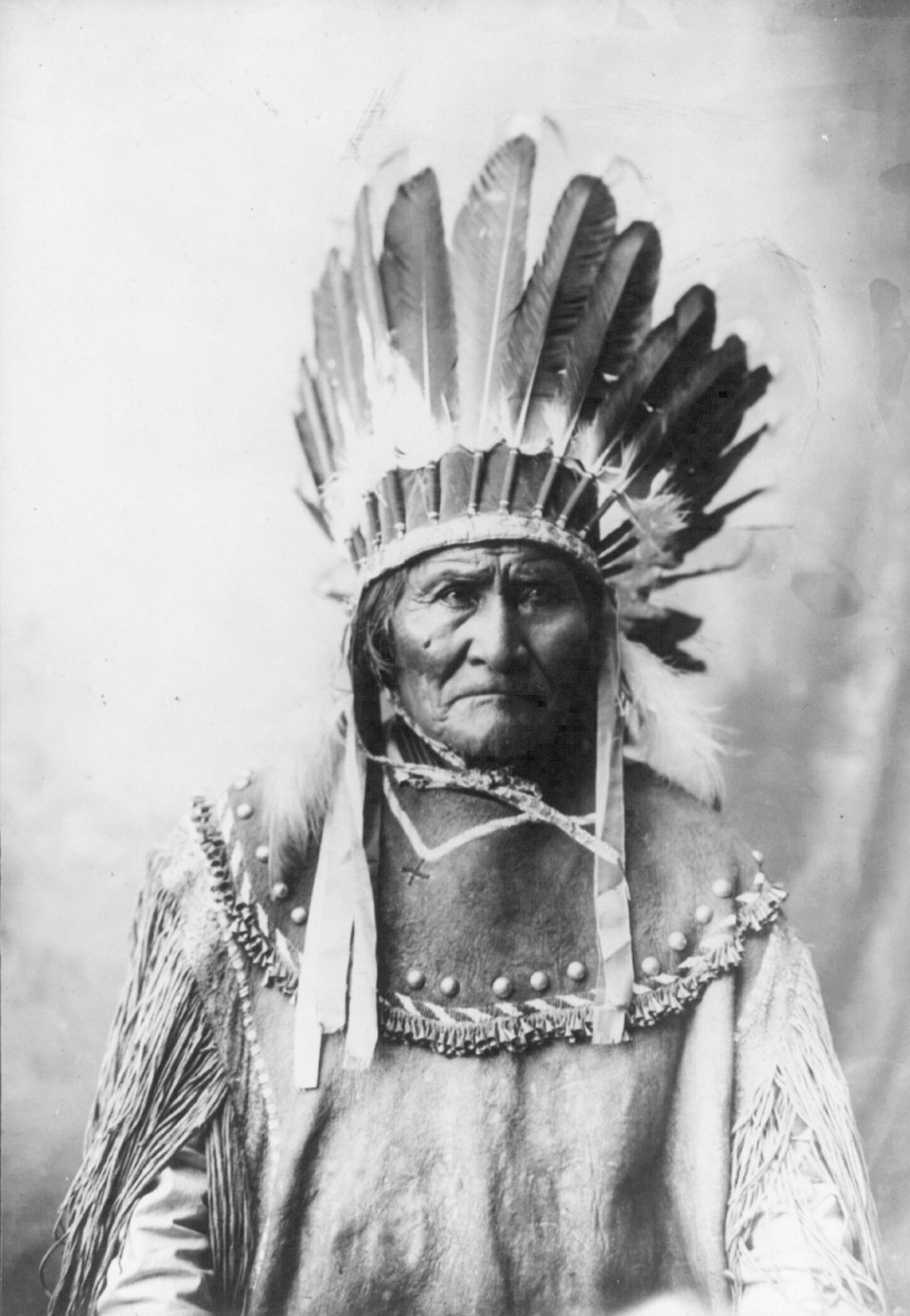
On this day in 1886, Apache chief Geronimo surrenders to U.S. government troops. For 30 years, the mighty Native American warrior had battled to protect his tribe’s homeland; however, by 1886 the Apaches were exhausted and hopelessly outnumbered. General Nelson Miles accepted Geronimo’s surrender, making him the last Indian warrior to formally give in to U.S. forces and signaling the end of the Indian Wars in the Southwest.

Geronimo was born in 1829 and grew up in what is present-day Arizona and Mexico. His tribe, the Chiricahua Apaches, clashed with non-Indian settlers trying to take their land. In 1858, Geronimo’s family was murdered by Mexicans. Seeking revenge, he later led raids against Mexican and American settlers. In 1874, the U.S. government moved Geronimo and his people from their land to a reservation in east-central Arizona. Conditions on the reservation were restrictive and harsh and Geronimo and some of his followers escaped. Over the next decade, they battled federal troops and launched raids on white settlements. During this time, Geronimo and his supporters were forced back onto the reservation several times. In May 1885, Geronimo and approximately 150 followers fled one last time. They were pursued into Mexico by 5,000 U.S. troops. In March 1886, General George Crook (1829–90) forced Geronimo to surrender; however, Geronimo quickly escaped and continued his raids. General Nelson Miles (1839–1925) then took over the pursuit of Geronimo, eventually forcing him to surrender that September near Fort Bowie along the Arizona-New Mexico border. Geronimo and a band of Apaches were sent to Florida and then Alabama, eventually ending up at the Comanche and Kiowa reservation near Fort Sill, Oklahoma Territory. There, Geronimo became a successful farmer and converted to Christianity. He participated in President Theodore Roosevelt’s inaugural parade in 1905. The Apache chief dictated his autobiography, published in 1906 as Geronimo’s Story of His Life. He died at Fort Sill on February 17, 1909.


History 101

August 29, 2005: Hurricane Katrina slams into Gulf Coast


By History.com

Hurricane Katrina makes landfall near New Orleans, Louisiana, as a Category 4 hurricane on this day in 2005. Despite being only the third most powerful storm of the 2005 hurricane season, Katrina was the worst natural disaster in the history of the United States. After briefly coming ashore in southern Florida on August 25 as a Category 1 hurricane, Katrina gained strength before slamming into the Gulf Coast on August 29. In addition to bringing devastation to the New Orleans area, the hurricane caused damage along the coasts of Mississippi and Alabama, as well as other parts of Louisiana.

New Orleans Mayor Ray Nagin ordered a mandatory evacuation of the city on August 28, when Katrina briefly achieved Category 5 status and the National Weather Service predicted “devastating” damage to the area. But an estimated 150,000 people, who either did not want to or did not have the resources to leave, ignored the order and stayed behind. The storm brought sustained winds of 145 miles per hour, which cut power lines and destroyed homes, even turning cars into projectile missiles. Katrina caused record storm surges all along the Mississippi Gulf Coast. The surges overwhelmed the levees that protected New Orleans, located at six feet below sea level, from Lake Pontchartrain and the Mississippi River. Soon, 80 percent of the city was flooded up to the rooftops of many homes and small buildings.

Tens of thousands of people sought shelter in the New Orleans Convention Center and the Louisiana Superdome. The situation in both places quickly deteriorated, as food and water ran low and conditions became unsanitary. Frustration mounted as it took up to two days for a full-scale relief effort to begin. In the meantime, the stranded residents suffered from heat, hunger, and a lack of medical care. Reports of looting, rape, and even murder began to surface. As news networks broadcast scenes from the devastated city to the world, it became obvious that a vast majority of the victims were African-American and poor, leading to difficult questions among the public about the state of racial equality in the United States. The federal government and President George W. Bush were roundly criticized for what was perceived as their slow response to the disaster. The head of the Federal Emergency Management Agency (FEMA), Michael Brown, resigned amid the ensuing controversy.

Finally, on September 1, the tens of thousands of people staying in the damaged Superdome and Convention Center begin to be moved to the Astrodome in Houston, Texas, and another mandatory evacuation order was issued for the city. The next day, military convoys arrived with supplies and the National Guard was brought in to bring a halt to lawlessness. Efforts began to collect and identify corpses. On September 6, eight days after the hurricane, the Army Corps of Engineers finally completed temporary repairs to the three major holes in New Orleans’ levee system and were able to begin pumping water out of the city.

In all, it is believed that the hurricane caused more than 1,300 deaths and up to $150 billion in damages to both private property and public infrastructure. It is estimated that only about $40 billion of that number will be covered by insurance. One million people were displaced by the disaster, a phenomenon unseen in the United States since the Great Depression. Four hundred thousand people lost their jobs as a result of the disaster. Offers of international aid poured in from around the world, even from poor countries like Bangladesh and Sri Lanka. Private donations from U.S. citizens alone approached $600 million.

The storm also set off 36 tornadoes in Mississippi, Alabama, Georgia, Pennsylvania, and Virginia, resulting in one death.

President Bush declared September 16 a national day of remembrance for the victims of Hurricane Katrina.


History 101

Photo courtesy: Google Images

August 21, 1959: Hawaii becomes 50th state

History.com

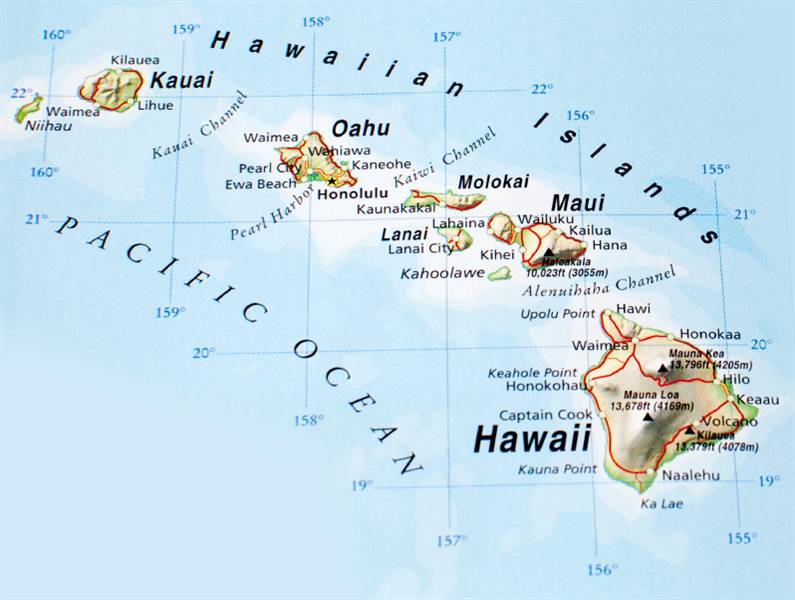
The modern United States receives its crowning star when President Dwight D. Eisenhower signs a proclamation admitting Hawaii into the Union as the 50th state. The president also issued an order for an American flag featuring 50 stars arranged in staggered rows: five six-star rows and four five-star rows. The new flag became official July 4, 1960.

The first known settlers of the Hawaiian Islands were Polynesian voyagers who arrived sometime in the eighth century. In the early 18th century, American traders came to Hawaii to exploit the islands’ sandalwood, which was much valued in China at the time. In the 1830s, the sugar industry was introduced to Hawaii and by the mid 19th century had become well established. American missionaries and planters brought about great changes in Hawaiian political, cultural, economic, and religious life. In 1840, a constitutional monarchy was established, stripping the Hawaiian monarch of much of his authority.

In 1893, a group of American expatriates and sugar planters supported by a division of U.S. Marines deposed Queen Liliuokalani, the last reigning monarch of Hawaii. One year later, the Republic of Hawaii was established as a U.S. protectorate with Hawaiian-born Sanford B. Dole as president. Many in Congress opposed the formal annexation of Hawaii, and it was not until 1898, following the use of the naval base at Pearl Harbor during the SpanishAmerican War, that Hawaii’s strategic importance became evident and formal annexation was approved. Two years later, Hawaii was organized into a formal U.S. territory. During World War II, Hawaii became firmly ensconced in the American national identity following the surprise Japanese attack on Pearl Harbor in December 1941.

History 101

Photo courtesy: Google Imgaes

By History.com


August 13, 1961: Berlin is divided


Shortly after midnight on August 13 in 1961, East German soldiers begin laying down barbed wire and bricks as a barrier between Soviet-controlled East Berlin and the democratic western section of the city.

After World War II, defeated Germany was divided into Soviet, American, British and French zones of occupation. The city of Berlin, though technically part of the Soviet zone, was also split, with the Soviets taking the eastern part of the city. After a massive Allied airlift in June 1948 foiled a Soviet attempt to blockade West Berlin, the eastern section was drawn even more tightly into the Soviet fold. Over the next 12 years, cut off from its western counterpart and basically reduced to a Soviet satellite, East Germany saw between 2.5 million and 3 million of its citizens head to West Germany in search of better opportunities. By 1961, some 1,000 East Germans–including many skilled laborers, professionals and intellectuals–were leaving every day.

In August, Walter Ulbricht, the Communist leader of East Germany, got the go-ahead from Soviet Premier Nikita Khrushchev to begin the sealing off of all access between East and West Berlin. Soldiers began the work over the night of August 12-13, laying more than 100 miles of barbed wire slightly inside the East Berlin border. The wire was soon replaced by a six-foot-high, 96-mile-long wall of concrete blocks, complete with guard towers, machine gun posts and searchlights. East German officers known as Volkspolizei (“Volpos”) patrolled the Berlin Wall day and night.

Many Berlin residents on that first morning found themselves suddenly cut off from friends or family members in the other half of the city. Led by their mayor, Willi Brandt, West Berliners demonstrated against the wall, as Brandt criticized Western democracies, particularly the United States, for failing to take a stand against it. President John F. Kennedy had earlier said publicly that the United States could only really help West Berliners and West Germans, and that any kind of action on behalf of East Germans would only result in failure.

The Berlin Wall was one of the most powerful and iconic symbols of the Cold War. In June 1963, Kennedy gave his famous “Ich bin ein Berliner” (“I am a Berliner”) speech in front of the Wall, celebrating the city as a symbol of freedom and democracy in its resistance to tyranny and oppression. The height of the Wall was raised to 10 feet in 1970 in an effort to stop escape attempts, which at that time came almost daily. From 1961 to 1989, a total of 5,000 East Germans escaped; many more tried and failed. High profile shootings of some would-be defectors only intensified the Western world’s hatred of the Wall.

Finally, in the late 1980s, East Germany, fueled by the decline of the Soviet Union, began to implement a number of liberal reforms. On November 9, 1989, masses of East and West Germans alike gathered at the Berlin Wall and began to climb over and dismantle it. As this symbol of Cold War repression was destroyed, East and West Germany became one nation again, signing a formal treaty of unification on October 3, 1990.


History 101

1945: Atomic bomb damage in Hiroshima. (Photo by Hulton Archive/Getty Images)

By History.com


August 6, 1945: American bomber drops atomic bomb on Hiroshima


On August 6, 1945, at 8:16 a.m. Japanese time, an American B-29 bomber, the Enola Gay, drops the world’s first atom bomb, over the city of Hiroshima. Approximately 80,000 people are killed as a direct result of the blast, and another 35,000 are injured. At least another 60,000 would be dead by the end of the year from the effects of the fallout.

U.S. President Harry S. Truman, discouraged by the Japanese response to the Potsdam Conference’s demand for unconditional surrender, made the decision to use the atom bomb to end the war in order to prevent what he predicted would be a much greater loss of life were the United States to invade the Japanese mainland. And so on August 5, while a “conventional” bombing of Japan was underway, “Little Boy,” (the nickname for one of two atom bombs available for use against Japan), was loaded onto Lt. Col. Paul W. Tibbets’ plane on Tinian Island in the Marianas. Tibbets’ B-29, named the Enola Gay after his mother, left the island at 2:45 a.m. on August 6. Five and a half hours later, “Little Boy” was dropped, exploding 1,900 feet over a hospital and unleashing the equivalent of 12,500 tons of TNT. The bomb had several inscriptions scribbled on its shell, one of which read “Greetings to the Emperor from the men of the Indianapolis” (the ship that transported the bomb to the Marianas).

There were 90,000 buildings in Hiroshima before the bomb was dropped; only 28,000 remained after the bombing. Of the city’s 200 doctors before the explosion; only 20 were left alive or capable of working. There were 1,780 nurses before-only 150 remained who were able to tend to the sick and dying.

According to John Hersey’s classic work Hiroshima, the Hiroshima city government had put hundreds of schoolgirls to work clearing fire lanes in the event of incendiary bomb attacks. They were out in the open when the Enola Gay dropped its load.

There were so many spontaneous fires set as a result of the bomb that a crewman of the Enola Gay stopped trying to count them. Another crewman remarked, “It’s pretty terrific. What a relief it worked.”


History 101

Photo courtesy: Google Images

July 22, 1934: Dillinger gunned down

 History.com

Outside Chicago’s Biograph Theatre, notorious criminal John Dillinger–America’s “Public Enemy No. 1″–is killed in a hail of bullets fired by federal agents. In a fiery bank-robbing career that lasted just over a year, Dillinger and his associates robbed 11 banks for more than $300,000, broke jail and narrowly escaped capture multiple times, and killed seven police officers and three federal agents.

John Dillinger was born in Indianapolis, Indiana, in 1903. A juvenile delinquent, he was arrested in 1924 after a botched mugging. He pleaded guilty, hoping for clemency, but was sentenced to 10 to 20 years at Pendleton Reformatory. While in prison, he made several failed escapes and was adopted by a group of professional bank robbers led by Harry Pierpont, who taught him the ways of their trade. When his friends were transferred to Indiana’s tough Michigan City Prison, he requested to be transferred there too.

In May 1933, Dillinger was paroled, and he met up with accomplices of Pierpont. Dillinger’s plan was to raise enough funds to finance a prison break by Pierpont and the others, who then would take him on as a member of their elite robbery gang. In four months, Dillinger and his gang robbed four Indiana and Ohio banks, two grocery stores, and a drug store for a total of more than $40,000. He gained notoriety as a sharply dressed and athletic gunman who at one bank leapt over the high teller railing into the vault.

With the help of two of Pierpont’s women friends, Dillinger set up the jailbreak. Guns were bought and arranged to be smuggled into Michigan City Prison. Prison workers were bribed, and a safe house was set up. On September 22, however, just days before the jailbreak was scheduled to occur, Dillinger was arrested in Dayton, Ohio. Four days later, Pierpont and nine others broke out of Michigan City. Pierpont’s gang robbed a bank in Ohio for $11,000 and on October 12 came to Ohio to free Dillinger from the Lima city jail. The Lima sheriff was killed during the successful breakout. On October 30, the gang robbed a police arsenal, acquiring weapons, ammunition, and bulletproof vests.

The Pierpont/Dillinger gang robbed banks in Indiana, Wisconsin, and Chicago for more than $130,000, a great fortune in the Depression era, and eluded the police in several close encounters. In January 1934, the gang headed to Tucson, Arizona, to lay low. By this time, four police officers had been killed and two wounded, and the Chicago police had established an elite squad to track down the fugitives. They were recognized in Tucson and on January 25 captured without bloodshed.

Dillinger was extradited to Indiana, arraigned for his January 15 murder of Indiana police officer William Patrick O’Malley, and held at Crown Point prison. On March 3, while still awaiting trial, he executed his most celebrated escape. That morning, he brandished a gun and methodically began locking up the prison officials. The legend is that the weapon was a wooden gun carved by Dillinger and blackened with shoe polish, but it may also have been a real gun smuggled into the prison by an associate. Whatever the case, Dillinger raided the prison arsenal, where he found two sub-machine guns, and then enlisted the aid of another prisoner, an African American man named Herbert Youngblood. Dillinger and Youngblood then made their way to the prison garage, where they stole a sheriff’s car and calmly drove off–after pulling the ignition wires from the other vehicles parked there.

Parting ways with Youngblood, Dillinger traveled to Chicago and formed a new gang featuring “Baby Face” Nelson, a psychopathic killer who used to work for Al Capone. The new Dillinger gang robbed banks in South Dakota and Iowa, netting $101,500 and wounding two more police officers. The Federal Bureau of Investigation (FBI) joined the manhunt for Dillinger after he escaped from Crown Point, and on March 31 two FBI agents closed in on him at an apartment in St. Paul, Minnesota. Dillinger and an accomplice shot their way out.

In April, the Dillinger gang went to hide out at a resort in Wisconsin, but the FBI was tipped off. On April 22, the FBI stormed the resort. In a disastrous operation, three civilians were mistakenly shot by the FBI, one of whom died; Baby Face Nelson killed one agent, shot another, and critically wounded a police officer; the entire Dillinger gang escaped.

With two other gang members, Dillinger traveled to Chicago, surviving a shoot-out with Minnesota police along the way. In Chicago, he lived in a safe house and got a facelift to conceal his identity. At some point, he also used acid to burn off his fingerprints. On June 30, he participated in his last robbery, in South Bend, Indiana. The gang got away with about $30,000 at the cost of one officer killed, four civilians shot, and one gang member shot.

In July, Anna Sage, a Romanian-born brothel madam in Chicago and friend of Dillinger’s, agreed to cooperate with the FBI in exchange for leniency in an upcoming deportation hearing. She also hoped to cash in on the $10,000 bounty that had been put on his head. On July 22, Sage and Dillinger went to see the gangster movie Manhattan Melodrama at the Biograph Theatre around the corner from her house. Twenty FBI agents and police officers staked out the theater and waited for him to emerge with Sage, who would be wearing an orange dress to identify herself.

At 10:40 p.m., Dillinger came out. Sage’s orange dress looked red under the Biograph’s lights, which would earn her the nickname “the lady in red.” Dillinger was ordered to surrender, but he took off running. He made it as far as an alley at the end of the block before he was gunned down, allegedly because he pulled a gun. Two bystanders were wounded in the gunfire. Public Enemy No. 1, as FBI Director J. Edgar Hoover had deemed him, was dead.

Some researchers have claimed that another man, not Dillinger, was killed outside the Biograph, citing autopsy findings on the corpse that allegedly contradict Dillinger’s known medical record.


History 101

Photo courtesy: Google Images

JULY 16, 1945: ATOM BOMB SUCCESSFULLY TESTED

By History.com


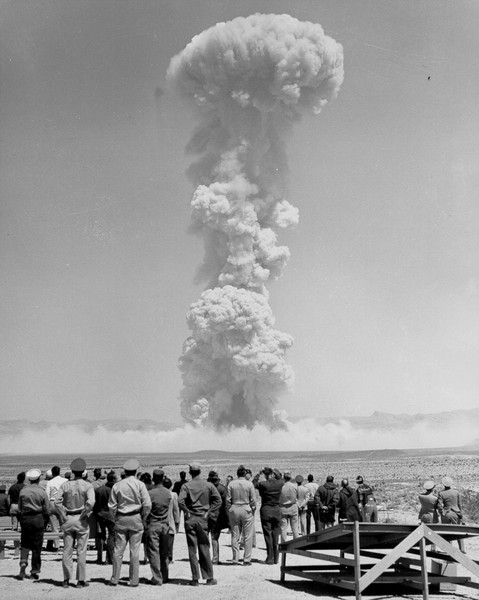
On this day in 1945, at 5:29:45 a.m., the Manhattan Project comes to an explosive end as the first atom bomb is successfully tested in Alamogordo, New Mexico.

Plans for the creation of a uranium bomb by the Allies were established as early as 1939, when Italian emigre physicist Enrico Fermi met with U.S. Navy department officials at Columbia University to discuss the use of fissionable materials for military purposes. That same year, Albert Einstein wrote to President Franklin Roosevelt supporting the theory that an uncontrolled nuclear chain reaction had great potential as a basis for a weapon of mass destruction. In February 1940, the federal government granted a total of $6,000 for research. But in early 1942, with the United States now at war with the Axis powers, and fear mounting that Germany was working on its own uranium bomb, the War Department took a more active interest, and limits on resources for the project were removed.

Brigadier-General Leslie R. Groves, himself an engineer, was now in complete charge of a project to assemble the greatest minds in science and discover how to harness the power of the atom as a means of bringing the war to a decisive end. The Manhattan Project (so-called because of where the research began) would wind its way through many locations during the early period of theoretical exploration, most importantly, the University of Chicago, where Enrico Fermi successfully set off the first fission chain reaction. But the Project took final form in the desert of New Mexico, where, in 1943, Robert J. Oppenheimer began directing Project Y at a laboratory at Los Alamos, along with such minds as Hans Bethe, Edward Teller, and Fermi. Here theory and practice came together, as the problems of achieving critical mass-a nuclear explosion-and the construction of a deliverable bomb were worked out.

Finally, on the morning of July 16,in the New Mexico desert, 120 miles south of Santa Fe, the first atomic bomb was detonated. The scientists and a few dignitaries had removed themselves 10,000 yards away to observe as the first mushroom cloud of searing light stretched 40,000 feet into the air and generated the destructive power of 15,000 to 20,000 tons of TNT. The tower on which the bomb sat when detonated was vaporized.

The question now became-on whom was the bomb to be dropped? Germany was the original target, but the Germans had already surrendered. The only belligerent remaining was Japan.

A footnote: The original $6,000 budget for the Manhattan Project finally ballooned to a total cost of $2 billion.


History 101

American politicians Alexander Hamilton (1757-1804) and Aaron Burr (1756-1836) take aim in the duel that would end Hamilton’s life, Weehawken, New Jersey. (Photo by Hulton Archive/Getty Images)

JULY 11, 1804 : BURR SLAYS HAMILTON IN DUEL

By History.com

In a duel held in Weehawken, New Jersey, Vice President Aaron Burr fatally shoots his long-time political antagonist Alexander Hamilton. Hamilton, a leading Federalist and the chief architect of America’s political economy, died the following day.

Alexander Hamilton, born on the Caribbean island of Nevis, came to the American colonies in 1773 as a poor immigrant. (There is some controversy as to the year of his birth, but it was either 1755 or 1757.) In 1776, he joined the Continental Army in the American Revolution, and his relentless energy and remarkable intelligence brought him to the attention of General George Washington, who took him on as an aid. Ten years later, Hamilton served as a delegate to the Constitutional Convention, and he led the fight to win ratification of the final document, which created the kind of strong, centralized government that he favored. In 1789, he was appointed the first secretary of the treasury by President Washington, and during the next six years he crafted a sophisticated monetary policy that saved the young U.S. government from collapse. With the emergence of political parties, Hamilton was regarded as a leader of the Federalists.

Aaron Burr, born into a prestigious New Jersey family in 1756, was also intellectually gifted, and he graduated from the College of New Jersey (later Princeton) at the age of 17. He joined the Continental Army in 1775 and distinguished himself during the Patriot attack on Quebec. A masterful politician, he was elected to the New State Assembly in 1783 and later served as state attorney. In 1790, he defeated Alexander Hamilton’s father-in-law in a race for the U.S. Senate.

Hamilton came to detest Burr, whom he regarded as a dangerous opportunist, and he often spoke ill of him. When Burr ran for the vice presidency in 1796 on Thomas Jefferson’s Democratic-Republican ticket (the forerunner of the Democratic Party), Hamilton launched a series of public attacks against Burr, stating, “I feel it is a religious duty to oppose his career.” John Adams won the presidency, and in 1797 Burr left the Senate and returned to the New York Assembly.

In 1800, Jefferson chose Burr again as his running mate. Burr aided the Democratic-Republican ticket by publishing a confidential document that Hamilton had written criticizing his fellow Federalist President John Adams. This caused a rift in the Federalists and helped Jefferson and Burr win the election with 73 electoral votes each.

Under the electoral procedure then prevailing, president and vice president were not voted for separately; the candidate who received the most votes was elected president, and the second in line, vice president. The vote then went to the House of Representatives. What at first seemed but an electoral technicality–handing Jefferson victory over his running mate–developed into a major constitutional crisis when Federalists in the lame-duck Congress threw their support behind Burr. After a remarkable 35 tie votes, a small group of Federalists changed sides and voted in Jefferson’s favor. Alexander Hamilton, who had supported Jefferson as the lesser of two evils, was instrumental in breaking the deadlock.

Burr became vice president, but Jefferson grew apart from him, and he did not support Burr’s renomination to a second term in 1804. That year, a faction of New York Federalists, who had found their fortunes drastically diminished after the ascendance of Jefferson, sought to enlist the disgruntled Burr into their party and elect him governor. Hamilton campaigned against Burr with great fervor, and Burr lost the Federalist nomination and then, running as an independent for governor, the election. In the campaign, Burr’s character was savagely attacked by Hamilton and others, and after the election he resolved to restore his reputation by challenging Hamilton to a duel, or an “affair of honor,” as they were known.

Affairs of honor were commonplace in America at the time, and the complex rules governing them usually led to an honorable resolution before any actual firing of weapons. In fact, the outspoken Hamilton had been involved in several affairs of honor in his life, and he had resolved most of them peaceably. No such recourse was found with Burr, however, and on July 11, 1804, the enemies met at 7 a.m. at the dueling grounds near Weehawken, New Jersey. It was the same spot where Hamilton’s son had died defending his father’s honor in 1801.

There are conflicting accounts of what happened next. According to Hamilton’s “second”–his assistant and witness in the duel–Hamilton decided the duel was morally wrong and deliberately fired into the air. Burr’s second claimed that Hamilton fired at Burr and missed. What happened next is agreed upon: Burr shot Hamilton in the stomach, and the bullet lodged next to his spine. Hamilton was taken back to New York, and he died the next afternoon.

Few affairs of honor actually resulted in deaths, and the nation was outraged by the killing of a man as eminent as Alexander Hamilton. Charged with murder in New York and New Jersey, Burr, still vice president, returned to Washington, D.C., where he finished his term immune from prosecution.

In 1805, Burr, thoroughly discredited, concocted a plot with James Wilkinson, commander-in-chief of the U.S. Army, to seize the Louisiana Territory and establish an independent empire, which Burr, presumably, would lead. He contacted the British government and unsuccessfully pleaded for assistance in the scheme. Later, when border trouble with Spanish Mexico heated up, Burr and Wilkinson conspired to seize territory in Spanish America for the same purpose.

In the fall of 1806, Burr led a group of well-armed colonists toward New Orleans, prompting an immediate U.S. investigation. General Wilkinson, in an effort to save himself, turned against Burr and sent dispatches to Washington accusing Burr of treason. In February 1807, Burr was arrested in Louisiana for treason and sent to Virginia to be tried in a U.S. court. In September, he was acquitted on a technicality. Nevertheless, public opinion condemned him as a traitor, and he fled to Europe. He later returned to private life in New York, the murder charges against him forgotten. He died in 1836.


History 101

Photo courtesy: Google Images

July 4, 1776: U.S. Declares Independence


By History.com

In Philadelphia, Pennsylvania, the Continental Congress adopts the Declaration of Independence, which proclaims the independence of the United States of America from Great Britain and its king. The declaration came 442 days after the first volleys of the American Revolution were fired at Lexington and Concord in Massachusetts and marked an ideological expansion of the conflict that would eventually encourage France’s intervention on behalf of the Patriots.

The first major American opposition to British policy came in 1765 after Parliament passed the Stamp Act, a taxation measure to raise revenues for a standing British army in America. Under the banner of “no taxation without representation,” colonists convened the Stamp Act Congress in October 1765 to vocalize their opposition to the tax. With its enactment in November, most colonists called for a boycott of British goods, and some organized attacks on the customhouses and homes of tax collectors. After months of protest in the colonies, Parliament voted to repeal the Stamp Act in March 1766.

Most colonists continued to quietly accept British rule until Parliament’s enactment of the Tea Act in 1773, a bill designed to save the faltering East India Company by greatly lowering its tea tax and granting it a monopoly on the American tea trade. The low tax allowed the East India Company to undercut even tea smuggled into America by Dutch traders, and many colonists viewed the act as another example of taxation tyranny. In response, militant Patriots in Massachusetts organized the “Boston Tea Party,” which saw British tea valued at some 18,000 pounds dumped into Boston Harbor.

Parliament, outraged by the Boston Tea Party and other blatant acts of destruction of British property, enacted the Coercive Acts, also known as the Intolerable Acts, in 1774. The Coercive Acts closed Boston to merchant shipping, established formal British military rule in Massachusetts, made British officials immune to criminal prosecution in America, and required colonists to quarter British troops. The colonists subsequently called the first Continental Congress to consider a united American resistance to the British.

With the other colonies watching intently, Massachusetts led the resistance to the British, forming a shadow revolutionary government and establishing militias to resist the increasing British military presence across the colony. In April 1775, Thomas Gage, the British governor of Massachusetts, ordered British troops to march to Concord, Massachusetts, where a Patriot arsenal was known to be located. On April 19, 1775, the British regulars encountered a group of American militiamen at Lexington, and the first shots of the American Revolution were fired.

Initially, both the Americans and the British saw the conflict as a kind of civil war within the British Empire: To King George III it was a colonial rebellion, and to the Americans it was a struggle for their rights as British citizens. However, Parliament remained unwilling to negotiate with the American rebels and instead purchased German mercenaries to help the British army crush the rebellion. In response to Britain’s continued opposition to reform, the Continental Congress began to pass measures abolishing British authority in the colonies.

In January 1776, Thomas Paine published Common Sense, an influential political pamphlet that convincingly argued for American independence and sold more than 500,000 copies in a few months. In the spring of 1776, support for independence swept the colonies, the Continental Congress called for states to form their own governments, and a five-man committee was assigned to draft a declaration.

The Declaration of Independence was largely the work of Virginian Thomas Jefferson. In justifying American independence, Jefferson drew generously from the political philosophy of John Locke, an advocate of natural rights, and from the work of other English theorists. The first section features the famous lines, “We hold these truths to be self-evident, that all men are created equal, that they are endowed by their Creator with certain unalienable Rights, that among these are Life, Liberty and the pursuit of Happiness.” The second part presents a long list of grievances that provided the rationale for rebellion.

On July 2, 1776, the Continental Congress voted to approve a Virginia motion calling for separation from Britain. The dramatic words of this resolution were added to the closing of the Declaration of Independence. Two days later, on July 4, the declaration was formally adopted by 12 colonies after minor revision. New York approved it on July 19. On August 2, the declaration was signed.

The American War for Independence would last for five more years. Yet to come were the Patriot triumphs at Saratoga, the bitter winter at Valley Forge, the intervention of the French, and the final victory at Yorktown in 1781. In 1783, with the signing of the Treaty of Paris with Britain, the United States formally became a free and independent nation.


History 101

History.com

JUNE 17, 1885 : STATUE OF LIBERTY ARRIVES IN NEW YORK HARBOR

On June 17th in 1885, the dismantled Statue of Liberty, a gift of friendship from the people of France to the people of America, arrives in New York Harbor after being shipped across the Atlantic Ocean in 350 individual pieces packed in more than 200 cases. The copper and iron statue, which was reassembled and dedicated the following year in a ceremony presided over by U.S. President Grover Cleveland, became known around the world as an enduring symbol of freedom and democracy. Intended to commemorate the American Revolution and a century of friendship between the U.S. and France, the statue was designed by French sculptor Frederic-Auguste Bartholdi (who modeled it after his own mother), with assistance from engineer Gustave Eiffel, who later developed the iconic tower in Paris bearing his name. The statue was initially scheduled to be finished by 1876, the 100th anniversary of America’s Declaration of Independence; however, fundraising efforts, which included auctions, a lottery and boxing matches, took longer than anticipated, both in Europe and the U.S., where the statue’s pedestal was to be financed and constructed. The statue alone cost the French an estimated $250,000 (more than $5.5 million in today’s money).

Finally completed in Paris in the summer of 1884, the statue, a robed female figure with an uplifted arm holding a torch, reached its new home on Bedloe’s Island in New York Harbor (between New York City and Hudson County, New Jersey) on June 17, 1885. After being reassembled, the 450,000-pound statue was officially dedicated on October 28, 1886, by President Cleveland, who said, “We will not forget that Liberty has here made her home; nor shall her chosen altar be neglected.” Standing more than 305 feet from the foundation of its pedestal to the top of its torch, the statue, dubbed “Liberty Enlightening the World” by Bartholdi, was taller than any structure in New York City at the time. The statue was originally copper-colored, but over the years it underwent a

natural color-change process called patination that produced its current greenish-blue hue. In 1892, Ellis Island, located near Bedloe’s Island (which in 1956 was renamed Liberty Island), opened as America’s chief immigration station, and for the next 62 years Lady Liberty, as the statue is nicknamed, stood watch over the more than 12 million immigrants who sailed into New York Harbor. In 1903, a plaque inscribed with a sonnet titled “The New Colossus” by American poet Emma Lazarus, written 20 years earlier for a pedestal fundraiser, was placed on an interior wall of the pedestal. Lazarus’ now-famous words, which include “Give me your tired, your poor/Your huddled masses yearning to breathe free,” became symbolic of America’s vision of itself as a land of opportunity for immigrants. Some 60 years after President Calvin Coolidge designated the statue a national monument in 1924, it underwent a multi-million-dollar restoration (which included a new torch and gold leaf-covered flame) and was rededicated by President Ronald Reagan on July 4, 1986, in a lavish celebration. Following the terrorist attacks of September 11, 2001, the statue was closed; its base, pedestal and observation deck re-opened in 2004, while its crown re-opened to the public on July 4, 2009. (For safety reasons, the torch has been closed to visitors since 1916, after an incident called the Black Tom explosions in which munitions-laden barges and railroad cars on the Jersey City, New Jersey, waterfront were blown up by German agents, causing damage to the nearby statue.)

Today, the Statue of Liberty is one of America’s most famous landmarks. Over the years, it has been the site of political rallies and protests (from suffragettes to anti-war activists), has been featured in numerous movies and countless photographs, and has received millions of visitors from around the globe.

History 101

Photo courtesy: Google Images

May 30, 1431: Joan of Arc Martyred

 By History.com

At Rouen in English-controlled Normandy, Joan of Arc, the peasant girl who became the savior of France, is burned at the stake for heresy.

Joan was born in 1412, the daughter of a tenant farmer at Domremy, on the borders of the duchies of Bar and Lorraine. In 1415, the Hundred Years War between England and France entered a crucial phase when the young King Henry V of England invaded France and won a series of decisive victories against the forces of King Charles VI. By the time of Henry’s death in August 1422, the English and their French-Burgundian allies controlled Aquitaine and most of northern France, including Paris. Charles VI, long incapacitated, died one month later, and his son, Charles, regent from 1418, prepared to take the throne. However, Reims, the traditional city of French coronation, was held by the Anglo-Burgundians, and the Dauphin (heir apparent to the French throne) remained uncrowned. Meanwhile, King Henry VI of England, the infant son of Henry V and Catherine of Valois, the daughter of Charles VI, was proclaimed king of France by the English.

Joan’s village of Domremy lay on the frontier between the France of the Dauphin and that of the Anglo-Burgundians. In the midst of this unstable environment, Joan began hearing “voices” of three Christian saints—St. Michael, St. Catherine, and St. Margaret. When she was about 16, these voices exhorted her to aid the Dauphin in capturing Reims and therefore the French throne. In May 1428, she traveled to Vaucouleurs, a stronghold of the Dauphin, and told the captain of the garrison of her visions. Disbelieving the young peasant girl, he sent her home. In January 1429, she returned, and the captain, impressed by her piety and determination, agreed to allow her passage to the Dauphin at Chinon.

Dressed in men’s clothes and accompanied by six soldiers, she reached the Dauphin’s castle at Chinon in February 1429 and was granted an audience. Charles hid himself among his courtiers, but Joan immediately picked him out and informed him of her divine mission. For several weeks, Charles had Joan questioned by theologians at Poitiers, who concluded that, given his desperate straits, the Dauphin would be well-advised to make use of this strange and charismatic girl.

Charles furnished her with a small army, and on April 27, 1429, she set out for Orleans, besieged by the English since October 1428. On April 29, as a French sortie distracted the English troops on the west side of Orleans, Joan entered unopposed by its eastern gate. She brought greatly needed supplies and reinforcements and inspired the French to a passionate resistance. She personally led the charge in several battles and on May 7 was struck by an arrow. After quickly dressing her wound, she returned to the fight, and the French won the day. On May 8, the English retreated from Orleans.

During the next five weeks, Joan and the French commanders led the French into a string of stunning victories over the English. On July 16, the royal army reached Reims, which opened its gates to Joan and the Dauphin. The next day, Charles VII was crowned king of France, with Joan standing nearby holding up her standard: an image of Christ in judgment. After the ceremony, she knelt before Charles, joyously calling him king for the first time.

On September 8, the king and Joan attacked Paris. During the battle, Joan carried her standard up to the earthworks and called on the Parisians to surrender the city to the king of France. She was wounded but continued to rally the king’s troops until Charles ordered an end to the unsuccessful siege. That year, she led several more small campaigns, capturing the town of Saint-Pierre-le-Moitier. In December, Charles ennobled Joan, her parents, and her brothers.

In May 1430, the Burgundians laid siege to Compiegne, and Joan stole into the town under the cover of darkness to aid in its defense. On May 23, while leading a sortie against the Burgundians, she was captured. The Burgundians sold her to the English, and in March 1431 she went on trial before ecclesiastical authorities in Rouen on charges of heresy. Her most serious crime, according to the tribunal, was her rejection of church authority in favor of direct inspiration from God. After refusing to submit to the church, her sentence was read on May 24: She was to be turned over to secular authorities and executed. Reacting with horror to the pronouncement, Joan agreed to recant and was condemned instead to perpetual imprisonment.

Ordered to put on women’s clothes, she obeyed, but a few days later the judges went to her cell and found her dressed again in male attire. Questioned, she told them that St. Catherine and St. Margaret had reproached her for giving in to the church against their will. She was found to be a relapsed heretic and on May 29 ordered handed over to secular officials. On May 30, Joan, 19 years old, was burned at the stake at the Place du Vieux-Marche in Rouen. Before the pyre was lit, she instructed a priest to hold high a crucifix for her to see and to shout out prayers loud enough to be heard above the roar of the flames.

As a source of military inspiration, Joan of Arc helped turn the Hundred Years War firmly in France’s favor. By 1453, Charles VII had reconquered all of France except for Calais, which the English relinquished in 1558. In 1920, Joan of Arc, one of the great heroes of French history, was recognized as a Christian saint by the Roman Catholic Church. Her feast day is May 30.


History 101

Photo courtesy: Google Images

MAY 23, 1934 : POLICE KILL FAMOUS OUTLAWS BONNIE AND CLYDE

History.com

On this day in 1934, notorious criminals Bonnie Parker and Clyde Barrow are shot to death by Texas and Louisiana state police while driving a stolen car near Sailes, Louisiana.

Bonnie Parker met the charismatic Clyde Barrow in Texas when she was 19 years old and her husband (she married when she was 16) was serving time in jail for murder. Shortly after they met, Barrow was imprisoned for robbery. Parker visited him every day, and smuggled a gun into prison to help him escape, but he was soon caught in Ohio and sent back to jail. When Barrow was paroled in 1932, he immediately hooked up with Parker, and the couple began a life of crime together.

After they stole a car and committed several robberies, Parker was caught by police and sent to jail for two months. Released in mid-1932, she rejoined Barrow. Over the next two years, the couple teamed with various accomplices to rob a string of banks and stores across five states–Texas, Oklahoma, Missouri, New Mexico and Louisiana. To law enforcement agents, the Barrow Gang–including Barrow’s childhood friend, Raymond Hamilton, W.D. Jones, Henry Methvin, Barrow’s brother Buck and his wife Blanche, among others–were cold-blooded criminals who didn’t hesitate to kill anyone who got in their way, especially police or sheriff’s deputies. Among the public, however, Parker and Barrow’s reputation as dangerous outlaws was mixed with a romantic view of the couple as “Robin Hood”-like folk heroes.

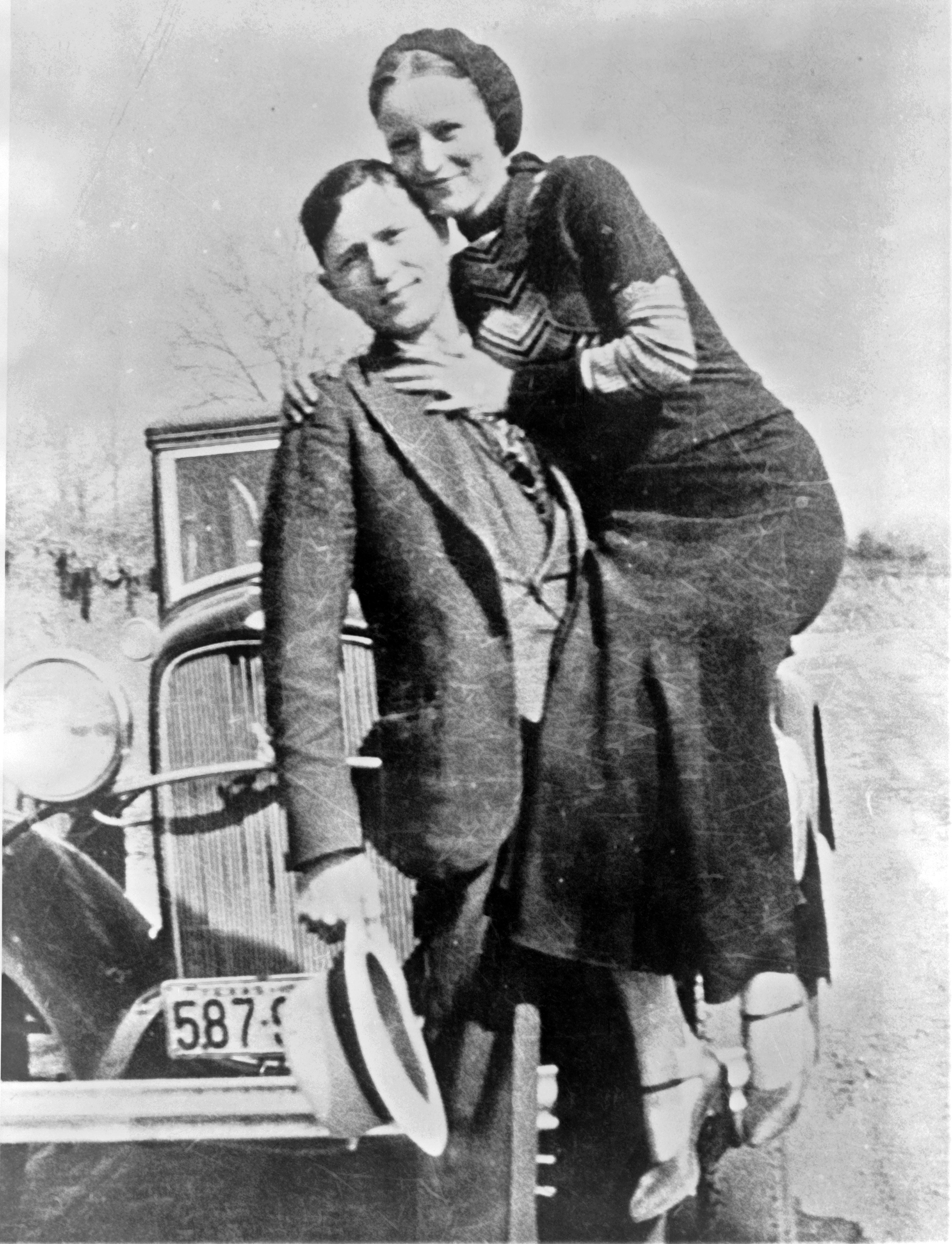
Their fame was increased by the fact that Bonnie was a woman–an unlikely criminal–and by the fact that the couple posed for playful photographs together, which were later found by police and released to the media. Police almost captured the famous duo twice in the spring of 1933, with surprise raids on their hideouts in Joplin and Platte City, Missouri. Buck Barrow was killed in the second raid, and Blanche was arrested, but Bonnie and Clyde escaped once again. In January 1934, they attacked the Eastham Prison Farm in Texas to help Hamilton break out of jail, shooting several guards with machine guns and killing one.

Texan prison officials hired a retired Texas police officer, Captain Frank Hamer, as a special investigator to track down Parker and Barrow. After a three-month search, Hamer traced the couple to Louisiana, where Henry Methvin’s family lived. Before dawn on May 23, Hamer and a group of Louisiana and Texas lawmen hid in the bushes along a country road outside Sailes. When Parker and Barrow appeared, the officers opened fire, killing the couple instantly in a hail of bullets.

All told, the Barrow Gang was believed responsible for the deaths of 13 people, including nine police officers. Parker and Barrow are still seen by many as romantic figures, however, especially after the success of the 1967 film Bonnie and Clyde, starring Faye Dunaway and Warren Beatty.

History 101

Photo courtesy: Google

History.com

MAY 14, 1804 : LEWIS AND CLARK DEPART

One year after the United States doubled its territory with the Louisiana Purchase, the Lewis and Clark expedition leaves St. Louis, Missouri, on a mission to explore the Northwest from the Mississippi River to the Pacific Ocean.

Even before the U.S. government concluded purchase negotiations with France, President Thomas Jefferson commissioned his private secretary Meriwether Lewis and William Clark, an army captain, to lead an expedition into what is now the U.S. Northwest. On May 14, the “Corps of Discovery”–featuring approximately 45 men (although only an approximate 33 men would make the full journey)–left St. Louis for the American interior.

The expedition traveled up the Missouri River in a 55-foot long keelboat and two smaller boats. In November, Toussaint Charbonneau, a French-Canadian fur trader accompanied by his young Native American wife Sacagawea, joined the expedition as an interpreter. The group wintered in present-day North Dakota before crossing into present-day Montana, where they first saw the Rocky Mountains. On the other side of the Continental Divide, they were met by Sacagawea’s tribe, the Shoshone Indians, who sold them horses for their journey down through the Bitterroot Mountains. After passing through the dangerous rapids of the Clearwater and Snake rivers in canoes, the explorers reached the calm of the Columbia River, which led them to the sea. On November 8, 1805, the expedition arrived at the Pacific Ocean, the first European explorers to do so by an overland route from the east. After pausing there for the winter, the explorers began their long journey back to St. Louis.

On September 23, 1806, after almost two and a half years, the expedition returned to the city, bringing back a wealth of information about the largely unexplored region, as well as valuable U.S. claims to Oregon Territory.

History 101

Photo couresty: Google Images

Hindenburg explodes in New Jersey

By History.com

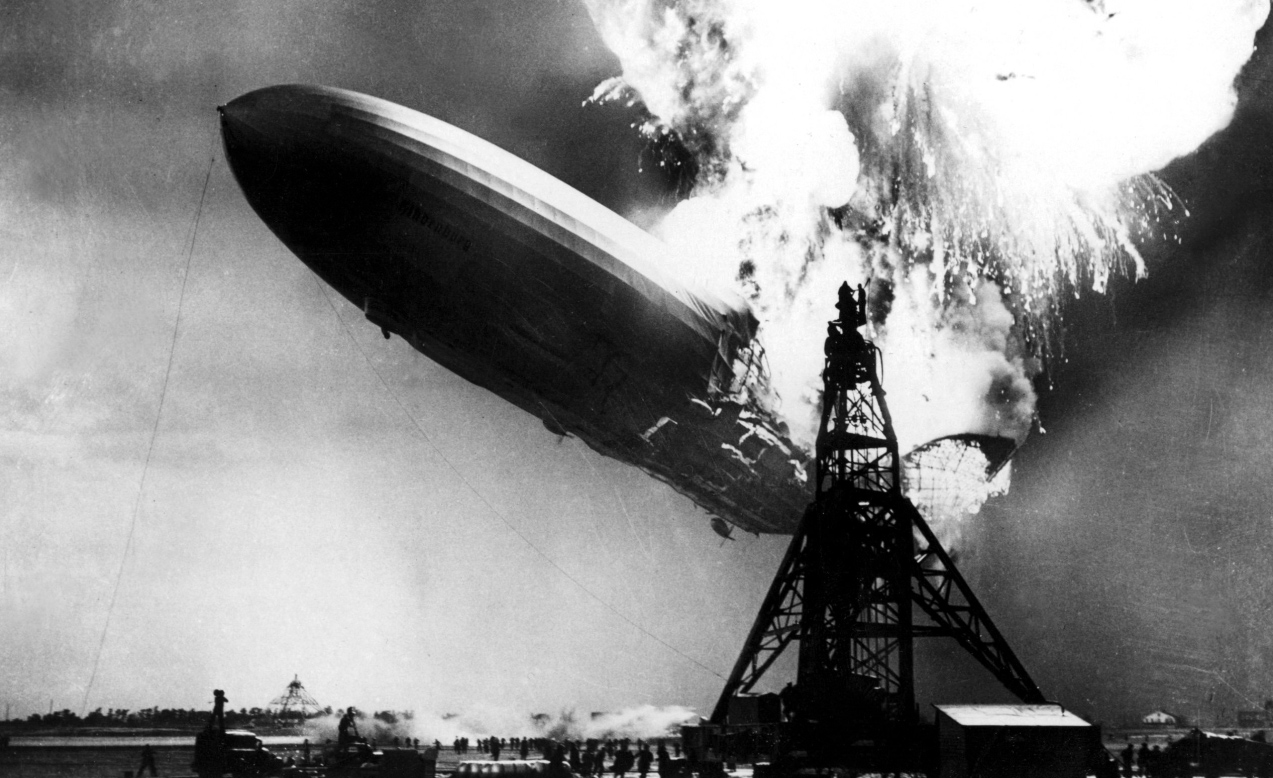
On May 6 in 1937, the German airship Hindenburg, the largest dirigible ever built, explodes as it arrives in Lakehurst, New Jersey. Thirty-six people died in the fiery accident that has since become iconic, in part because of the live radio broadcast of the disaster.

The dirigible was built to be the fastest, largest and most luxurious flying vessel of its time. It was more than 800 feet long, had a range of 8,000 miles, could carry 97 passengers and had a state-of-the-art Mercedes-Benz engine. It was filled with 7 million cubic feet of hydrogen, even though helium was known to be far safer, because it made the flying ship more maneuverable.

The Hindenburg had made 10 successful ocean crossings the year before and was held up by Germany’s Nazi government as a symbol of national pride. Flying at a speed of 85 miles per hour, the Hindenburg was scheduled to arrive in New Jersey at 5 a.m. on May 6. However, weather conditions pushed the arrival back to the late afternoon and then rain further delayed the docking at Lakehurst. When the dirigible was finally cleared to dock, Captain Max Pruss brought the ship in too fast and had to order a reverse engine thrust. At 7:20 p.m., a gas leak was noticed. Within minutes, the tail blew up, sending flames hundreds of feet in the air and as far down as the ground below.

A chain reaction caused the entire vessel to burn instantly. The nearly 1,000 spectators awaiting the Hindenburg‘s arrival felt the heat from a mile away. Some on the blimp attempted to jump for the landing cables at the docking station but most died when they missed. Others waited to jump until the blimp was closer to the ground as it fell. Those who were not critically injured from burns often suffered broken bones from the jump. Fifty-six people managed to survive.

On WLS radio, announcer Herbert Morrison gave an unforgettably harrowing live account of the disaster, “Oh, oh, oh. It’s burst into flames. Get out of the way, please . . . this is terrible . . . it’s burning, bursting into flames, and is falling . . . Oh! This is one of the worst . . . it’s a terrific sight . . .oh, the humanity.”

History 101

Photo courtesy: Google

May 5, 1862: Cinco de Mayo


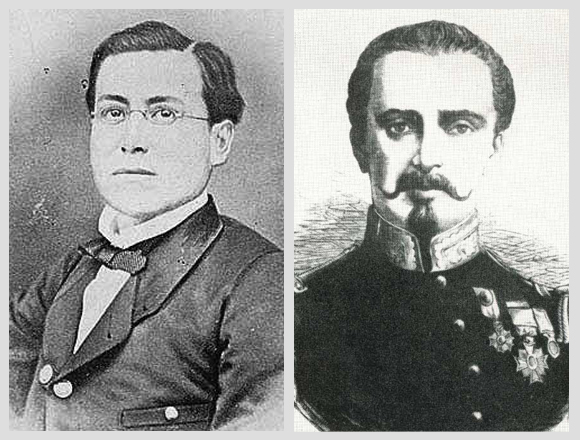
During the French-Mexican War (1861-1867), a poorly supplied and outnumbered Mexican army under General Ignacio Zaragoza defeats a French army attempting to capture Puebla de Los Angeles, a small town in east-central Mexico. Victory at the Battle of Puebla represented a great moral victory for the Mexican government, symbolizing the country’s ability to defend its sovereignty against a powerful foreign nation.

In 1861, Benito Juarez became president of a country in financial ruin, and he was forced to default on his debts to European governments. In response, France, Britain, and Spain sent naval forces to Veracruz to demand reimbursement. Britain and Spain negotiated with Mexico and withdrew, but France, ruled by Napoleon III, decided to use the opportunity to carve a dependent empire out of Mexican territory. Late in 1861, a well-armed French fleet stormed Veracruz, landing a large French force and driving President Juarez and his government into retreat.

Certain that French victory would come swiftly in Mexico, 6,000 French troops under General Charles Latrille de Lorencez set out in May, 1862, to attack Puebla de Los Angeles. From his new headquarters in the north, Juarez rounded up a ragtag force of loyal men and sent them to Puebla. Led by Texas-born General Zaragoza, the 2,000 Mexicans fortified the town and prepared for the French assault. On the fifth of May, or Cinco de Mayo, Lorencez gathered his army before the city of Puebla and began their assault from the north. The battle lasted from daybreak to early evening, and when the French finally retreated they had lost nearly 500 soldiers to the fewer than 100 Mexicans killed.

Although not a major strategic victory in the overall war against the French, Zaragoza’s victory at Puebla tightened Mexican resistance, and six years later France withdrew. The same year, Austrian Archduke Ferdinand Maximilian, who had been installed as emperor of Mexico by Napoleon in 1864, was captured and executed. Puebla de Los Angeles, the site of Zaragoza’s historic victory, was renamed Puebla de Zaragoza in honor of the general. Today, Mexicans celebrate the anniversary of the Battle of Puebla as Cinco de Mayo, a national holiday in Mexico.

History 101

Photo Courtesy: National Geographic

Billy The Kid Convicted of Murder

By History.com

After a one-day trial, Billy the Kid is found guilty of murdering the Lincoln County, New Mexico, sheriff and is sentenced to hang.

There is no doubt that Billy the Kid did indeed shoot the sheriff, though he had done so in the context of the bloody Lincoln County War, a battle between two powerful groups of ranchers and businessmen fighting for economic control of Lincoln County. When his boss, rancher John Tunstall, was murdered before his eyes in February 1878, the hotheaded young Billy swore vengeance. Unfortunately, the leader of the men who murdered Tunstall was the sheriff of Lincoln County, William Brady. When Billy and his partners murdered the sheriff several months later, they became outlaws, regardless of how corrupt Brady may have been.

After three years on the run and several other murders, Pat Garrett finally arrested Billy in early 1881. Garrett, a one-time friend, was the new sheriff of Lincoln County. On this day in 1881, a court took only one day to convict Billy of the murder of Sheriff Brady. Sentenced to hang, Billy was imprisoned in Lincoln’s county jail while Sheriff Garrett gathered the technical information and supplies needed to build an effective gallows.

On April 28, while Garrett was out of town, Billy managed to escape. While one of the jail’s two guards was escorting a group of prisoners across the street to dinner, Billy asked the remaining guard to take him to the jail outhouse. As the guard escorted him back to his cell, Billy somehow managed to slip a wrist through his handcuffs. He slugged the guard and shot him with a pistol either that he took from the guard or that a friend had hidden in the outhouse for him. Hearing the shot, the second guard ran back to the jail, and Billy killed him with a blast from a shotgun he found in Garrett’s office. Reportedly, Billy then smashed the gun and threw it down on the dead guard, yelling, “You won’t follow me any more with that gun!”

After murdering the guards, Billy seemed in no hurry to flee. He armed himself with two pistols and, according to one account, “danced about the balcony, laughed and shouted as though he had not a care on earth.” Apparently, the people of Lincoln were either too fearful or too admiring of the young outlaw to act. After nearly an hour, Billy rode off.

He was not able to ride far enough. Upon his return to Lincoln, Garrett immediately formed a posse and set off to recapture the outlaw. On July 14, 1881, Garrett surprised Billy in a darkened room not far from Lincoln and shot him dead.

History 101

Photo courtesy of: Google images

Alcatraz Closes Its Doors

By History.com

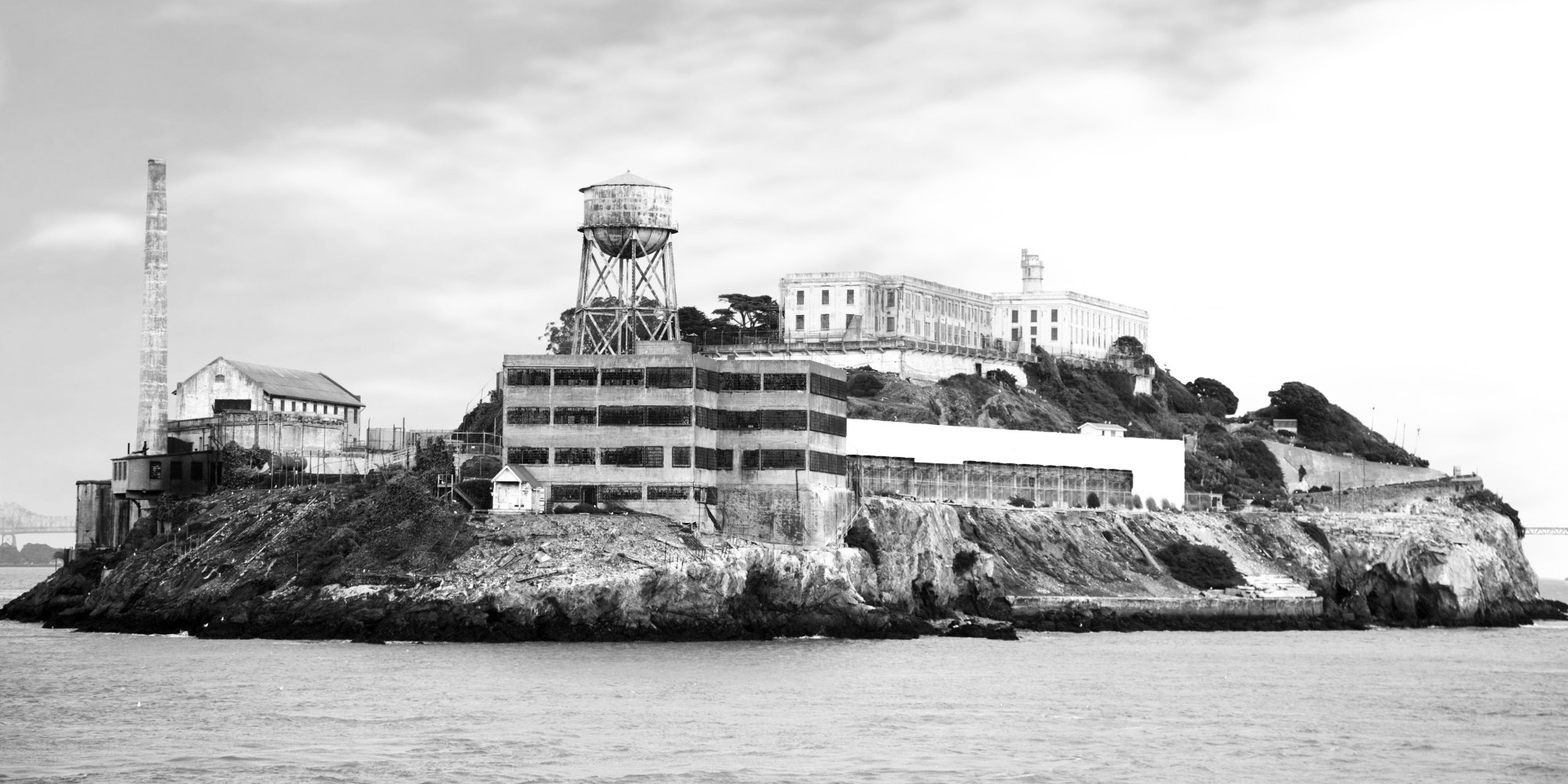
On March 21, 1963 Alcatraz Prison in San Francisco Bay closes down and transfers its last prisoners. At it’s peak period of use in 1950s, “The Rock”, or “America’s Devil Island” housed over 200 inmates at the maximum-security facility. Alcatraz remains an icon of American prisons for its harsh conditions and record for being inescapable.

The twelve-acre rocky island, one and a half miles from San Francisco, featured the most advanced security of the time. Some of the first metal detectors were used at Alcatraz. Strict rules were enforced against the unfortunate inmates who had to do time at Alcatraz. Nearly complete silence was mandated at all times.

Alcatraz was first explored by Juan Manuel de Ayala in 1775, who called it Isla de los Alcatraces (Pelicans) because of all the birds that lived there. It was sold in 1849 to the U.S. government. The first lighthouse in California was on Alcatraz. It became a Civil War fort and then a military prison in 1907.

The end of its prison days did not end the Alcatraz saga. In March 1964, a group of Sioux claimed that the island belonged to them due to a 100-year-old treaty. Their claims were ignored until November 1969 when a group of eighty-nine Native Americans representing the American Indian Movement (AIM) occupied the island. They stayed there until 1971 when AIM was finally forced off the island by federal authorities.

The following year, Alcatraz was added to the Golden Gate National Recreation Area. It is now open for tourism.

History 101

Fighting On Iwo Jima Ends

iwo-jima-1949-01-g.jpg

Photo courtesy: Google Images

By History.com

On this day, the west Pacific volcanic island of Iwo Jima is declared secured by the U.S. military after months of fiercely fighting its Japanese defenders.

The Americans began applying pressure to the Japanese defense of Iwo Jima in February 1944, when B-24 and B-25 bombers raided the island for 74 days straight. It was the longest pre-invasion bombardment of the war, necessary because of the extent to which the Japanese–21,000 strong–fortified the island, above and below ground, including a network of caves. Underwater demolition teams (“frogmen”) were dispatched by the Americans just before the actual invasion to clear the shores of mines and any other obstacles that could obstruct an invading force. In fact, the Japanese mistook the frogmen for an invasion force and killed 170 of them.

The amphibious landings of Marines began the morning of February 19, 1945, as the secretary of the Navy, James Forrestal, accompanied by journalists, surveyed the scene from a command ship offshore. The Marines made their way onto the island–and seven Japanese battalions opened fire, obliterating them. By that evening, more than 550 Marines were dead and more than 1,800 were wounded.

In the face of such fierce counterattack, the Americans reconciled themselves to the fact that Iwo Jima could be taken only one yard at a time. A key position on the island was Mt. Suribachi, the center of the Japanese defense. The 28th Marine Regiment closed in and around the base of the volcanic mountain at the rate of 400 yards per day, employing flamethrowers, grenades, and demolition charges against the Japanese that were hidden in caves and pillboxes (low concrete emplacements for machine-gun nests). Approximately 40 Marines finally began a climb up the volcanic ash mountain, which was smoking from the constant bombardment, and at 10 a.m. on February 23, a half-dozen Marines raised an American flag at its peak, using a pipe as a flag post. Two photographers caught a restaging of the flag raising for posterity, creating one of the most reproduced images of the war. With Mt. Suribachi claimed, one-third of Iwo Jima was under American control.

On March 16, with a U.S. Navy military government established, Iwo Jima was declared secured and the fighting over. When all was done, more than 6,000 Marines died fighting for the island, along with almost all the 21,000 Japanese soldiers trying to defend it.