Tag Archives: History 101

History 101

New Orleanians take to the streets for Mardi Gras

By History.com

On this day in 1827, a group of masked and costumed students dance through the streets of New Orleans, Louisiana, marking the beginning of the city’s famous Mardi Gras celebrations.

The celebration of Carnival–or the weeks between Twelfth Night on January 6 and Ash Wednesday, the beginning of the Christian period of Lent–spread from Rome across Europe and later to the Americas. Nowhere in the United States is Carnival celebrated as grandly as in New Orleans, famous for its over-the-top parades and parties for Mardi Gras (or Fat Tuesday), the last day of the Carnival season.

Though early French settlers brought the tradition of Mardi Gras to Louisiana at the end of the 17th century, Spanish governors of the province later banned the celebrations. After Louisiana became part of the United States in 1803, New Orleanians managed to convince the city council to lift the ban on wearing masks and partying in the streets. The city’s new Mardi Gras tradition began in 1827 when the group of students, inspired by their experiences studying in Paris, donned masks and jester costumes and staged their own Fat Tuesday festivities.

The parties grew more and more popular, and in 1833 a rich plantation owner named Bernard Xavier de Marigny de Mandeville raised money to fund an official Mardi Gras celebration. After rowdy revelers began to get violent during the 1850s, a secret society called the Mistick Krewe of Comus staged the first large-scale, well-organized Mardi Gras parade in 1857.

Over time, hundreds of krewes formed, building elaborate and colorful floats for parades held over the two weeks leading up to Fat Tuesday. Riders on the floats are usually local citizens who toss “throws” at passersby, including metal coins, stuffed toys or those now-infamous strands of beads. Though many tourists mistakenly believe Bourbon Street and the historic French Quarter are the heart of Mardi Gras festivities, none of the major parades have been allowed to enter the area since 1979 because of its narrow streets.

In February 2006, New Orleans held its Mardi Gras celebrations despite the fact that Hurricane Katrina had devastated much of the city with massive flooding the previous August. Attendance was at only 60-70 percent of the 300,000-400,000 visitors who usually attend Mardi Gras, but the celebration marked an important step in the recovery of the city, which counts on hospitality and tourism as its single largest industry.

History 101

Ireland allows sale of contraceptives

By History.com

This day in history, a highly controversial vote on February 20, 1985, the Irish government defies the powerful Catholic Church and approves the sale of contraceptives. Up until 1979, Irish law prohibited the importation and sale of contraceptives. In a 1973 case, McGee v. The Attorney General, the Irish Supreme Court found that a constitutional right to marital privacy covered the use of contraceptives. Pressured by strong conservative forces in Irish society, particularly the Roman Catholic Church, the government was slow to change the law to reflect the court’s decision, and a number of proposed bills failed before reaching the books.

In 1979, the Irish health minister, Charles Haughey, introduced a bill limiting the legal provision of contraceptives to “bona fide family planning purposes.” Signed into law in November 1980, the Health (Family Planning) Act ensured that contraceptives could be sold by a registered pharmacist to customers with a valid medical prescription. Still, many people saw the law as too strict. Over the next several years, a movement began to make contraceptives more easily available, causing bitter divisions inside and outside of the Dail, Ireland’s main house of Parliament.

As the government debated the changes, Catholic Church leaders railed against them, warning that increased access to contraceptives would encourage the moral decay of Ireland, leading to more illegitimate children and increased rates of abortion and venereal disease. On the eve of the vote in early 1985, the Dublin archbishop claimed the legislation would send Ireland down a “slippery slope of moral degradation.” Some politicians were even threatened with violence if they voted for the legislation.

On February 20, 1985, a coalition of the Fine Gael and Labour parties led by Dr. Garret FitzGerald defeated the opposition of the conservative Fianna Fail party by an 83-80 vote. The new legislation made non-medical contraceptives (condoms and spermicides) available without prescriptions to people over 18 at pharmacies; it also allowed for the distribution of these contraceptives at doctors’ offices, hospitals and family planning clinics. Though it was still illegal to advertise contraceptives and use of the birth control pill remained restricted, the vote marked a major turning point in Irish history–the first-ever defeat of the Catholic Church in a head-to-head battle with the government on social legislation.

History 101

Did You Know?Approximately 150 million Valentine’s Day cards are exchanged annually, making Valentine’s Day the second most popular card-sending holiday after Christmas.  

HISTORY OF VALENTINE’S DAY

Every February 14, across the United States and in other places around the world, candy, flowers and gifts are exchanged between loved ones, all in the name of St. Valentine. But who is this mysterious saint, and where did these traditions come from? Find out about the history of this centuries-old holiday, from ancient Roman rituals to the customs of Victorian England.

THE LEGEND OF ST. VALENTINE

The history of Valentine’s Day–and the story of its patron saint–is shrouded in mystery. We do know that February has long been celebrated as a month of romance, and that St. Valentine’s Day, as we know it today, contains vestiges of both Christian and ancient Roman tradition. But who was Saint Valentine, and how did he become associated with this ancient rite?

The Catholic Church recognizes at least three different saints named Valentine or Valentinus, all of whom were martyred. One legend contends that Valentine was a priest who served during the third century in Rome. When Emperor Claudius II decided that single men made better soldiers than those with wives and families, he outlawed marriage for young men. Valentine, realizing the injustice of the decree, defied Claudius and continued to perform marriages for young lovers in secret. When Valentine’s actions were discovered, Claudius ordered that he be put to death.

Other stories suggest that Valentine may have been killed for attempting to help Christians escape harsh Roman prisons, where they were often beaten and tortured. According to one legend, an imprisoned Valentine actually sent the first “valentine” greeting himself after he fell in love with a young girl–possibly his jailor’s daughter–who visited him during his confinement. Before his death, it is alleged that he wrote her a letter signed “From your Valentine,” an expression that is still in use today. Although the truth behind the Valentine legends is murky, the stories all emphasize his appeal as a sympathetic, heroic and–most importantly–romantic figure. By the Middle Ages, perhaps thanks to this reputation, Valentine would become one of the most popular saints in England and France.

ORIGINS OF VALENTINE’S DAY: A PAGAN FESTIVAL IN FEBRUARY

While some believe that Valentine’s Day is celebrated in the middle of February to commemorate the anniversary of Valentine’s death or burial–which probably occurred around A.D. 270–others claim that the Christian church may have decided to place St. Valentine’s feast day in the middle of February in an effort to “Christianize” the pagan celebration of Lupercalia. Celebrated at the ides of February, or February 15, Lupercalia was a fertility festival dedicated to Faunus, the Roman god of agriculture, as well as to the Roman founders Romulus and Remus.

To begin the festival, members of the Luperci, an order of Roman priests, would gather at a sacred cave where the infants Romulus and Remus, the founders of Rome, were believed to have been cared for by a she-wolf or lupa. The priests would sacrifice a goat, for fertility, and a dog, for purification. They would then strip the goat’s hide into strips, dip them into the sacrificial blood and take to the streets, gently slapping both women and crop fields with the goat hide. Far from being fearful, Roman women welcomed the touch of the hides because it was believed to make them more fertile in the coming year. Later in the day, according to legend, all the young women in the city would place their names in a big urn. The city’s bachelors would each choose a name and become paired for the year with his chosen woman. These matches often ended in marriage.

VALENTINE’S DAY: A DAY OF ROMANCE

Lupercalia survived the initial rise of Christianity and but was outlawed—as it was deemed “un-Christian”–at the end of the 5th century, when Pope Gelasius declared February 14 St. Valentine’s Day. It was not until much later, however, that the day became definitively associated with love. During the Middle Ages, it was commonly believed in France and England that February 14 was the beginning of birds’ mating season, which added to the idea that the middle of Valentine’s Day should be a day for romance.

Valentine greetings were popular as far back as the Middle Ages, though written Valentine’s didn’t begin to appear until after 1400. The oldest known valentine still in existence today was a poem written in 1415 by Charles, Duke of Orleans, to his wife while he was imprisoned in the Tower of London following his capture at the Battle of Agincourt. (The greeting is now part of the manuscript collection of the British Library in London, England.) Several years later, it is believed that King Henry V hired a writer named John Lydgate to compose a valentine note to Catherine of Valois.

TYPICAL VALENTINE’S DAY GREETINGS

In addition to the United States, Valentine’s Day is celebrated in Canada, Mexico, the United Kingdom, France and Australia. In Great Britain, Valentine’s Day began to be popularly celebrated around the 17th century. By the middle of the 18th, it was common for friends and lovers of all social classes to exchange small tokens of affection or handwritten notes, and by 1900 printed cards began to replace written letters due to improvements in printing technology. Ready-made cards were an easy way for people to express their emotions in a time when direct expression of one’s feelings was discouraged. Cheaper postage rates also contributed to an increase in the popularity of sending Valentine’s Day greetings.

Americans probably began exchanging hand-made valentines in the early 1700s. In the 1840s, Esther A. Howland began selling the first mass-produced valentines in America. Howland, known as the “Mother of the Valentine,” made elaborate creations with real lace, ribbons and colorful pictures known as “scrap.” Today, according to the Greeting Card Association, an estimated 1 billion Valentine’s Day cards are sent each year, making Valentine’s Day the second largest card-sending holiday of the year. (An estimated 2.6 billion cards are sent for Christmas.) Women purchase approximately 85 percent of all valentines.

History 101

Who is Cupid?

By Laura Schumm of History.com

The mention of Cupid typically conjures up images of a cherubic winged infant wielding a bow and arrow, but this wasn’t always the case. Long before the Romans adopted and renamed him, Cupid was known to the Greeks as Eros, the god of love.

One of the first authors to mention Eros (circa 700 B.C.) was Hesiod, who described him in “Theogony” as one of the primeval cosmogonic deities born of the world egg. But later accounts of the lineage of Eros vary, describing him as the son of Nyx and Erebus; or Aphrodite and Ares; or Iris and Zephyrus; or even Aphrodite and Zeus—who would have been both his father and grandfather.

Armed with a bow and a quiver filled with both golden arrows to arouse desire and leaden arrows to ignite aversion, Eros struck at the hearts of gods and mortals and played with their emotions. In one story from ancient Greek mythology, which was later retold by Roman authors, Cupid (Eros) shot a golden arrow at Apollo, who fell madly in love with the nymph Daphne, but then launched a leaden arrow at Daphne so she would be repulsed by him. In another allegory, Cupid’s mother, Venus (Aphrodite), became so jealous of the beautiful mortal Psyche that she told her son to induce Psyche to fall in love with a monster. Instead, Cupid became so enamored with Psyche that he married her—with the condition that she could never see his face. Eventually, Psyche’s curiosity got the better of her and she stole a glance, causing Cupid to flee in anger. After roaming the known world in search of her lover, Psyche was eventually reunited with Cupid and granted the gift of immortality.

In the poetry of the Archaic period, Eros was represented as a handsome immortal who was irresistible to both man and gods. But by the Hellenistic period, he was increasingly portrayed as a playful, mischievous child. It is this chubby love-inducing putto that has persisted over time and has become our ubiquitous Valentine’s Day mascot.

History 101

Gandhi assassinatedmahatma-gandhibw

By History.com

Mohandas Karamchand Gandhi, the political and spiritual leader of the Indian independence movement, is assassinated in New Delhi by a Hindu fanatic.

Born the son of an Indian official in 1869, Gandhi’s Vaishnava mother was deeply religious and early on exposed her son to Jainism, a morally rigorous Indian religion that advocated nonviolence. Gandhi was an unremarkable student but in 1888 was given an opportunity to study law in England. In 1891, he returned to India, but failing to find regular legal work he accepted in 1893 a one-year contract in South Africa.

Settling in Natal, he was subjected to racism and South African laws that restricted the rights of Indian laborers. Gandhi later recalled one such incident, in which he was removed from a first-class railway compartment and thrown off a train, as his moment of truth. From thereon, he decided to fight injustice and defend his rights as an Indian and a man. When his contract expired, he spontaneously decided to remain in South Africa and launched a campaign against legislation that would deprive Indians of the right to vote. He formed the Natal Indian Congress and drew international attention to the plight of Indians in South Africa. In 1906, the Transvaal government sought to further restrict the rights of Indians, and Gandhi organized his first campaign of satyagraha, or mass civil disobedience. After seven years of protest, he negotiated a compromise agreement with the South African government.

In 1914, Gandhi returned to India and lived a life of abstinence and spirituality on the periphery of Indian politics. He supported Britain in the First World War but in 1919 launched a new satyagraha in protest of Britain’s mandatory military draft of Indians. Hundreds of thousands answered his call to protest, and by 1920 he was leader of the Indian movement for independence. He reorganized the Indian National Congress as a political force and launched a massive boycott of British goods, services, and institutions in India. Then, in 1922, he abruptly called off the satyagraha when violence erupted. One month later, he was arrested by the British authorities for sedition, found guilty, and imprisoned.

After his release in 1924, he led an extended fast in protest of Hindu-Muslim violence. In 1928, he returned to national politics when he demanded dominion status for India and in 1930 launched a mass protest against the British salt tax, which hurt India’s poor. In his most famous campaign of civil disobedience, Gandhi and his followers marched to the Arabian Sea, where they made their own salt by evaporating sea water. The march, which resulted in the arrest of Gandhi and 60,000 others, earned new international respect and support for the leader and his movement.

In 1931, Gandhi was released to attend the Round Table Conference on India in London as the sole representative of the Indian National Congress. The meeting was a great disappointment, and after his return to India he was again imprisoned. While in jail, he led another fast in protest of the British government’s treatment of the “untouchables”–the impoverished and degraded Indians who occupied the lowest tiers of the caste system. In 1934, he left the Indian Congress Party to work for the economic development of India’s many poor. His protege, Jawaharlal Nehru, was named leader of the party in his place.

With the outbreak of World War II, Gandhi returned to politics and called for Indian cooperation with the British war effort in exchange for independence. Britain refused and sought to divide India by supporting conservative Hindu and Muslim groups. In response, Gandhi launched the “Quit India” movement it 1942, which called for a total British withdrawal. Gandhi and other nationalist leaders were imprisoned until 1944.

In 1945, a new government came to power in Britain, and negotiations for India’s independence began. Gandhi sought a unified India, but the Muslim League, which had grown in influence during the war, disagreed. After protracted talks, Britain agreed to create the two new independent states of India and Pakistan on August 15, 1947. Gandhi was greatly distressed by the partition, and bloody violence soon broke out between Hindus and Muslims in India.

In an effort to end India’s religious strife, he resorted to fasts and visits to the troubled areas. He was on one such vigil in New Delhi when Nathuram Godse, a Hindu extremist who objected to Gandhi’s tolerance for the Muslims, fatally shot him. Known as Mahatma, or “the great soul,” during his lifetime, Gandhi’s persuasive methods of civil disobedience influenced leaders of civil rights movements around the world, especially Martin Luther King Jr. in the United States.

History 101

Deadliest Earthquake In History Rocks China

By History.com

On this day in 1556, an earthquake in Shaanxi, China, kills an estimated 830,000 people. Counting casualties is often imprecise after large-scale disasters, especially prior to the 20th century, but this disaster is still considered the deadliest of all time.

The quake struck in late evening, with aftershocks continuing through the following morning. Later scientific investigation revealed that the magnitude of the quake was approximately 8.0 to 8.3, which isn’t close to the strongest tremor on record. However, the quake struck in the middle of a densely populated area with poorly constructed buildings and homes, resulting in a horrific death toll.

The epicenter of the earthquake was in the Wei River Valley in the Shaanxi Province, near the cities of Huaxian, Weinan and Huayin. In Huaxian, every single building and home collapsed, killing more than half the residents of the city, a number estimated in the tens of thousands. It was a similar story in Weinan and Huayin. In some places, 60-foot-deep crevices opened in the earth. Serious destruction and death occurred as much as 300 miles away from the epicenter. The earthquake also triggered landslides, which contributed to the massive death toll.

Even if the number of deaths caused by the Shaanxi earthquake has been overestimated slightly, it would still rank as the worst disaster in history by a considerable margin. The earthquake and tsunami in Indonesia in 2004 is generally considered the second deadliest disaster in history.


History 101

Hitler descends into his bunker

By History.com  

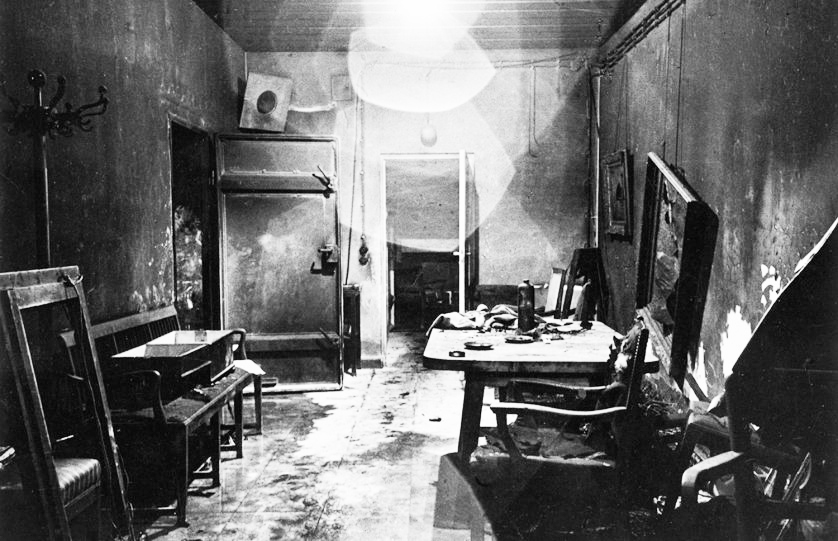
A new view of a photograph that appeared, heavily cropped, in LIFE, picturing Hitler's bunker, partially burned by retreating German troops and stripped of valuables by invading Russians.

A new view of a photograph that appeared, heavily cropped, in LIFE, picturing Hitler’s bunker, partially burned by retreating German troops and stripped of valuables by invading Russians.

On this day, Adolf Hitler takes to his underground bunker, where he remains for 105 days until he commits suicide. Hitler retired to his bunker after deciding to remain in Berlin for the last great siege of the war. Fifty-five feet under the chancellery (Hitler’s headquarters as chancellor), the shelter contained 18 small rooms and was fully self-sufficient, with its own water and electrical supply. He left only rarely (once to decorate a squadron of Hitler Youth) and spent most of his time micromanaging what was left of German defenses and entertaining Nazi colleagues like Hermann Goering, Heinrich Himmler, and Joachim von Ribbentrop. Constantly at his side during this time were his companion, Eva Braun, and his Alsatian, Blondi.

On April 29, Hitler married Eva in their bunker hideaway. Eva Braun met Hitler while working as an assistant to Hitler’s official photographer. Braun spent her time with Hitler out of public view, entertaining herself by skiing and swimming. She had no discernible influence on Hitler’s political career but provided a certain domesticity to the life of the dictator. Loyal to the end, she refused to leave the bunker even as the Russians closed in.

Only hours after they were united in marriage, both Hitler and Eva committed suicide. Warned by officers that the Russians were only about a day from overtaking the chancellery and urged to escape to Berchtesgarden, a small town in the Bavarian Alps where Hitler owned a home, the dictator instead chose to take his life. Both he and his wife swallowed cyanide capsules (which had been tested for their efficacy on his “beloved” dog and her pups). For good measure, he shot himself with his pistol.


History 101

Columbus mistakes manatees for mermaids

By History.com

On this day in 1493, Italian explorer Christopher Columbus, sailing near the Dominican Republic, sees three “mermaids”–in reality manatees–and describes them as “not half as beautiful as they are painted.” Six months earlier, Columbus (1451-1506) set off from Spain across the Atlantic Ocean with the Nina, Pinta and Santa Maria, hoping to find a western trade route to Asia. Instead, his voyage, the first of four he would make, led him to the Americas, or “New World.”

Mermaids, mythical half-female, half-fish creatures, have existed in seafaring cultures at least since the time of the ancient Greeks. Typically depicted as having a woman’s head and torso, a fishtail instead of legs and holding a mirror and comb, mermaids live in the ocean and, according to some legends, can take on a human shape and marry mortal men. Mermaids are closely linked to sirens, another folkloric figure, part-woman, part-bird, who live on islands and sing seductive songs to lure sailors to their deaths.

Mermaid sightings by sailors, when they weren’t made up, were most likely manatees, dugongs or Steller’s sea cows (which became extinct by the 1760s due to over-hunting). Manatees are slow-moving aquatic mammals with human-like eyes, bulbous faces and paddle-like tails. It is likely that manatees evolved from an ancestor they share with the elephant. The three species of manatee (West Indian, West African and Amazonian) and one species of dugong belong to the Sirenia order. As adults, they’re typically 10 to 12 feet long and weigh 800 to 1,200 pounds. They’re plant-eaters, have a slow metabolism and can only survive in warm water.

Manatees live an average of 50 to 60 years in the wild and have no natural predators. However, they are an endangered species. In the U.S., the majority of manatees are found in Florida, where scores of them die or are injured each year due to collisions with boats.


History 101

Sooners win 30th game in a row

By History.com

This day, On January 2, 1956, Oklahoma University’s champion football team, the Sooners, defeat Maryland 20-6 in the Orange Bowl in Miami, Florida, winning the national championship and scoring their 30th straight victory in the middle of a winning streak that went on to stretch to 47 games.

Behind Coach Bud Wilkinson, the Sooners had lost the opening game of the 1953 season to Notre Dame and tied Pittsburgh the next week; since then, they had gone undefeated. The game on January 2, 1956, was a rematch of the 1954 Orange Bowl, when Maryland had been ranked first and OU fourth. During that game, the Terrapins twice had a first down with the ball inside the 10-yard line only to be shut down by the Sooner defense. The Sooners won 7-0 with the game’s single touchdown, scored by tailback Larry Grigg in the second period.

In 1956, OU came into the Orange Bowl as the defending national champions, with the No. 1 ranking in the country and a 10-0 regular season record. Maryland was ranked third, with only one regular-season loss. Trailing 6-0 at halftime, the Sooners kicked in their offense in the second half, scoring three times and posting a second Orange Bowl win and a second straight national championship.

The Sooners’ historic winning streak didn’t come to an end until November 1957, when they lost to Notre Dame 7-0. In addition to their two national titles, in 1955 and 1956, they won or shared 14 straight conference titles from 1946 to 1959, all but the first year under Wilkinson. Their record of 47 straight wins over three years still stands, as of the end of the 2006 season.

History 101

Bugsy Siegel Opens Flamingo Hotel 

Bbugsymainy History.com

On December 26, 1946, in Las Vegas, Nevada, mobster Benjamin “Bugsy” Siegel opens The Pink Flamingo Hotel & Casino at a total cost of $6 million. The 40-acre facility wasn’t complete and Siegel was hoping to raise some revenue with the grand opening.

Well-known singer and comedian Jimmy Durante headlined the entertainment, with music by Cuban band leader Xavier Cugat. Some of Siegel’s Hollywood friends, including actors George Raft, George Sanders, Sonny Tufts and George Jessel were in attendance.

The grand opening, however, was a flop. Bad weather kept many other Hollywood guests from arriving. And because gamblers had no rooms at the hotel, they took their winnings and gambled elsewhere. The casino lost $300,000 in the first week of operation.

Siegel and his New York “partners” had invested $1 million in a property already under construction by Billy Wilkerson, owner of the Hollywood Reporter as well as some very popular nightclubs in the Sunset Strip. Wilkerson had wanted to recreate the Sunset Strip in Las Vegas, with a European style hotel with luxuious rooms, a spa, health club, showroom, golf course, nightclub and upscale restaurant. But he soon ran out of money due to the high cost of materials immediately after the war.

Siegel, who held a largest interest in the racing publication Trans America Wire, was drawn to Las Vegas in 1945 by his interest in legalized gambling and off-track betting. He purchased The El Cortez hotel for $600,000 and later sold it for a $166,000 profit.

Siegel and his organized crime buddies used the profits to influence Wilkerson to accept new partners. Siegel took over the project and supervised the building, naming it after his girlfriend Virginia Hill, whose nickname was “The Flamingo” because of her red hair and long legs.

Two weeks after the grand opening, the Flamingo closed down. It re-opened March 1, 1947, as The Fabulous Flamingo. Siegel forced Wilkerson out in April, and by May, the resort reported a profit, but it wasn’t enough to save Siegel.

Convinced that Siegel wasn’t giving them a “square count,” it is widely believed that his partners in organized crime had him killed while he was reading the paper June 20, 1947, at Hill’s Beverly Hills mansion. Hill was in Paris, having flown the coop after a fight with Siegel 10 days prior. The crime remains unsolved to this day.

Surviving a series of name and ownership changes, the hotel is known today as The Flamingo Las Vegas, owned and operated by Harrah’s Entertainment. The property offers 3,626 hotel rooms and a 77,000-square-foot casino.


History 101

President Clinton impeached

By History.com

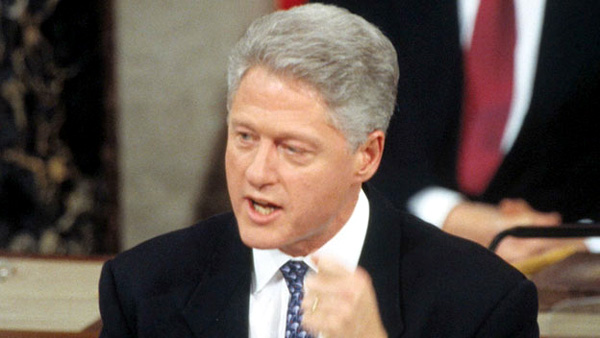
After nearly 14 hours of debate, the House of Representatives approves two articles of impeachment against President Bill Clinton, charging him with lying under oath to a federal grand jury and obstructing justice. Clinton, the second president in American history to be impeached, vowed to finish his term.

history-101-webIn November 1995, Clinton began an affair with Monica Lewinsky, a 21-year-old unpaid intern. Over the course of a year and a half, the president and Lewinsky had nearly a dozen sexual encounters in the White House. In April 1996, Lewinsky was transferred to the Pentagon. That summer, she first confided in Pentagon co-worker Linda Tripp about her sexual relationship with the president. In 1997, with the relationship over, Tripp began secretly to record conversations with Lewinsky, in which Lewinsky gave Tripp details about the affair.

In December, lawyers for Paula Jones, who was suing the president on sexual harassment charges, subpoenaed Lewinsky. In January 1998, allegedly under the recommendation of the president, Lewinsky filed an affidavit in which she denied ever having had a sexual relationship with him. Five days later, Tripp contacted the office of Kenneth Starr, the Whitewater independent counsel, to talk about Lewinsky and the tapes she made of their conversations. Tripp, wired by FBI agents working with Starr, met with Lewinsky again, and on January 16, Lewinsky was taken by FBI agents and U.S. attorneys to a hotel room where she was questioned and offered immunity if she cooperated with the prosecution. A few days later, the story broke, and Clinton publicly denied the allegations, saying, “I did not have sexual relations with that woman, Ms. Lewinsky.”

In late July, lawyers for Lewinsky and Starr worked out a full-immunity agreement covering both Lewinsky and her parents, all of whom Starr had threatened with prosecution. On August 6, Lewinsky appeared before the grand jury to begin her testimony, and on August 17 President Clinton testified. Contrary to his testimony in the Paula Jones sexual-harassment case, President Clinton acknowledged to prosecutors from the office of the independent counsel that he had had an extramarital affair with Ms. Lewinsky.

In four hours of closed-door testimony, conducted in the Map Room of the White House, Clinton spoke live via closed-circuit television to a grand jury in a nearby federal courthouse. He was the first sitting president ever to testify before a grand jury investigating his conduct. That evening, President Clinton also gave a four-minute televised address to the nation in which he admitted he had engaged in an inappropriate relationship with Lewinsky. In the brief speech, which was wrought with legalisms, the word “sex” was never spoken, and the word “regret” was used only in reference to his admission that he misled the public and his family.

Less than a month later, on September 9, Kenneth Starr submitted his report and 18 boxes of supporting documents to the House of Representatives. Released to the public two days later, the Starr Report outlined a case for impeaching Clinton on 11 grounds, including perjury, obstruction of justice, witness-tampering, and abuse of power, and also provided explicit details of the sexual relationship between the president and Ms. Lewinsky. On October 8, the House authorized a wide-ranging impeachment inquiry, and on December 11, the House Judiciary Committee approved three articles of impeachment. On December 19, the House impeached Clinton.

On January 7, 1999, in a congressional procedure not seen since the 1868 impeachment trial of President Andrew Johnson, the trial of President Clinton got underway in the Senate. As instructed in Article 1 of the U.S. Constitution, the chief justice of the U.S. Supreme Court (William Rehnquist at this time) was sworn in to preside, and the senators were sworn in as jurors.

Five weeks later, on February 12, the Senate voted on whether to remove Clinton from office. The president was acquitted on both articles of impeachment. The prosecution needed a two-thirds majority to convict but failed to achieve even a bare majority. Rejecting the first charge of perjury, 45 Democrats and 10 Republicans voted “not guilty,” and on the charge of obstruction of justice the Senate was split 50-50. After the trial concluded, President Clinton said he was “profoundly sorry” for the burden his behavior imposed on Congress and the American people.


Da Vinci notebook sells for over 5 million

By History.comhistory-davinci-web

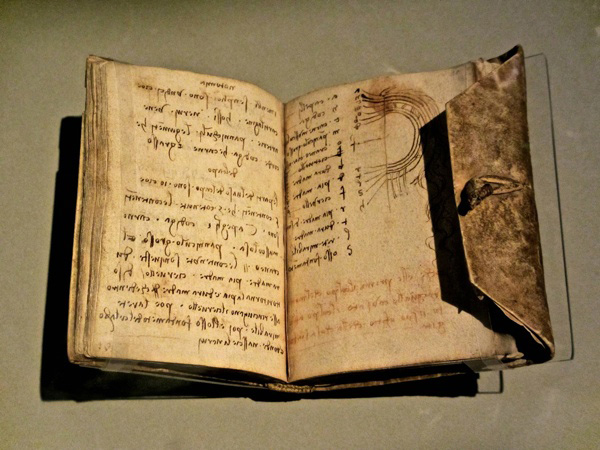
On this day in 1980, American oil tycoon Armand Hammer pays $5,126,000 at auction for a notebook containing writings by the legendary artist Leonardo da Vinci.

The manuscript, written around 1508, was one of some 30 similar books da Vinci produced during his lifetime on a variety of subjects. It contained 72 loose pages featuring some 300 notes and detailed drawings, all relating to the common theme of water and how it moved. Experts have said that da Vinci drew on it to paint the background of his masterwork, the Mona Lisa. The text, written in brown ink and chalk, read from right to left, an example of da Vinci’s favored mirror-writing technique. The painter Giuseppi Ghezzi discovered the notebook in 1690 in a chest of papers belonging to Guglielmo della Porto, a 16th-century Milanese sculptor who had studied Leonardo’s work. In 1717, Thomas Coke, the first earl of Leicester, bought the manuscript and installed it among his impressive collection of art at his family estate in England.

More than two centuries later, the notebook–by now known as the Leicester Codex–showed up on the auction block at Christie’s in London when the current Lord Coke was forced to sell it to cover inheritance taxes on the estate and art collection. In the days before the sale, art experts and the press speculated that the notebook would go for $7 to $20 million. In fact, the bidding started at $1.4 million and lasted less than two minutes, as Hammer and at least two or three other bidders competed to raise the price $100,000 at a time. The $5.12 million price tag was the highest ever paid for a manuscript at that time; a copy of the legendary Gutenberg Bible had gone for only $2 million in 1978. “I’m very happy with the price. I expected to pay more,” Hammer said later. “There is no work of art in the world I wanted more than this.” Lord Coke, on the other hand, was only “reasonably happy” with the sale; he claimed the proceeds would not be sufficient to cover the taxes he owed.

Hammer, the president of Occidental Petroleum Corporation, renamed his prize the Hammer Codex and added it to his valuable collection of art. When Hammer died in 1990, he left the notebook and other works to the Armand Hammer Museum of Art and Cultural Center at the University of California at Los Angeles (UCLA). Several years later, the museum offered the manuscript for sale, claiming it was forced to take this action to cover legal costs incurred when the niece and sole heir of Hammer’s late wife, Frances, sued the estate claiming Hammer had cheated Frances out of her rightful share of his fortune. On November 11, 1994, the Hammer Codex was sold to an anonymous bidder–soon identified as Bill Gates, the billionaire founder of Microsoft–at a New York auction for a new record high price of $30.8 million. Gates restored the title of Leicester Codex and has since loaned the manuscript to a number of museums for public display.


History 101

Aircraft squadron lost in the Bermuda Triangle  aircraft

By History.com

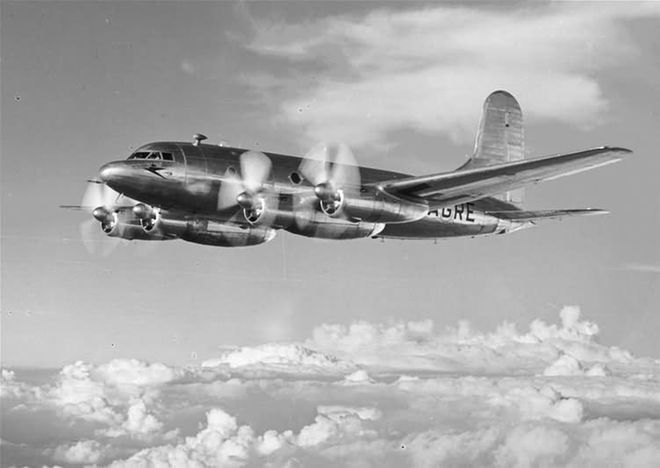
At 2:10 p.m., five U.S. Navy Avenger torpedo-bombers comprising Flight 19 take off from the Ft. Lauderdale Naval Air Station in Florida on a routine three-hour training mission. Flight 19 was scheduled to take them due east for 120 miles, north for 73 miles, and then back over a final 120-mile leg that would return them to the naval base. They never returned.

Two hours after the flight began, the leader of the squadron, who had been flying in the area for more than six months, reported that his compass and back-up compass had failed and that his position was unknown. The other planes experienced similar instrument malfunctions. Radio facilities on land were contacted to find the location of the lost squadron, but none were successful. After two more hours of confused messages from the fliers, a distorted radio transmission from the squadron leader was heard at 6:20 p.m., apparently calling for his men to prepare to ditch their aircraft simultaneously because of lack of fuel.

By this time, several land radar stations finally determined that Flight 19 was somewhere north of the Bahamas and east of the Florida coast, and at 7:27 p.m. a search and rescue Mariner aircraft took off with a 13-man crew. Three minutes later, the Mariner aircraft radioed to its home base that its mission was underway. The Mariner was never heard from again. Later, there was a report from a tanker cruising off the coast of Florida of a visible explosion seen at 7:50 p.m.

The disappearance of the 14 men of Flight 19 and the 13 men of the Mariner led to one of the largest air and seas searches to that date, and hundreds of ships and aircraft combed thousands of square miles of the Atlantic Ocean, the Gulf of Mexico, and remote locations within the interior of Florida. No trace of the bodies or aircraft was ever found.

Although naval officials maintained that the remains of the six aircraft and 27 men were not found because stormy weather destroyed the evidence, the story of the “Lost Squadron” helped cement the legend of the Bermuda Triangle, an area of the Atlantic Ocean where ships and aircraft are said to disappear without a trace. The Bermuda Triangle is said to stretch from the southern U.S. coast across to Bermuda and down to the Atlantic coast of Cuba and Santo Domingo.

History 101

Moby-Dick published

By History.com  histort-101-web

On this day in 1851, Moby-Dick, a novel by Herman Melville about the voyage of the whaling ship Pequod, is published by Harper & Brothers in New York. Moby-Dick is now considered a great classic of American literature and contains one of the most famous opening lines in fiction: “Call me Ishmael.” Initially, though, the book about Captain Ahab and his quest for a giant white whale was a flop.

Herman Melville was born in New York City in 1819 and as a young man spent time in the merchant marines, the U.S. Navy and on a whaling ship in the South Seas. In 1846, he published his first novel, Typee, a romantic adventure based on his experiences in Polynesia. The book was a success and a sequel, Omoo, was published in 1847. Three more novels followed, with mixed critical and commercial results. Melville’s sixth book, Moby-Dick, was first published in October 1851 in London, in three volumes titled The Whale, and then in the U.S. a month later. Melville had promised his publisher an adventure story similar to his popular earlier works, but instead, Moby-Dick was a tragic epic, influenced in part by Melville’s friend and Pittsfield, Massachusetts, neighbor, Nathaniel Hawthorne, whose novels include The Scarlet Letter.

After Moby-Dick‘s disappointing reception, Melville continued to produce novels, short stories (Bartleby) and poetry, but writing wasn’t paying the bills so in 1865 he returned to New York to work as a customs inspector, a job he held for 20 years.

Melville died in 1891, largely forgotten by the literary world. By the 1920s, scholars had rediscovered his work, particularly Moby-Dick, which would eventually become a staple of high school reading lists across the United States. Billy Budd, Melville’s final novel, was published in 1924, 33 years after his death.


History 101

Nixon re-elected president  history-101-web

By History.com

Richard Nixon defeats Senator George McGovern (D-South Dakota) and is re-elected President of the United States.

With only 55 percent of the electorate voting, the lowest turnout since 1948, Nixon carried all states but Massachusetts, taking 97 percent of the electoral votes. During the campaign, Nixon pledged to secure “peace with honor” in Vietnam. Aided by the potential for a peace agreement in the ongoing Paris negotiations and the upswing in the American economy, Nixon easily defeated McGovern, an outspoken peacenik whose party was divided over several issues, not the least of which was McGovern’s extreme views on the war. McGovern had said during the campaign, “If I were President, it would take me twenty-four hours and the stroke of a pen to terminate all military operations in Southeast Asia.” He said he would withdraw all American troops within 90 days of taking office, whether or not U.S. prisoners of war were released. To many Americans, including many Democrats, McGovern’s position was tantamount to total capitulation in Southeast Asia. Given this radical alternative, Nixon seemed a better choice to most voters.

In other races, the Democrats widened their majority in Congress, picking up two Senate seats. Almost unnoticed during the presidential campaign was the arrest of five men connected with Nixon’s re-election committee who had broken into the Democratic Party’s national headquarters in the Watergate apartment complex in Washington, D.C. The Watergate scandal ultimately proved to be Nixon’s undoing, and he resigned the presidency as a result of it in August 1974.


Was there really a “red telephone” hotline during the Cold War?

history-picBy Evan Andrews of History.com

During the height of the Cold War, the United States and the Soviet Union established a direct communications link to allow their leaders to contact one another in the event of a nuclear crisis or other emergency. This Washington-Moscow hotline has since featured in countless novels and films such as 1964’s “Dr. Strangelove,” but contrary to its depictions in pop culture, it never took the form of a red telephone. In fact, it never involved phone calls at all.

The Washington-Moscow hotline was first proposed in the 1950s, but the idea didn’t gain traction until 1962’s Cuban Missile Crisis, when the Americans and Soviets found that their diplomatic messages often took several hours to reach one another. Fearing that any further mishaps might trigger an accidental nuclear war, the two superpowers met in Geneva the following year and signed a “Memorandum of Understanding Regarding the Establishment of a Direct Communications Line.” On August 30, 1963, the new system went live. Rather than a telephone link, which presented the possibility of miscommunications, the hotline consisted of teletype machines that allowed the two countries to send written messages to one another via transatlantic cable. The Soviet system was located in the Kremlin, but the American version was always housed in the Pentagon, not the White House. Satellite links were later added to the hotline during the Nixon administration, and in 1986, it was upgraded to include high-speed fax capability. The most recent overhaul came in 2008, when the system switched to email.

While there is no evidence that the hotline was ever used to avert a nuclear disaster, it often played a key role in U.S.-Soviet relations. In 1967, Lyndon B. Johnson became the first president to use the system when he negotiated with Soviet leader Alexei Kosygin during the Six Day War, a brief conflict between Israel and several Arab states. Richard Nixon later used it for similar purposes during 1971’s Indo-Pakistani War and 1973’s Yom Kippur War, and Jimmy Carter famously hopped on the hotline to object to the Soviet invasion of Afghanistan in 1979. The hotline’s last crisis uses came during the Reagan administration and the dying days of the Cold War, but it still exists to this day. To ensure that the system will function in the event of an emergency, Russian and American technicians continue to send test messages to one another once every hour.


History 101

First barrel ride down Niagara Falls

By History.com  annie5-bw

On this day in 1901, a 63-year-old schoolteacher named Annie Edson Taylor becomes the first person to take the plunge over Niagara Falls in a barrel.

After her husband died in the Civil War, the New York-born Taylor moved all over the U. S. before settling in Bay City, Michigan, around 1898. In July 1901, while reading an article about the Pan-American Exposition in Buffalo, she learned of the growing popularity of two enormous waterfalls located on the border of upstate New York and Canada. Strapped for cash and seeking fame, Taylor came up with the perfect attention-getting stunt: She would go over Niagara Falls in a barrel.

Taylor was not the first person to attempt the plunge over the famous falls. In October 1829, Sam Patch, known as the Yankee Leaper, survived jumping down the 175-foot Horseshoe Falls of the Niagara River, on the Canadian side of the border. More than 70 years later, Taylor chose to take the ride on her birthday, October 24. (She claimed she was in her 40s, but genealogical records later showed she was 63.) With the help of two assistants, Taylor strapped herself into a leather harness inside an old wooden pickle barrel five feet high and three feet in diameter. With cushions lining the barrel to break her fall, Taylor was towed by a small boat into the middle of the fast-flowing Niagara River and cut loose.

Knocked violently from side to side by the rapids and then propelled over the edge of Horseshoe Falls, Taylor reached the shore alive, if a bit battered, around 20 minutes after her journey began. After a brief flurry of photo-ops and speaking engagements, Taylor’s fame cooled, and she was unable to make the fortune for which she had hoped. She did, however, inspire a number of copy-cat daredevils. Between 1901 and 1995, 15 people went over the falls; 10 of them survived. Among those who died were Jesse Sharp, who took the plunge in a kayak in 1990, and Robert Overcracker, who used a jet ski in 1995. No matter the method, going over Niagara Falls is illegal, and survivors face charges and stiff fines on either side of the border.


History 101

Capone goes to prison

By History.com  capone-mug-shot-e-web

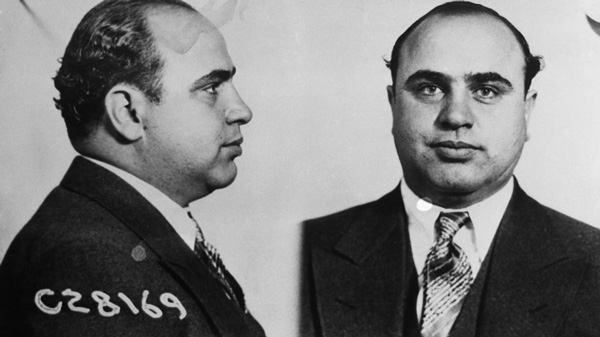
On this day in 1931, gangster Al Capone is sentenced to 11 years in prison for tax evasion and fined $80,000, signaling the downfall of one of the most notorious criminals of the 1920s and 1930s.

Alphonse Gabriel Capone was born in Brooklyn, New York, in 1899 to Italian immigrants. He was expelled from school at 14, joined a gang and earned his nickname “Scarface” after being sliced across the cheek during a fight. By 1920, Capone had moved to Chicago, where he was soon helping to run crime boss Johnny Torrio’s illegal enterprises, which included alcohol-smuggling, gambling and prostitution. Torrio retired in 1925 after an attempt on his life and Capone, known for his cunning and brutality, was put in charge of the organization.

Prohibition, which outlawed the brewing and distribution of alcohol and lasted from 1920 to 1933, proved extremely lucrative for bootleggers and gangsters like Capone, who raked in millions from his underworld activities. Capone was at the top of the F.B.I.’s “Most Wanted” list by 1930, but he avoided long stints in jail until 1931 by bribing city officials, intimidating witnesses and maintaining various hideouts. He became Chicago’s crime kingpin by wiping out his competitors through a series of gangland battles and slayings, including the infamous St. Valentine’s Day Massacre in 1929, when Capone’s men gunned down seven rivals. This event helped raise Capone’s notoriety to a national level.

Among Capone’s enemies was federal agent Elliot Ness, who led a team of officers known as “The Untouchables” because they couldn’t be corrupted. Ness and his men routinely broke up Capone’s bootlegging businesses, but it was tax-evasion charges that finally stuck and landed Capone in prison in 1931. Capone began serving his time at the U.S. Penitentiary in Atlanta, but amid accusations that he was manipulating the system and receiving cushy treatment, he was transferred to the maximum-security lockup at Alcatraz Island, in California’s San Francisco Bay. He got out early in 1939 for good behavior, after spending his final year in prison in a hospital, suffering from syphilis.

Plagued by health problems for the rest of his life, Capone died in 1947 at age 48 at his home in Palm Island, Florida.

History 101

Achille Lauro hijacking ends

By History.com achillelauro08ct

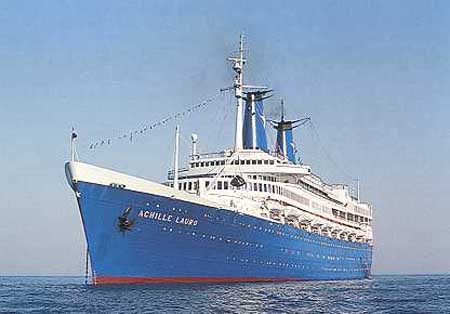
The hijacking of the Italian cruise ship Achille Lauro reaches a dramatic climax when U.S. Navy F-14 fighters intercept an Egyptian airliner attempting to fly the Palestinian hijackers to freedom and force the jet to land at a NATO base in Sigonella, Sicily. American and Italian troops surrounded the plane, and the terrorists were taken into Italian custody.

On October 7, four heavily armed Palestinian terrorists hijacked the Achille Lauroin the Mediterranean Sea off the coast of Alexandria, Egypt. Some 320 crewmembers and 80 passengers,were taken hostage. Hundreds of other passengers had disembarked the cruise ship earlier that day to visit Cairo and tour the Egyptian pyramids. Identifying themselves as members of the Palestine Liberation Front–a Palestinian splinter group–the gunmen demanded the release of 50 Palestinian militants imprisoned in Israel. If their demands were not met, they threatened to blow up the ship and kill the 11 Americans on board. The next morning, they also threatened to kill the British passengers.

The Achille Lauro traveled to the Syrian port of Tartus, where the terrorists demanded negotiations on October 8. Syria refused to permit the ship to anchor in its waters, which prompted more threats from the hijackers. That afternoon, they shot and killed Leon Klinghoffer, a 69-year-old Jewish-American who was confined to a wheelchair as the result of a stroke. His body was then pushed overboard in the wheelchair.

Yasir Arafat’s Palestine Liberation Organization (PLO) condemned the hijacking, and PLO officials joined with Egyptian authorities in attempting to resolve the crisis. On the recommendation of the negotiators, the cruise ship traveled to Port Said. On October 9, the hijackers surrendered to Egyptian authorities and freed the hostages in exchange for a pledge of safe passage to an undisclosed destination.

The next day–October 10–the four hijackers boarded an EgyptAir Boeing 737 airliner, along with Mohammed Abbas, a member of the Palestine Liberation Front who had participated in the negotiations; a PLO official; and several Egyptians. The 737 took off from Cairo at 4:15 p.m. EST and headed for Tunisia. President Ronald Reagan gave his final order approving the plan to intercept the aircraft, and at 5:30 p.m. EST, F-14 Tomcat fighters located the airliner 80 miles south of Crete. Without announcing themselves, the F-14s trailed the airliner as it sought and was denied permission to land at Tunis. After a request to land at the Athens airport was likewise refused, the F-14s turned on their lights and flew wing-to-wing with the airliner. The aircraft was ordered to land at a NATO air base in Sicily, and the pilot complied, touching down at 6:45 p.m. The hijackers were arrested soon after. Abbas and the other Palestinian were released, prompting criticism from the United States, which wanted to investigate their possible involvement in the hijacking.

On July 10, 1986, an Italian court later convicted three of the terrorists and sentenced them to prison terms ranging from 15 to 30 years. Three others, including Mohammed Abbas, were convicted in absentia for masterminding the hijacking and sentenced to life in prison. They received harsher penalties because, unlike the hijackers, who the court found were acting for “patriotic motives,” Abbas and the others conceived the hijacking as a “selfish political act” designed “to weaken the leadership of Yasir Arafat.” The fourth hijacker was a minor who was tried and convicted separately.


O.J. Simpson acquitted

By History.comhistory-101-web

At the end of a sensational trial, former football star O.J. Simpson is acquitted of the brutal 1994 double murder of his estranged wife, Nicole Brown Simpson, and her friend, Ronald Goldman. In the epic 252-day trial, Simpson’s “dream team” of lawyers employed creative and controversial methods to convince jurors that Simpson’s guilt had not been proved “beyond a reasonable doubt,” thus surmounting what the prosecution called a “mountain of evidence” implicating him as the murderer.

Orenthal James Simpson–a Heisman Trophy winner, star running back with the Buffalo Bills, and popular television personality–married Nicole Brown in 1985. He reportedly regularly abused his wife and in 1989 pleaded no contest to a charge of spousal battery. In 1992, she left him and filed for divorce. On the night of June 12, 1994, Nicole Brown Simpson and Ronald Goldman were stabbed and slashed to death in the front yard of Mrs. Simpson’s condominium in Brentwood, Los Angeles. By June 17, police had gathered enough evidence to charge O.J. Simpson with the murders.

Simpson had no alibi for the time frame of the murders. Some 40 minutes after the murders were committed, a limousine driver sent to take Simpson to the airport saw a man in dark clothing hurrying up the drive of his Rockingham estate. A few minutes later, Simpson spoke to the driver though the gate phone and let him in. During the previous 25 minutes, the driver had repeatedly called the house and received no answer.

A single leather glove found outside Simpson’s home matched a glove found at the crime scene. In preliminary DNA tests, blood found on the glove was shown to have come from Simpson and the two victims. After his arrest, further DNA tests would confirm this finding. Simpson had a wound on his hand, and his blood was a DNA match to drops found at the Brentwood crime scene. Nicole Brown Simpson’s blood was discovered on a pair of socks found at the Rockingham estate. Simpson had recently purchased a “Stiletto” knife of the type the coroner believed was used by the killer. Shoe prints in the blood at Brentwood matched Simpson’s shoe size and later were shown to match a type of shoe he had owned. Neither the knife nor shoes were found by police.

On June 17, a warrant was put out for Simpson’s arrest, but he refused to surrender. Just before 7 p.m., police located him in a white Ford Bronco being driven by his friend, former teammate Al Cowlings. Cowlings refused to pull over and told police over his cellular phone that Simpson was suicidal and had a gun to his head. Police agreed not to stop the vehicle by force, and a low-speed chase ensued. Los Angeles news helicopters learned of the event unfolding on their freeways, and live television coverage began. As millions watched, the Bronco was escorted across Los Angeles by a phalanx of police cars. Just before 8 p.m., the dramatic journey ended when Cowlings pulled into the Rockingham estate. After an hour of tense negotiation, Simpson emerged from the vehicle and surrendered. In the vehicle was found a travel bag containing, among other things, Simpson’s passport, a disguise kit consisting of a fake moustache and beard, and a revolver. Three days later, Simpson appeared before a judge and pleaded not guilty.

Simpson’s subsequent criminal trial was a sensational media event of unprecedented proportions. It was the longest trial ever held in California, and courtroom television cameras captured the carnival-like atmosphere of the proceedings. The prosecution’s mountain of evidence was systemically called into doubt by Simpson’s team of expensive attorneys, who made the dramatic case that their client was framed by unscrupulous and racist police officers. Citing the questionable character of detective Mark Fuhrman and alleged blunders in the police investigation, defense lawyers painted Simpson as yet another African American victim of the white judicial system. The jurors’ reasonable doubt grew when the defense spent weeks attacking the damning DNA evidence, arguing in overly technical terms that delays and other anomalies in the gathering of evidence called the findings into question. Critics of the trial accused Judge Lance Ito of losing control of his courtroom.

In polls, a majority of African Americans believed Simpson to be innocent of the crime, while white America was confident of his guilt. However, the jury–made up of nine African Americans, two whites, and one Hispanic–was not so divided; they took just four hours of deliberation to reach the verdict of not guilty on both murder charges. On October 3, 1995, an estimated 140 million Americans listened in on radio or watched on television as the verdict was delivered.

In February 1997, Simpson was found liable for several charges related to the murders in a civil trial and was forced to award $33.5 million in compensatory and punitive damages to the victims’ families. However, with few assets remaining after his long and costly legal battle, he has avoided paying the damages.

In 2007, Simpson ran into legal problems once again when he was arrested for breaking into a Las Vegas hotel room and taking sports memorabilia, which he claimed had been stolen from him, at gunpoint. On October 3, 2008, he was found guilty of 12 charges related to the incident, including armed robbery and kidnapping, and sentenced to 33 years in prison.