
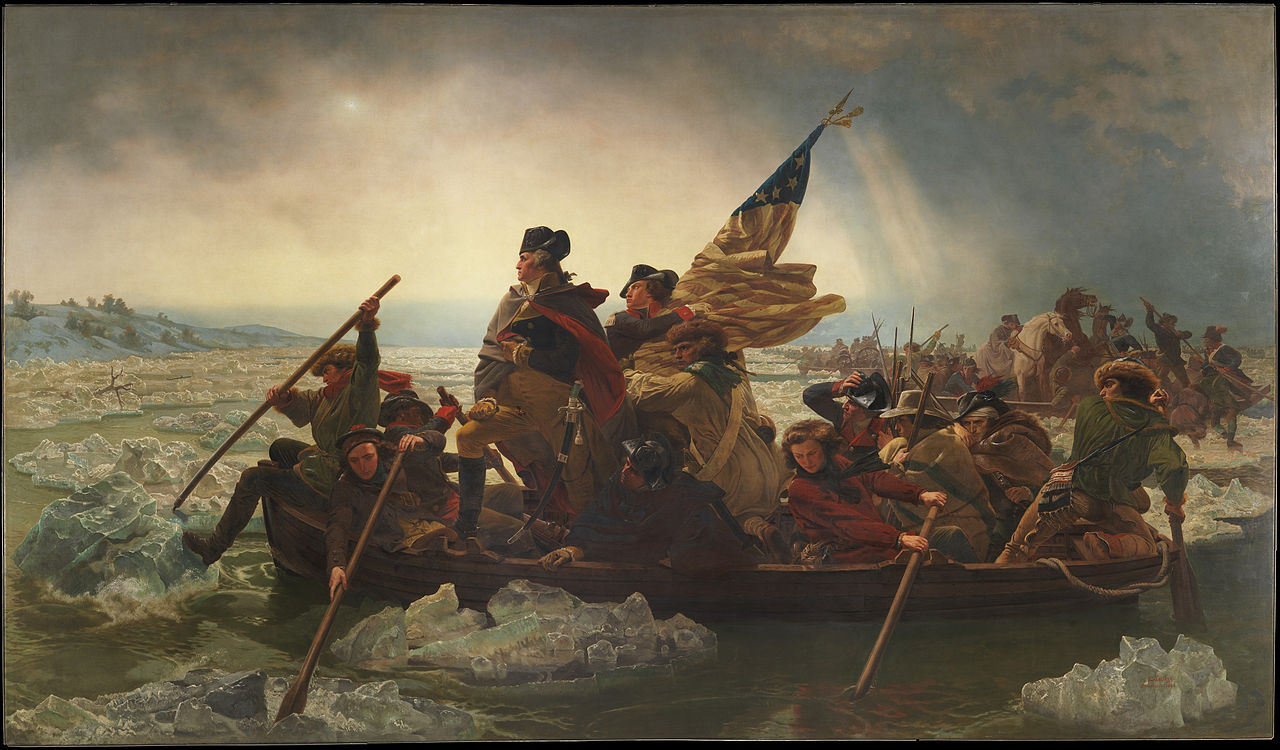
(Image Courtesy: Wikipedia)
Washington Crossing the Delaware (December 25, 1776), by Emanuel Leutze, 1851
By K.P. Sander
George Washington was the very first President of the United States, but that was just one of his many accomplishments in a long list of devotions to serving this country.
On Feb. 22, 1732, Washington was born to a wealthy plantation family in Westmoreland, Virginia. Of course he grew to greatness and was not only our first President, but also the Commander-in-Chief of the Continental Army during the Revolutionary War, a founding father of the United States, a governor of the convention that drafted the U.S. Constitution (and a signer thereof), and a Delegate from Virginia to the First and Second Continental Congresses. We remember him on the one dollar bill and the quarter, and know he did great things, but here are some interesting – albeit lesser-known facts – about the amazing George Washington (thanks, Wikipedia).
- Washington’s father died when he was 11-years old, and his half brother, Lawrence, became a surrogate father and mentor.
- In 1751, Washington escorted Lawrence to Barbados for tuberculosis treatment, and contracted smallpox during the trip. The disease left his face a bit scarred, but immunized him against future exposure.
- The mercury used to treat his smallpox ultimately led to the loss of all of Washington’s teeth. He had three pair made: two from elephant/hippo ivory, and one from human teeth (none from wood). All were a source of constant pain, though he never complained.
- Smallpox reportedly left Washington sterile, and he had no children of his own.
- Washington married the wealthy widow, Martha Custis in 1759. She had two children, and he loved them as his own.
- At exactly six feet tall, Washington towered over most of his contemporaries
- He owned tobacco plantations, but gave up smoking.
- He owned (inherited) slaves, but desired to free them and abolish slavery.
- Washington was one of the wealthiest land owners in Virginia, and owned thousands of acres of land.
- Washington lived an aristocratic lifestyle, with fox hunting, dancing, theater, and racing some of his favorite activities.
- He was unanimously elected as President by the electors in both the 1788 and 1792 elections.
- Historian John Shy said that in 1783, Washington was “a mediocre military strategist but had become a master political tactician with an almost perfect sense of timing and a developed capacity to exploit his charismatic reputation, using people who thought they were using him.”
- Washington was pulled out of retirement in 1787 to oversee the Constitutional Convention in Philadelphia.
- He was not a member of any political party and hoped that they would not be formed, fearing that they would undermine republicanism.
- Washington’s death was perhaps the result of malpractice. He became ill with a severe sore throat in Dec. 1799, with severe difficulty breathing and inability to swallow. Bloodletting was a standard medical practice of the time, and Washington authorized the removal of a pint. Three different physicians intervened for a myriad of symptoms, and half or more of his blood was ultimately removed. Washington died in his bed around 10 p.m. on Sat., Dec. 14, 1799, at the age of 67. His last words were recorded as, “’Tis well.”
- Napoleon Bonaparte ordered ten days of mourning in France at Washington’s passing.
- Washington was interred in the family tomb at his home in Mt. Vernon. A new tomb was constructed at Mt. Vernon in 1837. His remains were moved there on Oct. 7 of that year, and after the ceremony the inner vault’s door was locked and the key was thrown into the Potomac River.
- Washington was well-loved throughout his life. Congressman Henry Lee eulogized him, saying, “First in war, first in peace, and first in the hearts of his countrymen, he was second to none in the humble and enduring scenes of private life; pious, just, humane, temperate, and sincere; uniform, dignified, and commanding, his example was as edifying to all around him as were the effects of that example lasting…such was the man America has lost – such was the man for whom our nation mourns.”
 ABC PR -Community News, Public Relations and Advertising Services