
Photo Courtesy: Wikipedia
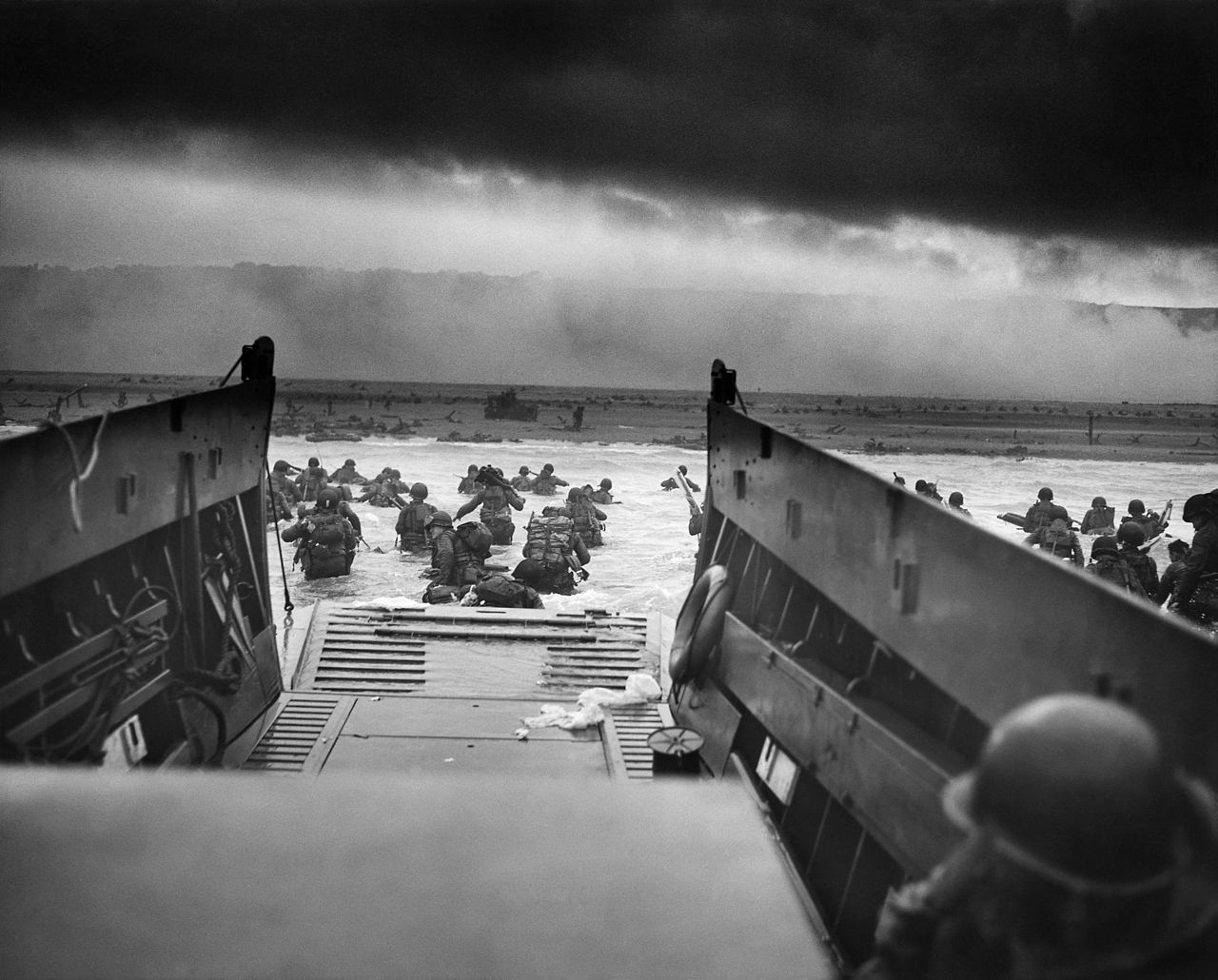
U.S. Army troops wade ashore on Omaha Beach, on the morning of June 6, 1944
By K. P. Sander
On Sat., June 6, we remembered that it had been 71 years since World War II Allied Forces invaded the beaches of Normandy, in northern France.
In the largest seaborne invasion in history, the attack landed 5,000 assault craft, 289 escort vessels and 277 minesweepers. According to Wikipedia, nearly 160,000 troops crossed the English Channel on “D-Day,” with 875,000 men ashore by the end of June 1944.
German preparations to secure the beaches all along the Atlantic Wall of France were only partially completed, allowing the Allies to take advantage of large, undefended stretches of coastline.
The planning attack for Normandy was nearly a year in the making, and the weather on the target date was dismal, but postponement would have delayed the attack for weeks. Strong winds blew the water crafts east of their intentions – particularly at Omaha and Utah beaches – and they were met with heavy gunfire where casualties were ultimately the heaviest.
Allied casualties on D-Day were estimated at more than 10,000, with 4,400 confirmed dead. Although the Germans had ordered all non-essential French civilians to evacuate the coastline combat zones, casualties came to 3,000 by D+1. Germany ultimately had between 4,000 and 9,000 casualties.
Allied air attack preceded the amphibious landings on D-Day, severely impacting transportation. This made it very difficult for Germany to bring supplies and reinforcements to the front. While the Allies did not achieve all of their objectives on D-Day, they ultimately gained control toward victory over the next several weeks and months.
The Allied victory in Normandy led to the liberation of France from Nazi control and contributed to the ending of German-occupied Western Europe, and ultimately the end of World War II. Less than one year after D-Day, Germany surrendered.
Operation Overlord Allies of the Normandy Invasion: United States, United Kingdom, Canada, Australia, Belgium, Czechoslovakia, Denmark, Free France, Greece, Netherlands, New Zealand, Norway and Poland.
D-Day is military terminology for a particular day in which any combat attack or operation is to be initiated; H-Hour is used for the particular time. The terms are used in conjunction with numbers for specifics that all units understand, yet secrecy is protected. For example, D+3 means three days after D-Day; D-1 was the day before D-Day; H-3 means three hours before H-Hour.
 ABC PR -Community News, Public Relations and Advertising Services