Tag Archives: Did You Know

Did You Know?

5 Easy Ways to Live More Sustainably

By StatePoint   

Consumers can take cues from eco-friendly brands like Musco to go green at home.

Consumers can take cues from eco-friendly brands like Musco to go green at home.

It might not feel like you alone can have an impact on the environment, but over time, small lifestyle changes can make a substantial difference.

Need some ideas to get started? Draw inspiration from the collective efforts of one California olive company working to run operations in an eco-friendly way.

“Our employees are vital to our zero waste efforts,” says Dennis Leikam, environmental manager at Musco Family Olive Company. “Through monthly sustainability topics and a compost program, they’re encouraged to reduce not only our corporate environmental impact, but also their personal impact away from work, as well.”

Over 75 percent of residential waste is recyclable, but most people only recycle 30 percent, according to the Environmental Protection Agency. While it may be unrealistic to produce zero waste at home, you can get closer to that goal.

Such commitment to sustainability is achievable in your own home. Here are some simple actions you can take.

Buy the Right Stuff

Musco has an ethical sourcing program to ensure that every part of the olive production process meets their sustainability goals. Do your own ethical sourcing by:

  • Buying local.
  • Buying products with minimal, recyclable packaging.
  • Reducing your use of disposable items.
  • Choosing products from companies with a commitment to sustainability.

Drive Less and Bike More

In an effort to reduce greenhouse gas emissions at its facilities by five percent, Musco is tracking emissions through Carbon Disclosure Project, the leading non-profit working to reduce greenhouse gas emissions. You can lower your carbon footprint by consolidating car trips, and walking or riding your bike to work and on errands.

Conserve Water

In the last 10 years, Musco has recycled almost 1.5 billion gallons of water onsite in a closed-loop system. They even grow a special grass that pulls salt from the soil, is harvested and becomes a tasty supplement for local cattle. Here are ways you too can conserve water:

  • Turn off the tap when you brush your teeth.
  • Use the dishwasher. Unless your dishwasher is more than a decade old, it uses less water than washing by hand. Really.
  • Put a brick in your tank to get a low-flow effect without the cost of a new toilet.
  • Add aerators to faucets. They cost less than $10 and the accumulated water savings is substantial.
  • Limit watering outdoors to the coolest times of day, use a moisture sensor, and landscape with native, drought-resistant plants.

Bring Your Own Bag

Remembering to bring your own bags to the supermarket is hard at first, but is a great habit. Keep market bags in the back of your car and get a foldable tote bag to store in your purse.

Feed the Soil

Take advantage of municipal compost programs. Most allow whole pizza boxes, paper plates, plate scraps, and bones in the green bin — all no-no’s for a backyard bin. Or, get yourself a worm box and compost small food scraps that will help your garden grow. You can also toss veggie scraps into a freezer bag until you have enough to make veggie broth.

To learn more about sustainability leadership, visit http://www.olives.com.

Remember every small step makes a difference.

How To Stay Safe When Digging On Your Property

Did-You-Know-WEB

Photo courtesy: StatePoint

By StatePoint 

Whether you are a “do-it-yourself” homeowner or a contracted professional, before starting landscaping or home improvement projects, it is essential to protect yourself and stay safe when digging.

Most people are surprised to learn that there are more than 100 billion feet of underground utilities in the U.S. This equates to more than one football field’s length of buried utilities for every man, woman and child in the country, according to the Common Ground Alliance, an organization dedicated to protecting the safety of people who dig near underground utility lines.

Every six minutes in the U.S., an underground utility line is damaged because someone did not call 811, the national “Call Before You Dig” phone number, or connect online at http://www.call811.com.

Each year, August 11 (8/11) is a reminder to dig safely and lawfully. It’s important to dial 811 or connect online to have the approximate location of underground utilities and pipelines marked, whether you’re installing a fence, deck or swimming pool; planting a tree; or beginning any excavation project at home or on your property.

Protect yourself and those around you from injury by contacting 811. Not only is it the law, but knowing where pipelines and underground utility lines are buried prevents unintentional damage, service interruptions, potential fines and costly repairs.

You must contact 811 every time, even if you have done so previously for a similar project, as the depth of utilities can vary, and there may be multiple utilities located in the same area.

Contacting 811

When you contact 811, information will be collected about your digging plans, and local pipeline and utility companies will be notified about your project. Representatives will be sent to mark the approximate location of underground utilities using color-coded paint, flags or stakes. If there are no underground utilities in the area, they will mark “clear.”

The advance notice required to have underground utilities marked varies by state, although most require 48 to 72 hours (excluding weekends, holidays and the day the call was made). You can find state-specific information or place an online request to have utilities marked at http://www.call811.com.

Project Planning

  • Regardless of the depth of your digging or your familiarity with the property, always contact 811 before starting a project that involves digging.
  • If a contractor has been hired, confirm they have done so. Don’t allow work to start until all utilities have been marked.
  • After you have waited the required time for markings, if utilities have not been marked, you must contact 811 again to check the status of your request before digging. Also confirm whether the markings have an expiration date and when they will need to be re-marked.
  • If your project is located near the paint, flags or stakes, contact the underground operator for the specific steps you should take.

Protect your safety, the safety of the community and the environment by digging with care.


Did You Know?

Eastvale Street Sweeping Reminder

City of Eastvale  

Street Sweeping days and times vary based on location

Photo courtesy: City of Eastvale
Street Sweeping days and times vary based on location

Eastvale – The City of Eastvale contracts through Waste Management with Dickson Street Sweeping for street sweeping services. This service ensures that all City-approved arterial, residential, industrial and alley roadways are kept clean. Maintaining clean streets keeps the City of Eastvale beautiful and complies with the South Coast Air Quality Management District (SCAQMD) and National Pollutant Discharge Elimination System (NPDES) requirements. Residents maybe unaware of the storm water pollution (polluted runoff) problem, and the threat it poses to the local Santa Ana River, lakes and streams.

Street parking is prohibited during the days and times identified on the street sweeping sign posted at the main entrance(s) to each development. The “No Parking Zone” is enforceable during the block of time identified on the posted sign, regardless of the location of the street sweeper on the scheduled route. Street sweeping services will continue rain or shine and will not take place on holidays. Vehicles parked on the street during those days and between the posted hours will be cited under section 10.20.040-Parking prohibited-street sweeping. The fine amount is $50.00. For residents who wish to contest their citations, please follow the instructions located on the back of the citation.

Residents are encouraged to pay close attention to the street sweeping sign(s) posted at the entrance of your development. If you wish to view the street sweeping maps for the community, please visit the Street Sweeping page on the City’s website, http://www.EastvaleCA.gov/residents/street-sweeping. For more information regarding the street sweeping schedule, general street maintenance or service, please call Eastvale City Hall at (951) 361-0900.

About the City of Eastvale

Eastvale, one of California’s newest cities, incorporated on October 1, 2010. Roughly ten years prior, Eastvale was a part of the world-famous Chino dairy area, home to thousands of dairy cattle and only a handful of residents. Today, Eastvale has an ever-growing population of 63,162 residents according to recent CA Department of Finance data. Roughly 90 percent of the city is developed and served by a variety of local and regional shopping centers. Eastvale residents are proud of their community and of incorporation as well as the chance to chart their own future as an independent city. Eastvale is a young and dynamic community in Western Riverside County filled with economic opportunity and strong values. The City Council values and encourages public participation in the governing process. For more information on the City of Eastvale, please visit: www.eastvaleca.gov.

Back-To-School Checklist For Families With Asthma

By StatePoint  

Photo courtesy: StatePoint

Photo courtesy: StatePoint

For the more than six million children living with asthma nationwide, gearing up for another school year involves much more than picking out a new pencil case and backpack. Asthma is the third leading cause of hospitalization among children in the U.S. under the age of 15 and one of the main reasons that students miss school due to illness, with more than 10 million lost school days every year.

With better asthma management, children are able to feel healthy and safe, and are ready to learn. For a full toolkit and free resources, visit Lung.org/asthma-in-schools.

To get ready for a successful school year, the American Lung Association also recommends this back-to-school checklist for families with asthma:

  1. Schedule a check-up with your child’s physician.

Use your yearly check-up to create or revise your Asthma Action Plan, check the effectiveness of asthma medication and dosage, and get prescriptions for back-up medications for your school nurse, coaches, after-school programs and other individuals helping with your child’s care.

  1. Assess your child’s readiness to self-carry medication.

All 50 states have laws that allow children to self-carry and use their asthma inhalers at school. Use the American Lung Association’s Self-Carry Assessment Tool to see if your child is ready to carry and self-administer his or her asthma medication, which can save precious time, as well as ease concern if your child has an asthma episode at school.

  1. Set up an appointment with your school nurse.

Remember to bring in your updated Asthma Action Plan and back-up medications. Take this time to sign all required medical forms and talk about whether your child can self-carry his or her own quick-relief inhaler, and how to manage any asthma emergencies that may happen during the school year.

  1. Talk to your classroom teacher.

Take a moment to talk to your child’s teacher about his or her asthma, what triggers might bring on an attack and what to do in an emergency — whether that is to head directly to the school nurse or use a quick-relief inhaler.

  1. Introduce yourself to the PE teacher and any coaches.

Kids with asthma shouldn’t have to miss out on playing outside or participating in gym class! You can quickly put minds at ease by talking about exercise-induced asthma, ways to manage symptoms and what to do in an emergency.

  1. Have fun!

There’s a lot to do at the start of the school year, but it can also be exciting to see old school friends and prep for a whole new year. Make sure to take a deep breath an

Did You Know?

Bicycle Helmets: Reminder to Parents and Persons Under 18Bike Helmet

City of Eastvale
The City of Eastvale would like to give a courtesy reminder about helmets to all parents and persons under the age of 18. There seems to be an ongoing presence of children and teenagers on skateboards, bicycles and scooters, without helmets. This poses a safety danger to the youth within the community. As it is encouraged for children of all ages to participate in recreational outdoor activities, we strongly urge parents to ensure that the proper safety equipment is being utilized. In addition to safety, it is a California state law that requires the use of a helmet for those under the age of 18.

Section 21212 (a) VC (Vehicle Code) states:

  1. (a) VC:A person under 18 years of age shall not operate a bicycle, a nonmotorized scooter, or a skateboard, nor shall they wear in-line or roller skates, nor ride upon a bicycle, a nonmotorized scooter, or a skateboard as a passenger, upon a street, bikeway, as defined in Section 890.4 of the Streets and Highways Code, or any other public bicycle path or trail unless that person is wearing a properly fitted and fastened bicycle helmet that meets the standards of either the American Society for Testing and Materials (ASTM) or the United States Consumer Product Safety Commission (CPSC), or standards subsequently established by those entities. This requirement also applies to a person who rides upon a bicycle while in a restraining seat that is attached to the bicycle or in a trailer towed by the bicycle.

Here are some tips on ensuring a proper fit for your helmet, according to skateboardsafety.org:

  • Wear it flat on your head with the bottom edge parallel to the ground
  • Sits low on your forehead
  • Has side straps that form a “V” shape around each ear
  • Has pads inside that you install or remove so the helmet fits snuggly
  • Does not move in any direction when you shake your head
  • Does not interfere with your movement, vision or hearing
  • Has a buckle that fastens tightly (there should be room to put only two fingers between the strap and chin)

As always, the deputies of the Eastvale Police Department are committed to the safety of the community.


Bring The Family Together For Meal Time

By StatePoint  

Photo courtesy: StatePoint

Photo courtesy: StatePoint

Between work and school-year commitments, it can be difficult to carve out time to sit down at the table and enjoy a home-cooked dinner as a family, but it is well worth the effort. In addition to offering an opportunity to bond, eating together and engaging in conversation can have a deeper influence on children. Follow these tips to bring the family together and create a lasting tradition.

Mark the Calendar

Create a monthly calendar that incorporates a few meals a week in which everyone can be present when there are no sports, activities or after-work functions. Research shows that children benefit when the family eats together at least three times a week. In fact, reported improvements range from healthy eating habits to improved literacy and verbal skills, according to the Family Dinner Project. If three dinners is a stretch for your busy family, consider morning brunches or evening desserts.

Create a Family-Friendly Menu

Integrate family favorites to create excitement around supper, such as a weekly pizza night. Make homemade crust as a team and craft personal pies incorporating fresh toppings, such as bell peppers, onions, spinach, zucchini and tomatoes. To further maximize time, create dishes on a weekend to freeze and thaw when ready. Try a simple tortilla soup that can be prepared in minutes using a high-performance blender, such as a Vitamix.

Have Hands-on Meal Prep

Incorporate the kids into every step of meal prep in a safe and easy way. Drop vegetables into the blender to chop for pizza or salad toppings, tortilla soup or even a Taco Tuesday fiesta. Then, allow kids to add these veggies to the recipe. Engage your children further by having them set timers and watch for meals to cook. As a final step, allow them to add spices and fresh herbs before setting dinner on the table. Fast and tasty family recipe ideas that you can create together can be found at Vitamix.com.

Turn Off Electronics

Make the table an electronic-free zone. Turn off cell phones and television shows to make room for face-to-face communication. Removing cell phones from the equation can positively influence the quality of conversation, while helping kids to gain a better understanding of social cues, facial expressions and changes in tone that lead to more fruitful interactions, according to a study by researchers at Virginia Tech. Unplugged conversations can help create memorable family moments.

Think of the kitchen and the dinner table as family gathering places to help instill good habits — from great communication skills to healthier eating. If you look at meals as more than just food, your family will reap the benefits.

Energizing Breakfasts For Weekday Mornings

By StatePoint

Photo Courtesy: StatePoint

Photo Courtesy: StatePoint

Greens for breakfast might sound unconventional, but starting the day with vegetables is a fantastic way to check off some of the daily requirements for vitamins and minerals, plus get the energy needed to stay full and focused all morning.

If your family isn’t exactly keen on greens, these simple breakfast items can ease everyone into a healthier morning routine.

Satisfying Smoothie Bowls

Smoothie bowls are sweet and satisfying — and meant to be eaten with a spoon. Thicker than a typical smoothie, these delicious bowls are a mix of fresh and frozen produce, blended with your choice of superfoods and toppings. Include leafy greens such as kale or spinach and seeds like chia or hemp for a power-packed breakfast. Add avocado for a silky texture, then top with fresh berries, nuts or seeds.

Pumped-Up Pancakes

Use a high-powered blender, such as the Vitamix Professional Series 750, to whip up pancakes with a secret ingredient — zucchini. Mix chopped zucchini right into the batter and your family won’t even notice that their favorite breakfast treat has an extra boost of antioxidants and Vitamin C. For a less intense green color, peel the zucchini before blending into the batter.

Make-Ahead Savory Muffins

Muffins can be sweet or savory and are easy to take on the go. Create tasty, satiating breakfast muffins with a crust made of blended cauliflower, spinach, eggs and spices. Mold the crust into the bottom of muffin tins, top with an egg and bits of cooked bacon or ham, and bake for a make-ahead breakfast item.

Silky Green Smoothies

Smoothies are a great grab-and-go breakfast item that can be customized to each family member’s tastes. A handful of fresh greens can increase the nutritional value of nearly any smoothie recipe.

Use the natural sweetness of fruit as a camouflage for vegetables. Pineapples, oranges and grapes are particularly good ingredients to marry with vegetables. Apples can offset greens with a slight bite. Experiment to figure out your favorite combinations, increasing the amount of greens as your family becomes more accustomed to them.

To get started, try this recipe for a Basic Green Smoothie:

Ingredients:

  • 1/2 banana, peeled
  • 1 1/2 cups green grapes
  • 1 medium orange, about 5 1/2 ounces, whole, peeled but with pith intact
  • 1-inch thick slice pineapple with core, peeled
  • 1 1/2 cups packed fresh spinach
  • 1/8 teaspoon grated lime zest or thin slice of lime with peel, about 1-inch diameter
  • 2 Tablespoons agave nectar
  • 1 cup ice cubes

Directions:

  • Place ingredients into blender in the order listed and secure lid. If using a Vitamix blender, select Variable 1. Turn machine on and slowly increase speed to Variable 10, then to High.
  • Blend for 30 seconds, or until desired consistency is reached.

Subtly incorporating vegetables into your family’s diet can help expand palates and get the day off to a strong start.

How To Create A Cash Stash For Unexpected Expenses

By StatePoint  

Photo Courtesy: StatePoint

Photo Courtesy: StatePoint

Do you have a solid plan in place to support your financial goals that includes preparing for emergency expenses, too?

The best time to plan for unexpected expenses is well before they happen. One strategy to consider is to open an emergency savings account where you can stash cash specifically for unexpected expenses or short-term savings goals. That way, you can avoid having to pay for these expenses with a credit card and incur interest.

Regardless of your financial circumstances, a rainy day fund offers peace of mind and, if you plan well, it won’t derail your other long-term savings goals. To get one started, consider the following tips from Ally Financial Inc., which offers personal finance tips, tools and education through its Wallet Wise financial literacy program:

  • Create an account specifically for emergencies:

Many make the mistake of assuming that a standard savings account can also serve as a rainy day fund. However, dipping into savings when your roof leaks, may not be the best solution.

Start an account that’s only purpose is for emergencies. Some banks, such as Ally Bank, will allow you to create “nicknames” for the accounts to reinforce their purpose.

  • Specify amount to be allocated:

Set a goal for your fund that could cover most emergencies with a little extra to spare. (Some plumbing repairs can easily run close to $1,000.) Determine how much you would realistically need if an emergency were to arise.

Set up a recurring transfer or direct deposit to automate savings. If money is tight, decide where you’ll cut corners to make your plan work. For example, directing $30 a paycheck to a rainy day fund in lieu of going out for dinner one night will help plan for the future.

  • Fee free is the way to be:

Maximize your savings potential by finding a bank that won’t charge you a monthly maintenance fee, or penalize you for dipping into your emergency fund. Better yet, an account that earns a competitive interest rate or one that is compounded daily will allow your emergency fund to grow faster on its own.

  • Ensure you can access funds:

Many Money Market Accounts come with checks or a debit card to ensure quick access to funds, because emergencies usually don’t happen at convenient times.

The benefits of such accounts allow you to pay a locksmith, plumber or roofer directly without needing to run to the bank. Why add an additional step to a stressful situation?

For additional tips on what you need to know to be smart with your money, visit allywalletwise.com.

Everyone is going to face a situation where an emergency strains their budget. You don’t leave home in the rain without an umbrella, so don’t take on life without the same safety net. A rainy day fund is a smart way to guard against financial stress.

Did You Know?

Fun Activities To Foster Children’s Love Of The Outdoors

Courtesy of StatePointCourtesy of StatePoint

Many families spend summer vacation taking advantage of the great outdoors — from picnics to hikes to time at the pool.

Parents are often looking for ways to turn these typical warm weather activities into creative adventures and engaging learning experiences.

Jessica Turner, author of “The Fringe Hours,” and mother of three, is an expert at incorporating the sun, sand and surf into crafting activities. She’s sharing some of her best summer tips to encourage creative play, while keeping kids healthy, happy and safe.

Crafty Ideas

  • Take a hike: There over 6,000 state parks nationwide. Take advantage of one near home. While traversing the terrain, gather leaves, sticks and fallen flowers. Print out an 8×10 inch picture of your child and glue the nature finds around the edges.
  • Picnic imprints: Let little ones run around in search of rocks and sticks. Place the items on top of a piece of construction paper and leave somewhere sunny. Check back in an hour and remove the objects. Kids will be amazed to see the objects’ outlines imprinted on the paper.
  • Seashells by the seashore: Bring along pails and stroll the shore in search of seashells of varying sizes. Once home, break out the glue, paint and googly eyes to create whimsical jewelry, funny fish and even wind chimes.
  • Backyard adventure: All it takes to turn a backyard into a deserted island is a little paint. Grab some rocks, paint them gold and hide them around the yard. Create a treasure map and get into the theme by dressing the kids up in pirate gear. Then head outside to hunt for gold.

Be Prepared

  • Sun protection: Young children can be especially sensitive to sun. Seek shade when possible and wear hats and sunglasses.

Protect babies’ skin from harmful UV rays with a pediatrician-tested sunscreen created with the fewest ingredients possible. For example, Tom’s of Maine Baby Sunscreen is comprised of only five ingredients, including zinc oxide. It provides SPF 30 protection and is water-resistant up to 80 minutes.

  • Basic first aid: Outdoor fun can lead to scrapes and boo boos. Don’t leave home without basic first aid items. Your kit should include bandages, antiseptic wipes, tweezers for splinters and anti-itch relief, in the event of bug bites.
  • Baby care: Babies are prone to a number of skin irritations, particularly in warmer weather. Prevent diaper rash with a gentle hypoallergenic cream, such as Tom’s of Maine Baby Diaper Cream. More information can be found at TomsofMaine.com.
  • Healthy hydration: No matter how much fun the kids are having, never forget the importance of hydration, particularly when they are active. For maximum benefit, stick to water, healthy drinks and fresh fruit. On a similar note, keep kids fueled for outdoor exploration with plenty of nutrition-packed snacks!

This season, foster a love of the great outdoors. To maximize your fun in the sun, be prepared with all the essentials for creative, safe adventures.

Did You Know?

By FamilyDoctor.org  Heat Stroke 6

What causes heat exhaustion and heatstroke?

Heat-related illnesses, such as heat exhaustion and heatstroke, occur when your body can’t keep itself cool. As the air temperature rises, your body stays cool when your sweat evaporates. On hot, humid days, the evaporation of sweat is slowed by the increased moisture in the air. When sweating isn’t enough to cool your body, your body temperature rises, and you may become ill.

What is heat exhaustion?

Heat exhaustion happens when your body gets too hot. It can be caused by physical exercise or hot weather. You may experience:

  • Heavy sweating
  • Feeling weak and/or confused
  • Dizziness
  • Nausea
  • Headache
  • Fast heartbeat
  • Dark-colored urine, which indicates dehydration

What is heatstroke?

Heatstroke is when the internal temperature of the body reaches 104°F. It can happen when your body gets too hot during strenuous exercise or when exposed to very hot temperatures, or it can happen after heat exhaustion isn’t properly treated. Heatstroke is much more serious than heat exhaustion. Heatstroke can cause damage to your organs and brain. In extreme cases, it can kill you.

Symptoms of heatstroke

  • High fever (104°F or higher)
  • Severe headache
  • Dizziness and feeling light-headed
  • A flushed or red appearance to the skin
  • Lack of sweating
  • Muscle weakness or cramps
  • Nausea
  • Vomiting
  • Fast heartbeat
  • Fast breathing
  • Feeling confused, anxious or disoriented
  • Seizures

Do medicines affect heatstroke?

The following are some medicines that can put you in danger of heatstroke because they affect the way your body reacts to heat:

  • Allergy medicines (antihistamines)
  • Some blood pressure and heart medicines (beta-blockers and vasoconstrictors)
  • Diet pills and illegal drugs such as cocaine (amphetamines)
  • Laxatives
  • Some medicines that treat mental health conditions (antidepressants and antipsychotics)
  • Seizure medicines (anticonvulsants)
  • Water pills (diuretics)

Get medical help right away if you have these warning signs:

  • Skin that feels hot and dry, but not sweaty
  • Confusion or loss of consciousness
  • Frequent vomiting
  • Shortness of breath or trouble breathing

What should I do after having heat exhaustion or heatstroke?

Having heat exhaustion or heatstroke makes you more sensitive to hot conditions for about a week afterwards. Be especially careful not to exercise too hard, and avoid hot weather. Your doctor can tell you when it is safe to return to your normal activities.


Did YOU Know?

Boats, RVs and Recreational Vehicles

City of Eastvale

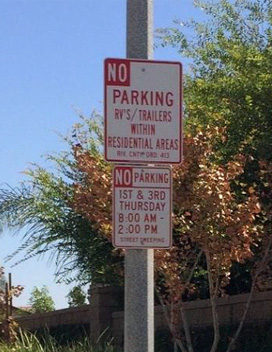
It’s that time of year – summer fun and vacations are upon us! When preparing to use your boat, RV, trailer or other recreational vehicle(s), please keep in mind of the parking standards in the City of Eastvale and pay close attention to your street sweeping schedule as posted at the main entrance to each development.

According to Municipal Code Section Sec. 120.05.080. – Neighborhood preservation standards states the following: (2)(a-c) No vehicle shall be parked upon a public street for more than 72 consecutive hours within a radius of 500 yards and shall be subject to citation and/or removal by the city as provided for in state law; No person shall construct, repair, grease, lubricate or dismantle any vehicle, or any part thereof, upon a public street, sidewalk or right-of-way, except for temporary emergency purposes; No vehicle, such as a car, truck or motorized bike, shall be parked in any landscaped area.

Effective August 20, 2015, Eastvale City Council amended the above ordinance; increasing the number of hours that a recreational vehicle can be parked on a city highway from 48 hours to 72 hours. No recreational vehicles shall be parked in any front yard area of a property. No recreational vehicle, or any part thereof, shall encroach upon a public street, sidewalk or right-of-way. Recreational vehicles shall be allowed, if they are screened behind a fence or wall of at least five feet in height and parked in a garage, side yard or rear yard. A recreational vehicle may be parked in a public right-of-way or approved parking area for a period of not more than 72 hours twice a month for the purposes of loading or unloading said vehicle.

For more information on the Neighborhood Preservation Standards and parking, please visit the Municipal Code page on the City’s website: http://www.eastvaleca.gov/city-hall/office-of-the-city-clerk/municipal-code

If you have additional Code Enforcement questions, please feel free to call the Code Enforcement Department at City Hall at (951) 361-2888 or email Code_Complaint@eastvaleca.gov. Residents can also report code violations via the E-Citizens app. For additional information please visit http://www.bitly.com/ECitizen.

Did You Know?

Time Is Truly A Complicated Matter

[ File # csp6788458, License # 1083807 ] Licensed through http://www.canstockphoto.com in accordance with the End User License Agreement (http://www.canstockphoto.com/legal.php) (c) Can Stock Photo Inc. / magann

DidYouKnow.org 

Remember how as a child you were waiting for your birthday and how it seemed to take forever to arrive? And now as an adult, the time from Monday to Sunday passes all too briefly.

How does time do that? How does time trick us?

Looking from a scientific, psychological and biological perspective, the greatest influence on how we perceive time is made by our internal rhythms, gained experiences, and memories.

Everyone perceives time differently– Five minutes seems to be a definite time limit. However, after five minutes, ask ten people how it passed for them – did it go quick or did it seem long? We can bet that each of them would have a different opinion.

Emotions and time are connected– How do you feel? Happy, depressed, horrified, fascinated, angry, or sad? When you look at the full scale of emotions, you will soon realize that time is perceived differently during each of those sensations. However, one study suggests that pleasant emotions theoretically last longer.

Researchers say that negative emotions can be adopted in different ways; especially then it comes to anxiety or tension. Meanwhile, boredom is usually distinguished by the sense that time slows or stops.

The older we become, the faster time seem to pass– Why does time appear to pass more quickly the older we get?

It is argued that as a younger person gets acquainted with the world, all that new information raises a lot of intrigue and thus, according to Scientific American, a lot of “firsts”. But as we get older, we generally lack new experiences.

Psychologist William James, in his 1890 text Principles of Psychology, wrote that as we age, time seems to speed up because adulthood is accompanied by fewer and fewer memorable events.

One study states that 20-year-olds felt time quite accurately while the persons in their 70s significantly overestimated the time (they said, that the time has passed much faster). The mentioned Scientific American article points out the following:

“How fast did the last 10 years pass for you?” yielded a tendency for the perception of the speed of time (in the last decade, anyway) to increase with age; this pattern peaked at age 50, however, and remained steady until the mid-90s.

Latest technologies changing the concept of time– A few recently done studies state that social networks and smart devices are “stealing” our time more than we think about it. We are always checking the latest news or messages, often wasting time, and we become new technologies’ hostages. In fact, a 2013 Internet Trends report by Kleiner Perkins Caufield & Byers shows that people check their phones up to 150 times a day. According to RawHide, “Every year, teens spend almost 7 full work days taking selfies.”

Stanford University psychologist Dr. Phillip Zimbardo believes that social networking is actually changing the concept of time, and how we take it.

So maybe if you are constantly online but can’t understand where the time passed, log off and enjoy your life without the blue screens.

Joan Rivers said it perfectly: “Yesterday is history, tomorrow is a mystery, today is God’s gift, that’s why we call it the present.”

Past, present, future– However, if you don’t want tomorrow to be a mystery, you should realize that every moment is now, because the past and future concepts become one. The essence lies in the fact that every event in the past and the future is and will be affected by what we do now.

As G.I. Gurdjieff explained: “In order to know the future it is necessary first to know the present in all its details, as well as to know the past. Today is what it is because yesterday was what it was. And if today is like yesterday, tomorrow will be like today. If you want tomorrow to be different you must make today different.”


Did You Know?

How Banks And Other Businesses Can  Avoid Becoming Cyber-Crime Victims

Courtesy of Gary S. Miliefskycyber-crime

In February, Bangladesh’s central bank saw $81 million disappear out a virtual window. Now it’s been revealed that, although the computer hackers used custom-made malware, they probably didn’t need to work up a cyber sweat while pulling off their long-distance theft. The bank had no firewalls to defend against intruders and its computers were linked to global-financial networks through second-hand routers that cost $10.

Apparently, the heist couldn’t have been any simpler if it had been drawn up in the lunch line at an elementary school cafeteria.

“It’s stunning that a major institution would leave itself so defenseless in this day and age when everyone should know that cyber criminals are waiting for you to let your guard down,” says Gary S. Miliefsky, CEO of SnoopWall (www.snoopwall.com), a company that specializes in cyber security.

But he says the episode can serve as a cautionary tale for other banks and any businesses that want to protect themselves against today’s cyber versions of Bonnie and Clyde.

“Most companies have some vulnerability and it doesn’t take a sophisticated attack to cause a security breach,” Miliefsky says. “Often on the hackers’ end of things, it just takes patience.”

For example, he says, a cyber criminal can gain access by sending a company an email with an attachment called a Remote Access Trojan, or RAT, that looks like a normal file. All it takes is for an unsuspecting employee to open that file and, voila, security is compromised.

That’s bad for companies, of course, but it’s also bad for consumers, whose bank account, credit card and other private information is at risk.

Miliefsky says it’s important to go on the offensive. Among his recommendations:

  • Employers need to train their staffs.Those employees sitting at their computers each day are a company’s first line of defense. An errant click on the wrong email is like unlocking the front door, so employees should be made aware of the dangers and told what do about suspicious email.
    • Companies should routinely update their defenses.Outdated technology and outdated security software make a company’s computers vulnerable to attack. It’s important that businesses periodically review their IT operations to make sure what worked last year still provides the needed security.
    • Consumers must take their own safety measures. It would be nice to expect banks and retailers to protect consumer information, but the average person can’t count on that. Miliefsky suggests consumers take personal security measures such as frequently changing passwords and deleting any phone apps they don’t use. Many apps contain malware that can spy on you.

“Most people log onto the internet every day without much thought about how susceptible they are to being hacked,” Miliefsky says. “It takes vigilance to protect yourself against cyber criminals who are working hard to figure their way around security measures.”

Did You Know?

Living with Diabetes


Courtesy of IEHP

Nearly 16 million people in the United States have diabetes. But diabetes can be treated.  With the right care and some lifestyle changes, you’ll feel better, and enjoy a long and healthy life.

What is diabetes?

When you have diabetes, your body does not have enough of the hormone “insulin”, or it is not working correctly. If you have type 1 diabetes, your body makes little or no insulin. If you have type 2 diabetes, your body is making insulin but is not able to use it.

Is there a cure?

There is no cure for diabetes, but many people with the illness can live healthy lives. Your Doctor will work closely with you to set up a plan. Here are some changes you can make to stay healthy:

  • Eat a well balanced diet
  • Exercise each day
  • Take your medicine the way your Doctor tells you
  • Keep a healthy weight
  • Check your blood sugar levels
  • See your dentist every six months, and your eye doctor yearly
  • Practice good foot and skin care

When to see your Doctor:

Whether you have diabetes or not, you should see your Doctor often. If you have diabetes, Doctor visits are important. Your Doctor will review your blood sugar levels, perform tests and check your feet.

You don’t always have to wait for regular visits. Call your Doctor if:

  • You have the flu, cold, or respiratory infection
  • You have discomfort in your hands or feet
  • You have any vision problems


Did You Know?

How Women Can Recover After Hitting Rock Bottom

Confident_Woman-WEB

Photo Courtesy: Google Images


By Brittany Thomas

Movies from the 1980s profiled the prototypical “It Girl” – pretty, blond, wealthy, who drove luxury sports cars to high school, was liked by other girls and chased by all the boys.

Jane Zarse was that girl, and the persona continued into the ’90s, when she eventually graduated Boston University on the dean’s list and began acting in New York City and in Hollywood films.

That’s what nearly every young woman wants, right? Unfortunately for Zarse, it was a parallel image of her true self, she says. All the while, she’d been devolving into alcoholism and other self-abuses.

“My folks did very well and thought they were doing all the right things for their kids, but we never – never – spoke about our problems,” says Zarse, author of Love and Compassion Is My Religion.

“It was more important to keep up appearances, especially how we appeared to ourselves. After punishing myself with substance abuse, doomed relationships and more, I’d finally hit rock bottom.”

It’s the life story for countless Americans. For Zarse, a non-romantic relationship opened her eyes, aiding her to a robust recovery and a new way of experiencing spirituality. She offers insights for those who need help recovering after hitting rock bottom.

  • You can’t change or improve what you don’t acknowledge. Spirituality includes more than mental abstractions; it’s about applying transcendent insights into everyday life. Admitting problems, for instance, means transcending the powerful forces of pride, habit, complacency, etc. Hitting rock bottom forces you to see what you’ve been hiding for so long – that ugly, desperately addicted side of yourself.
    • Don’t fall for a false sense of control. When alcohol, serial dating and unsuccessful job prospects gave Zarse the sense that her life was spinning out of control, she developed an eating disorder. It gave her a false sense of security via an unhealthy expression of discipline. While recovering from rock bottom, such temptations may occur. If so, be honest that you may be grasping, once again, at something unsustainable.
    • Successful relationships require kindness and respect. As the “It Girl,” Zarse received plenty of attention from men. If she wanted a relationship, she was able to find herself in one quickly. But an entitled mentality, coupled with substance abuse, fostered toxicity in her first marriage. You get back what you put into relationships.

“I remember thinking: What’s the point of quitting drinking? – I’ll still be thinking about it constantly,” Zarse says. “If you find yourself with similar thoughts, it may be time seek help. Remember, that help may come in unexpected people.”

Did You Know?

Things That Are Often Missed In Financial Planning

By Brittany ThomasFinancial_Planning_Small

Our relationship with money can be complicated, and it’s for this reason many people seek professional help.

But even when we get help, there are still important aspects that can be overlooked, says Brett King, the managing/founding partner and Senior Vice President Investments for Elite Financial Associates (www.elitefinancialassociates.com). “The wrong way to look at service from a financial advisor is the ‘handing it off’ mentality – that you can put your financial destiny in their hands and not have to think about it anymore,” he says.

“A better attitude is similar to what you might have between your health and your doctor, where your participation is required. Part of that means better understanding your personal wealth by furthering your financial literacy.”

King says some of the important aspects to financial planning that might be missing from your financial wellbeing include:

  • A reliable relationship with your money manager. While you have a duty to yourself to understand your own wealth and subsequent goals, so do your money managers. Only recently has the Labor Department issued regulations requiring financial advisers and brokers handling individual retirement and 401(k) accounts to act in the best interests of their clients. You’ll want someone you feel comfortable communicating with, and who makes themselves available.
    • Accounting for inflation. Inflation erodes the purchasing power of your income and wealth. But you can fight it. Stocks, stock mutual funds, variable annuities and variable universal life insurance may be options to consider. These alternatives provide the potential for returns that exceed inflation over the long term. Growth-oriented alternatives carry more risk than other types of investments. Over the long term, however, they may help you stave off the effects of inflation and realize your financial goals. Remember to diversify investments.
    • Utilization of the right annuity. Annuities enable you to accumulate payments, tax-deferred, in exchange for a future income stream in retirement. The different types include fixed, immediate fixed, deferred fixed, variable and the hybrid fixed index annuity – the fastest-growing type of annuity providing principal guarantees and market index upside return. How you use them can make a big difference in reaching your financial goals. If you’re working with a sizeable retirement plan, you probably have some form of annuity, but you want to make sure it’s the right fit.

“Between estates and trusts, tax planning, cash management, risk management, investing and retirement, there could literally be dozens of important factors you’re missing,” King says. “That’s why it all starts with the money managers – you and your advisor.”

Did YOU Know?

City of Eastvale

Garage Sales and SignageGarage Sale-BW

According to Municipal Code Section 6.28.060. Garage Sale Signs states the following: (a) No sign advertising a garage sale shall be posted, erected or maintained except on the premises where such sale is to be held. No more than one unlighted sign advertising a garage sale may be posted, erected or maintained on the premises where such sale is to be held; provided, however, that no such sign may be posted, erected or maintained on the public right-of-way. Any such sign posted, erected or maintained on the public right-of-way may be immediately and without notice removed by the city or designee. The city or designee may thereafter bill the responsible party for the reasonable costs of such removal.

In addition, Section 6.28.060. (b) states that each such sign shall be removed at or before the close of the last day on which the garage sale may be lawfully conducted.

Municipal Code Section 6.28.040 which governs the frequency and time of garage/yard sales states that no person, firm, association or corporation shall conduct more than three garage sales during any period of 12 consecutive months, nor shall more than three garage sales be conducted upon any lot or parcel of land during any period of 12 consecutive months. No garage sale shall be conducted between the hours of 8:00 p.m. to 8:00 a.m. or be conducted for longer than three consecutive days.

For more information on the Garage Sales, please visit the Municipal Code page on the City’s website: www.eastvaleca.gov/index.aspx?page=170

If you have additional Code Enforcement questions, please feel free
to call Eastvale City Hall at (951) 361-0900 or email Code_Complaint@eastvaleca.gov

Garage Sign Map-BW

Did You Know?

Women and Blood Clots: Know the Risk FactorsWomen-BW

By StatePoint

Blood clots are dangerous. About 100,000 Americans die annually due to blood clots, which is more than those who die from AIDS, breast cancer, and automobile accidents combined. Women have different risk factors than men.

Pregnancy hormones, such as estrogen, cause women’s’ bodies to produce extra clotting factor proteins, making pregnancy a major risk factor for life-threatening blood clots. Similarly, any birth control method or menopause therapy containing estrogen can pose a blood clot risk.

To reduce risk, the National Blood Clot Alliance (NBCA) offers these tips:

  • If you’re pregnant, ask your doctor about your blood clot risk to determine if you need to be on blood thinning medication.
  • If taking birth control, consider methods not associated with pregnancy hormones, including barrier methods, copper IUD and progestin-only pills, IUDs and implants.
  • When managing menopause symptoms, consider non-estrogen and natural treatments that don’t carry blood clot risks.

NBCA’s experts urge women to know the signs of blood clots, which include swelling and pain in limbs, shortness of breath, chest pain and coughing up blood.

To learn more, visit WomenAndBloodClots.org.

Reducing your risk for blood clots is crucial, particularly when it comes to choices connected to pregnancy, family planning and menopause treatment.


Did You Know?

4 Alternative Ways To Heal ADD

By Brittany Thomas

A visit to the school nurse is a daily ritual for a growing number of American students who take a pill to calm their hyperactivity or to help them concentrate.

If that’s surprising, it shouldn’t be. The number of cases of attention deficit disorder (ADD), also called attention-deficit/hyperactivity disorder (ADHD), is on the rise among children and teenagers, up 43 percent over an eight-year period, according to a recently published study by the Milken Institute School of Public Health at George Washington University. Today, roughly 12 percent of children and teens have the diagnosis.

But medication isn’t the only alternative for treating ADD. Focusing on natural treatments and the individual ADHD type can produce great results, says Daniel Amen, MD, a clinical neuroscientist and brain imaging expert who also is the Founder of Amen Clinics (www.amenclinics.com), which treat patients at six locations around the country.

“Through our work with over 20,000 ADD patients over the last three decades, using a powerful brain-imaging tool called SPECT (single photon emission computed tomography), we discovered that ADD is not a single or simple disorder; there are seven different types,” says Amen, author of numerous books, including “Healing ADD” and “Change Your Brain, Change Your Life.”

“In addition, many natural treatments can help all the ADD types.  I always prefer to start with the least toxic, most effective treatment,” said Amen.

That doesn’t mean medication is never right, he says. “For some children, medication is the best option,” Amen says. “But whether they are on medication or not, there are several lifestyle changes that can help all types.”

He suggests parents consider these four non-medical interventions:

  • Nutrition. The right diet can have an impact. Amen says parents should try putting their children on a high protein, low carbohydrate diet that is relatively high in healthy fat. The reason: Such a diet has a stabilizing effect on blood sugar levels and helps with both energy level and concentration.
  • Exercise. Parents need to make sure their children aren’t just sitting around watching TV. Exercise increases blood flow to all parts of the body, the brain included. That, of course, is particularly beneficial to people with ADD. Exercise also increases the availability of serotonin in the brain, helping to calm hyperactivity.
  • Meditation. Parents should teach their children how to meditate because research shows that meditation can calm stress and enhance brain function. Help them find a quiet spot where they can sit comfortably, Amen says, then tell them to gently close their eyes and focus on their breathing. He suggests starting with just a few minutes and working up to 10, 15 or 20 minutes.
  • Neurofeedback. This is a specialized treatment that uses computer technology to balance and optimize the brain. During each session, patients play a video game using just their brain. Amen says it’s both fun for the child, and also helps strengthen their brains “to a healthier, more focused state.”

“Parents shouldn’t automatically discount medication as a way to treat children with ADD,” Amen says. “But they also need to be mindful that medication isn’t their only option.”

Did You Know?

Can you drive blindfolded? 

Staff Reports
Is distracted driving really a problem? YES! 80 percent of vehicle crashes involve some sort of driver inattention. Up to 3000 people nationwide are killed in crashes where driver distractions are involved, and thousands more are injured.

Distraction occurs any time you take your eyes off the road, your hands off the wheel, and your mind off your primary task: driving safely. Any non-driving activity you engage in is a potential distraction and increases your risk of crashing.

According to the CHP, sending or reading a text takes your eyes off the road for 5 seconds. At 55 mph, that’s like driving the length of an entire football field, blindfolded. Texting is the most alarming distraction because it involves manual, visual, and cognitive distraction simultaneously.

Some people still don’t know how dangerous distracted driving is. Others know about the risks of texting and talking while driving, but still choose to do so anyway. They make the mistake of thinking the statistics don’t apply to them, that they can defy the odds. Still others simply lead busy, stressful lives and use cell phones and smartphones to stay connected with their families, friends, and workplaces. They forget or choose not to shut these devices off when they get behind the wheel.

In 2008, California motorists were prohibited from talking on hand-held cellular phones while driving. A ban on texting while driving followed in 2009.  According to the California Department of Motor Vehicles, all text-based communication, including e-mail and instant messaging, reading, writing or sending a text message are prohibited.  Both offenses carry $20 fines for first offenses and subsequent infractions are $50.  Be aware that additional fees and additional penalties can end up tripling the total fee amount. The convictions will appear on your driving record.  The law pertains to all drivers, regardless of age or state of residence.

There are special rules for young drivers, under the age of 18.  These new drivers are not allowed to use a wireless telephone, pager, laptop or any other electronic mobile device to speak or text while driving; this applies even if they intend on using a hands-free headset. The only exception to this new rule is in emergency situations to call police, fire or medical authorities.

The California Highway Patrol wants to remind you don’t become a statistic. Distracted driving is 100% preventable.