Vejar Elementary to celebrate 50 golden years


Photo Courtesy of WVUSD

Photo Courtesy of WVUSD
Vejar Elementary students and staff gather for a 50th anniversary aerial photo.

WALNUT—Vejar Elementary School, home of the Vaqueros in the City of Walnut, will mark its 50th anniversary during an Open House on March 24 from 5-8p.m.

Community members, former students, and staff members are invited to attend.

Students have been celebrating the milestone by completing acts of kindness throughout the community, including picking up grocery carts at the local Vons parking lot.

Vejar is looking for stories and memorabilia from the past five decades.  Please contact Yadira Gostel to RSVP or share your Vejar memories at (909) 594-1434 ext. 3.


Why A Bad Night’s Sleep Makes It Harder To Focus

By Robert Rosenberg, D.O./Everyday Health


You know how your brain acts when you’re tired: it’s hard to remember things and your thoughts are sluggish. Sleep deprivation strongly impairs memory and learning, and research confirms this (though the actual mechanism causing these deficits has escaped detection). However, a recent study done on persons with sleep apnea may provide some much-needed answers as to why.

The researchers from the University of California, San Diego, checked 55 sleep apnea patients’ blood cortisol levels every two hours for 24 hours. The patients underwent sleep studies the following night and then took a battery of tests to assess cognitive function. The researchers looked to see how many times they stopped breathing, and how often their oxygen levels dropped in response to airway obstruction.

Previous research has assumed that sleep-related memory problems are caused by a drop in oxygen. But this study found that it was elevated cortisol levels that best predicted cognitive dysfunction.

The results are in line with previous studies that have demonstrated chronic exposure to elevated cortisol levels can result in impaired cognitive function. In fact, prior studies have revealed adverse effects of elevated cortisol on the brain’s hippocampus. The hippocampus is a structure that resides in the temporal lobe of the brain. It is intimately involved in acquiring information and consolidating that information into long-term memory.

Why is this important? It may explain why sleep-deprived individuals frequently exhibit poor memory and concentration abilities. We know that insomnia sufferers and those who chronically get inadequate sleep because of life style choices, have elevated levels of stress hormones such as cortisol. These folks do not have sleep apnea or low nighttime oxygen levels, yet they frequently exhibit cognitive dysfunction similar to patients with sleep apnea. Perhaps what they have in common is elevated levels of the hormone cortisol.

It is plausible that overstimulation of the adrenal gland produces the excess cortisol. The common thread is stress, produced by either insufficient sleep, or in the case of sleep apnea, fragmented sleep. Measuring cortisol levels in patients with sleep apnea and insufficient sleep may provide an important diagnostic tool. I am hopeful that this might serve as a motivator to convince people of the importance of good quality sleep. If it worked, a simple lab test may convince people to take their sleep and sleep disorders seriously. I am aware that much of this is still speculative. However, if future studies related to sleep continue to demonstrate this relationship, the possibilities are exciting.

Diamond Bar City Council Recap

By Natalie Kim

Diamond Bar– The February 16 Diamond Bar City Council meeting began with an announcement from a representative from the Diamond Bar Public Library. The representative announced two upcoming events that will be held at the library, including a Chinese Calligraphy workshop on February 23 from 3-4 p.m., and an event for Black History Month, on February 20, from 2-3 p.m. that will feature an African drum circle.

Following the public comments, the schedule of future events was read.  The schedule includes: the Third Annual Bridal Show on February 21 from 11 a.m. to 3 p.m. at the Diamond Bar Center on 1600 Grand Avenue; the next Planning Commission meeting on February 23 at 7 p.m. at 21810 Copley Drive; the next Parks and Recreation Commission meeting on February 25 at 7 p.m. at 21810 Copley Drive; and the next City Council meeting on March 1 at 6:30 p.m. at 21810 Copley Drive.

The Council then approved the City Council minutes from the meeting of February 2; the Parks and Recreation Commission minutes from the meetings of October 22 and November 19; the ratification of a check register totaling $1,015,874.50; appropriation of $137,747 of Prop A funds to the 2015/16 fiscal year CIP budget; a resolution approving plans and specifications and establishing a project payment amount and a construction contract award for the traffic signal infrastructure upgrades project to Elecnor Belco Electric Inc; and approval of contract amendment with David Evans and Associates Inc. to provide landscape plan checking services for three fiscal years with an option for two one-year extensions. Two items were tabled until the March 1 Council meeting.

The Council then adopted a resolution amending the 2015-16 fiscal year municipal budget, and confirmed Council appointments to the Parks and Recreation Commission, the Planning Commission, and the Traffic and Transportation Commission.

The meeting adjourned with plans to meet again on March 1 at 6:30 p.m. at 21810 Copley Dr.

Did You Know?

Courtesy of UCR

Courtesy of UCR

Earthquake Preparedness

By Carol Heyen

According to the Riverside County Fire Department, a damaging earthquake strikes somewhere in California approximately every two years. Many large quakes have hit Southern California, including the Northridge earthquake in 1994, the Big Bear and Landers earthquakes in 1992 and the Sylmar earthquake in 1971.

Scientists agree that another big quake is on the horizon for Southern California.  It is just a matter of time until a large quake hits either the San Andreas Fault or one of the numerous faults that crisscross the Southland.

What can you do to keep your family safe?

  • First, identify places in your home and office that are likely to be safe havens in a quake. Find strong furniture under which you can be protected while riding out the shaking.  Identify items that are not strongly secured and are likely to fall or fly if strong shaking starts, and make sure to secure them.  These can include electronics, small kitchen appliances, mirrors and picture frames, and objects on open shelves, including bookcases.
  • Make sure to keep a flashlight and shoes next to your bed. Buy fire extinguishers for each level of your home.  Secure your water heater, know where your utility shut-offs are and make sure you have the proper tools to shut off your gas and/or water in an emergency.  Connect with your neighbors and see who may have special skills and resources to help out if a large quake hits.
  • Keep an emergency kit and extra food and water in your home and in your cars. Make sure you have enough food and water for you and your pets for a minimum of three days; ideally, this stockpile will be enough for two weeks.  Portable radios, sleeping bags, tents, camping-type cookstoves and utensils, tarps, protective goggles, extra flashlights, extra toiletries and emergency cash (in small bills) is all good to add to your kits.
  • Set up a post-disaster meeting spot for yourself and your family. It is imperative that your family members know how to contact each other after a large quake.  Figure out a plan that will help your family get a hold of each other should cell phones and landlines not work.  For help on this, visit ready.gov/make-a-plan.
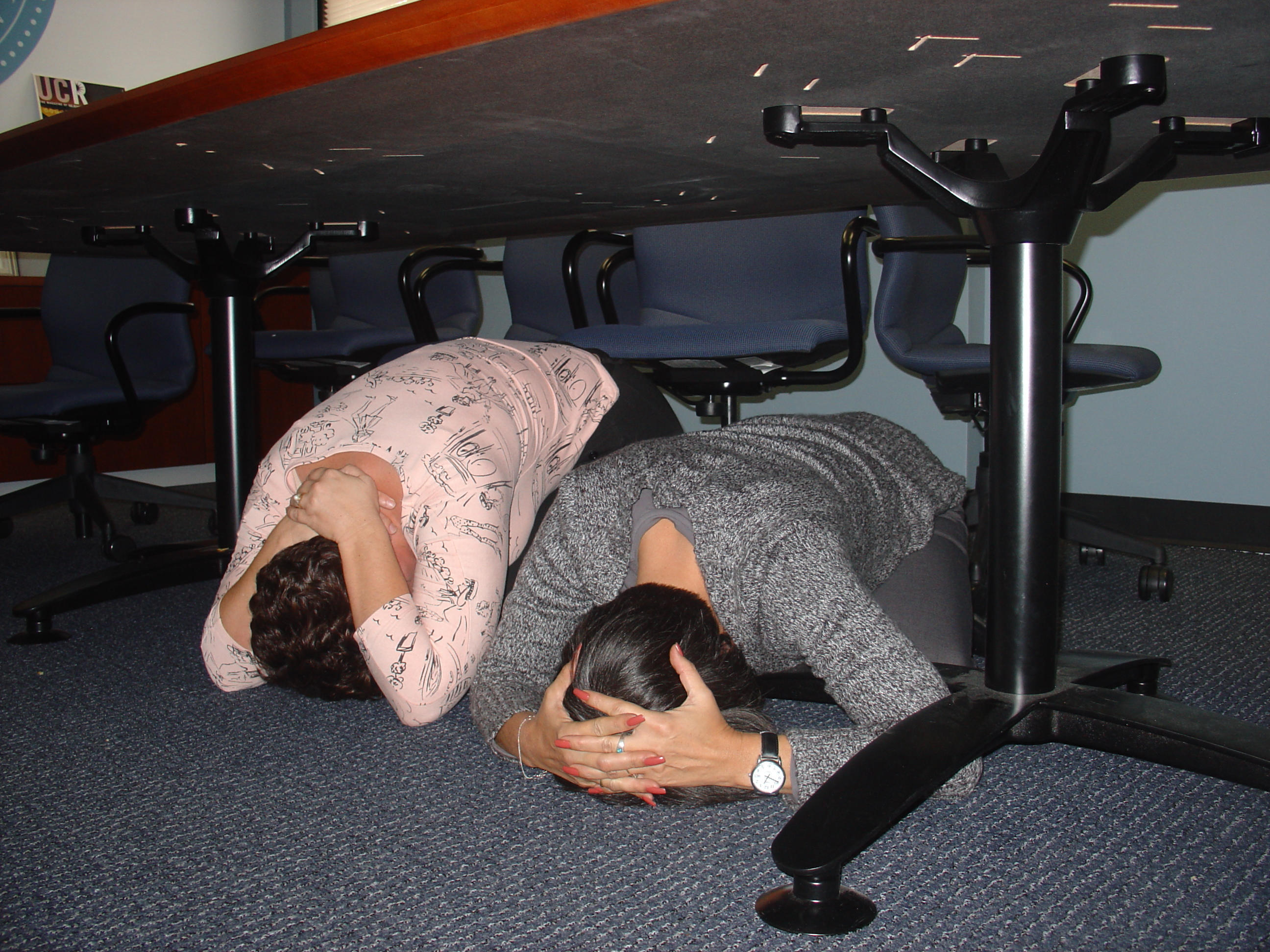
  • Practice Drop, Cover and Hold On. Drop to your knees before you are knocked down by the force of the quake.  Cover your head and neck to protect yourself from falling debris.  Hold on to whatever sturdy covering you have found to hide under.   Stay away from windows and glass objects that can shatter.  Research shows that the doorways of modern homes are no safer than the rest of the house, so make sure to find shelter under a table or against a wall.

After the quake is over, make sure to be alert for aftershocks, which can be as strong as the main quake.  Listen for news reports via radio, TV, social media, or smart phone.  If you are trapped, do not kick up dust so you can keep your air pocket clean. Use a whistle or tap a pipe or wall so that rescuers can locate you.   Get to your pre-determined family meeting spot.

Although we cannot stop an oncoming earthquake, we can do our best to keep ourselves and our families safe.  If you would like more information on how to survive an earthquake, visit www.redcross.org/prepare/disaster/earthquake, www.ready.gov/earthquakes, or earthquake.usgs.gov/learn/preparedness.php.


Man Arrested for Workers’ Comp Fraud

Staff Reports

San Bernardino County – A Fontana man was arrested on insurance fraud charges earlier this month following an investigation conducted by the San Bernardino County District Attorney’s Workers’ Compensation Insurance Fraud Unit.
Jamie Gallardo, 45, is charged with a violation of workers’ compensation insurance fraud. Gallardo was employed at California Coach & Body located in Walnut, Calif. on or about April 21, 2010 through April 19, 2014. During this time, Gallardo filed a workers’ compensation claim alleging he sustained injuries to his chest and back while performing his job duties.
According to D.A. investigators, an investigation into possible fraud resulted in the current allegation that Gallardo presented a knowingly false or fraudulent statement in order to obtain Workers’ Compensation benefits.
After obtaining an arrest warrant, investigators–with the assistance of officers from the Fontana Police Department–arrested Gallardo at his place of residence Feb. 2. Gallardo was transported and booked into the West Valley Detention Center. If convicted, Gallardo faces five years County prison. Arraignment is scheduled for March 24 in the Rancho Cucamonga Courthouse.

Suzanne’s Robotics Leading The Pack

Photo courtesy of WVUSD

Photo courtesy of WVUSD
Suzanne Middle School 6th grade student Wolf Corps team members demonstrate award-winning can crusher robot.

By Kelli Gile 


Walnut– A new robotics club at Suzanne Middle School dominated a First Lego League (FLL) competition aimed at finding solutions to global environmental issues.

Two teams of sixth grade programmers vied in separate divisions while focusing on this year’s FLL theme – Trash Trek.  Students were challenged to explore the world of trash, from collection, to sorting, to smart production, and reuse, and then invent a solution to help our trash problem.

The Suzanne teams won coveted championship awards during the recent 2016 California FLL Cup challenge at Legoland in Carlsbad on January 24.  They also took numerous 1st place awards at tournaments throughout Los Angeles.

“We like having fun together and encouraging people to get involved in STEM education,” said Kaden Salvador about his enthusiasm for robotics.  “We want to show them how cool it is!”

Every Tuesday and Thursday, the 14 students meet after school to build and program the little bots using Lego Mindstorm EV3 kits and refine their presentations.

Robotics encompasses all aspects of STEM education, according to teacher advisor Vicky Silcock.  “Not only must students learn to engineer and program a robot that will accomplish the task before them, but they also need to learn to do research and use teamwork to explain real world applications.”

Wolf Corps team members designed an automatic can crusher called the “BEATit” that compacts, counts the collected cans, and calculates a payout.

“We came up with the idea after our school held a pop top drive,” explained Gordon Lau. “This is the first can crusher designed for households.”

The robot bin opens using an ultrasonic sensor and motor, while two additional motors crush the can and drop it into a bottom bin.  Students believe their innovative product will encourage families to earn extra money from recycling (five cents a can), reduce landfill size, and save energy consumption.

“We work together like a pack of wolves!” said Wolf Corp member Kawin Watkins.

The Wolf Corp team was invited to represent the Los Angeles Region at the Razorback Invitational Tournament after their 1st place FLL performance.

The RoboHeroes team built a robot that completes recycling missions during a building demolition and salvage challenge.  During a tabletop demonstration, students expertly explained each step before sending their robot through the course brimming with trash reduction and recycling components  – landfill, methane energy, re-use of toy packaging, and trash sorting.

The team programmed their sturdy robot to move forward, backward, turn, pick up and drop off pieces, and then return to base.

“It was fun finding a design for our robot,” said Marcus Robles. “We started from scratch to make something new!”

“There’s a lot of trial and error in programming,” added Matthew Carreon, age 12. “We must have run the program over 100 times.”

Students must demonstrate how well they practice the FLL Core Values of teamwork and friendly competition during matches.  Along with participating in robotics competitions, the teams share their environmental plans with several community groups and local businesses.

The group of students began participating in robotics competitions during the 4th grade at Collegewood Elementary with Wolf Corp parent coaches Scott and Leh Watkins.

“I think the biggest benefits for students is collaborating and working as a team,” said coach Scott Watkins.

“The kids come up with a solution for real world programs. This year is trash reduction and recycling,” said RoboHeroes parent coach Jonathan Fong.

“We all hope to continue through middle school and into high school,” Watkins added.

Collegewood Completes 612 Acts of Kindness

Photo courtesy: WVUSD

Photo courtesy: WVUSD
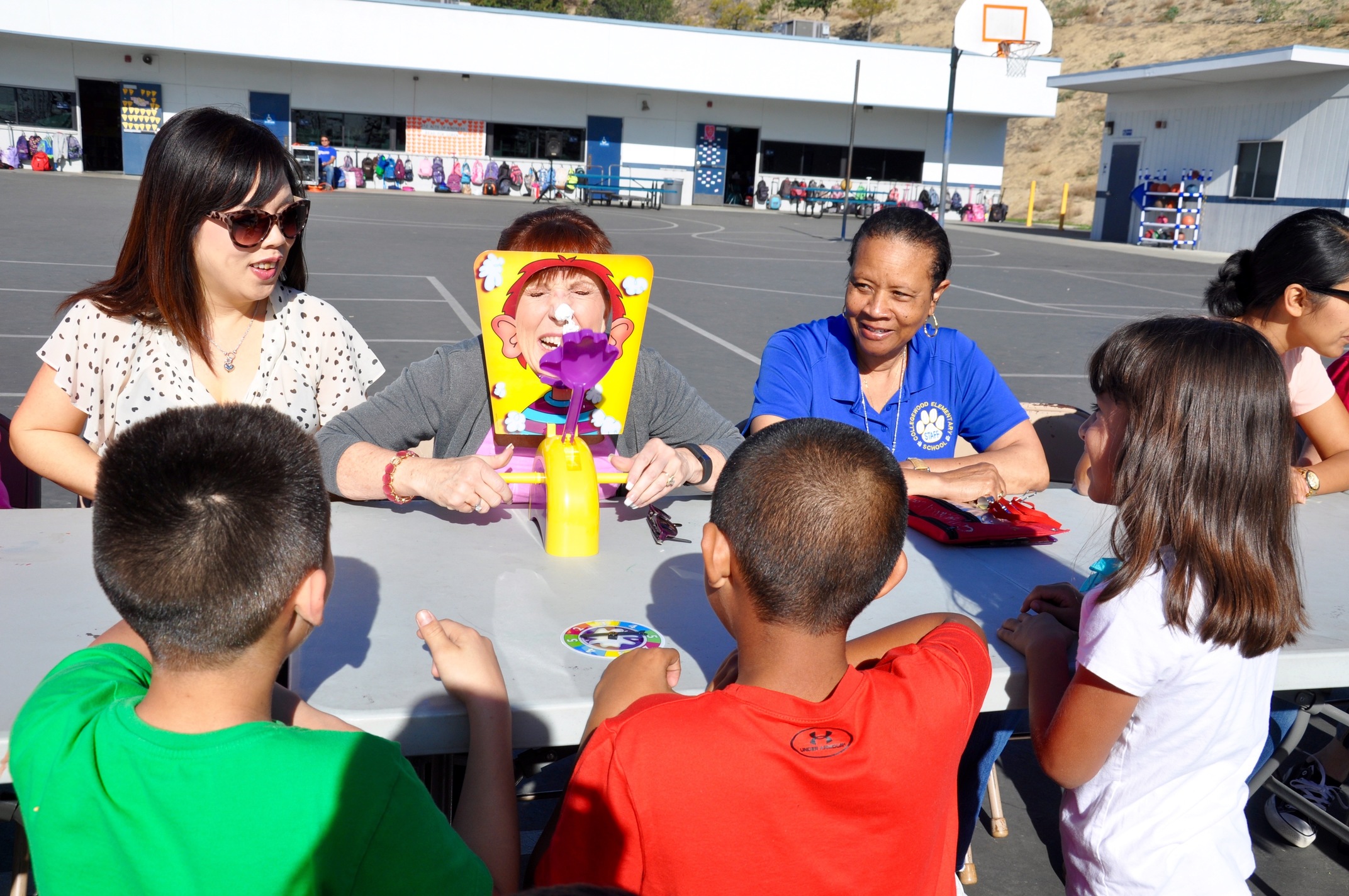
Teachers took turns playing a pie in the face game as a treat for students.

By Kelli Gile

WALNUT, CA—Collegewood Elementary showed support for second grader Coben Swanson with 612 acts of kindness during a read-a-thon at the school on February 12.

The school quickly rallied when the eight-year-old was diagnosed with leukemia in November, sending get-well video messages and fundraising to help the family with expenses.

All 612 students and staff members came together once again during a special reading time held on the upper playground.  With towels and blankets spread out on the grass, the children and their teachers opened favorite books and quietly read for about 20 minutes.

The event was the culmination of a two-week reading challenge where students were encouraged to read daily, log minutes, and collect pledges. All donations will benefit the Swanson family.

“He’s our friend and needs our help”, said Kaitlyn Tran. “We’re donating money to help his family. We miss him!”

“Coben’s going through a hard time and we should support him no matter what,” added fifth grader Cassidy Ng.

Afterward, teachers surprised the group with a pie in the face game.  The children crowded around to watch their teachers get doused with whipped cream after taking turns spinning the wheel on the tabletop game.

“Acts of kindness instill empathy and teach children the value of living a life of giving,” said teacher Jane Dyer-Smith.

Eastvale: Car Crashes into Home

By Carol Heyen

EASTVALE– The Espinoza family of Eastvale has been forced out of their home after a car crashed through a cement wall, into the back yard of their house and into their living room.

Just after 2 a.m. on Monday, February 23, the fire department was advised of a car that had crashed into the first floor of a home in the 13800 block of Dellbrook Street, in the Brookdale Place housing development.  A fire official at the scene said that the crash caused the car to burst into flames, which set the house on fire.  Firefighters were able to put the fire out within 20 minutes.

A resident of the home, Hunter Espinoza, said it sounded “like a bomb.”

“I was in shock for a little bit,” said Freddy Espinoza, Hunter’s father, who alerted the rest of his family members. “I went ‘there’s a car here and I think it’s going to catch fire.’ I told the people ‘get up, get out of the house.’ ”

One occupant of the home had minor injuries, and all five residents have been displaced so that repairs can be done.   The American Red Cross was called to help the family find shelter.

The two occupants of the Saturn sedan fled the scene, and the cause of the collision is still under investigation.

Anyone with information about the incident was encouraged to call the Eastvale Police Department, which is serviced by the Jurupa Valley Sheriff’s Station, at 951-955-2600.

CHH Places in Top Five of County Academic Decathlon

Photo Courtesy of CVUSD

Photo Courtesy of CVUSD
Members of the Chino Hills Academic Decathlon team with County Superintendent of Schools Ted Alejandre (center).

Courtesy of CVUSD

CHINO HILLS-Chino Hills High’s Academic Decathlon team was among the top five teams in the San Bernardino County Academic Decathlon held in late January and early February in the San Bernardino and Redlands area.

The event featured 39 teams representing 21 high schools, competing in 10 subject areas. Each team included a mix of students with A, B and C grade point averages.

Chaffey High School was the top winner of the academic challenge for the fifth straight time.
Others in the top five were Redlands High, Rancho Cucamonga High, and Redlands East Valley High.
 

Stroke Awareness

Staff Reports

According to the CDC, every 40 seconds someone in the United States has a stroke.  In 2008 alone, more than 133,000 Americans died from a stroke, which equates to one person every four minutes-making it the fourth leading cause of death in the United States.  Strokes can affect people of all ages and backgrounds.

Strokes are sometimes called brain attacks.  Strokes happen when a blockage stops the flow of blood to the brain or when a blood vessel in or around the brain bursts. There are two main types of strokes: ischemic and hemorraghic.  Ischemic strokes are caused by blood clots and hemorraghic strokes are caused by bleeds.  The American Heart Association says that ischemic strokes account for 87 percent of all strokes and are usually caused by uncontrolled high blood pressure.

You can lower your risk for stroke, regardless of your background.  Family history, age, sex and ethnicity all play a role in an individual’s stroke risk, but there are still things you can do to help keep yourself healthy.  One of the best preventative measures is to not smoke cigarettes.  Cigarette smoking and exposure to second-hand smoke can thicken the blood and make it more likely to clot, according to the CDC.  Thicker blood flow can lead to increased plaque buildup in your arteries and can damage the blood vessels leading to the brain.
Controlling your blood pressure is also extremely important.  High blood pressure, also called hypertension, increases your risk of stroke and heart attack by weakening and thinning blood vessels, making them more prone to rupture.  More than half of the world’s stroke deaths are caused by elevated blood pressure levels.

Some other proactive measures that you can take to help lower your stroke risk include exercising regularly, eating a healthy diet low in sodium, maintaining a healthy weight and preventing or controlling diabetes.

Stroke.org says there are several treatment options for stroke, depending on the cause of your stroke.  If you are having an ischemic stroke or a stroke that is caused by a blood clot, your doctor may recommend drug treatment that will help dissolve the clot and improve blood flow to your brain.  Another way your doctor may treat your stroke is to use a small mechanical device that removes or breaks-up the clot.  A surgeon will insert the device into the blocked artery using a thin tube. Once inside, the tool traps the clot, and either breaks it up or the surgeon pulls it out of the brain, reopening the blocked blood vessel in the process.

A hemorrhagic stroke (sometimes called a bleed) occurs if an artery in your brain leaks blood or ruptures (breaks open). The first steps in treating a hemorrhagic stroke are to find the cause of bleeding in the brain and then control it. Some of the options for treatments include surgical clips or coils inserted in aneurisms (weaknesses in the blood vessel wall), controlling high blood pressure, and surgery to remove the bleeding vessel and blood that has spilled into the brain.

Medical advances have greatly improved survival rates and recovery from stroke during the last decade. Your chances of survival and recovery outcomes are even better if the stroke is identified and treated immediately.

If you think you are having a stroke, every minute counts. The sooner a patient receives medical treatment, the lower the risk for death or disability. If you or someone you know exhibits the following signs or symptoms, call 9-1-1 immediately:

  • Numbness or weakness of the face, arm, or leg, especially on one side of the body.
  • Confusion, trouble speaking, or difficulty understanding.
  • Trouble seeing in one or both eyes.
  • Trouble walking, dizziness, or loss of balance and coordination.
  • Severe headache with no known cause.
  • Remember, getting immediate medical attention for stroke is crucial to preventing disability and death.

Straight Talk With Danice

Danice Akiyoshi

Danice Akiyoshi

A Concerned Cousin

By Danice Akiyoshi, N.D.


Dear Dr. Akiyoshi:

My cousin was recently complaining about how awful she’s been feeling and how her weight has reached an unacceptable range.  We were having this chat when we met for drinks at my house.  After we had a glass of wine, she stepped out on my patio and smoked a cigarette.  When I said, “I thought you quit,” her response was, “I don’t smoke all week, only when I have drinks and on the weekends.”  I didn’t say anything further and we moved on to our favorite late night diner where she ordered a healthy meal, but asked me if I want to split a short stack of pancakes with her.  I declined, and mentioned our earlier conversation about her complaints about her weight and feeling awful.  I was caught by surprise when she threw her napkin on the table, stood up, and said, “I don’t need a mother,” and headed for the door.  I drove, so I knew she couldn’t leave without me.  I hustled to pay our bill and drove back to my house.  She went directly to her car and hasn’t returned my calls for five days.  Now I don’t know how I should handle this.  Was I wrong to point out her concerns?  I am miserable.  I probably should have stayed silent. What’s your advice?

-Frannie


Dear Frannie:

Unfortunately you got caught up in the, “I can put myself down, but you’d better not,” situation.  I have been in your shoes many times.  I also learned the hard way.  The way I currently handle situations like this is to ask my friend, “Are you just hoping to vent to a friend in order to feel better as you sort through your own thoughts and feelings, or do you prefer that I listen for awhile and then offer some sensible and sound advice?”  Then I smile and say, “It’s your call, I can go either way.”  This way, you’ll know exactly how to manage the conversation.  I do give you credit for trying to calm the situation, but your cousin is obviously emotionally immature.  You’ve been a decent person, made the proper phone calls to apologize and she hasn’t responded.  Your work is done here.  Get back to your own life now.  The ball is in her court.

Danice Akiyoshi is a Naturopathic Doctor and the head of Candid Coaching Service. She offers personal coaching services relating to all types of issues and concerns. This is a letter she received from an anonymous reader. To send a question to Danice, email her at straighttalk@candidcoachingservices.com. You can also visit her website at http://www.candidcoachingservices.com.

Four Arrested in Diamond Bar Burglary

Staff Reports
Diamond Bar– On Wednesday, February 10, Pomona Police Department officers observed a white 2007 Toyota Camry being driven in to the American Inn Motel parking lot at 310 East Foothill Boulevard.  Officers ran the license plate and found that the car had been reported stolen out of Diamond Bar, during a residential burglary.  The lone driver was arrested for Grand Theft Auto.  Investigators then found three more suspects in a motel room, along with stolen property from the Diamond Bar home burglary. Officers were able to recover and return multiple stolen items.

Four suspects were arrested:  Daniel Torres, 23, of Pomona; Deserie Villa, 38, of Pomona, Victoria Ahedd, 19, of Pomona and a 17-year-old juvenile.

Anyone with information regarding this incident is encouraged to contact the Pomona Police Department at 909-620-2085. If you prefer to provide information anonymously, you may call “Crime Stoppers” at 1-800-222-TIPS (8477).

Pruners Garden Restoration

Pruners_logo-WEBThe common sense alternative to California gardening


Staff Reports

It’s no secret that we are long into an historic drought for the state of California.  Water departments are encouraging lawns to turn to “California Gold,” and landscapes and curb-appeal overall are suffering.  You can even be fined if you water more that your allotment just to keep a little green in your yard.

Is there anything you can do to keep a beautiful yard and comply with recent drought regulations?  Yes, says Pruners!  It is much easier than you think.

By removing thirsty lawns, and installing synthetic sod, artistic gravel or rocks and planting vegetation that requires less water are all options that can lower your water bill and still show off an enviable garden.  Drought-friendly landscaping can even support a possible rebate from your local water department.

Achieving a common sense alternative to California gardening is easy, especially if you work with a professional in the field who loves his work.

David Hetland, owner of Pruners, is a licensed landscape artist who designs individual gardens.  He opened his full-service design landscape contracting business in 1997.  The difference between Pruners and other garden places is that Hetland specializes in garden restoration.

“We’re different because of the restoration side of gardening,” Hetland says. “I work with the idea of being able to save some of what’s good and take out what’s bad.”

Hetland, who has been landscaping for over 25 years, offers a free, brief consultation to analyze damages, estimate costs and arrange your fix.

Through restoration, your garden can be added on to, brought back to life, or simply be used to build a brand new garden.

Hetland works closely with clients, on a one-on-one basis, and is able to finish the work at one time, so there are no monthly fees.

Summer is almost upon us.  Rather than be disappointed with a thirsty, lack-luster yard, call Pruners to discover the beauty of an ecologically transformed landscape.

All Pruners today at (909) 468-5017, and see their ad in the Weekly News.

History 101

Photo courtesy of Google Images

Photo courtesy of Google Images

The First Mardi Gras Celebration

Courtesy of History.com


On February 27, 1827, a group of masked and costumed students danced through the streets of New Orleans, Louisiana, marking the beginning of the city’s famous Mardi Gras celebrations.

The celebration of Carnival–or the weeks between Twelfth Night on January 6 and Ash Wednesday, the beginning of the Christian period of Lent–spread from Rome across Europe and later to the Americas. Nowhere in the United States is Carnival celebrated as grandly as in New Orleans, famous for its over-the-top parades and parties for Mardi Gras (or Fat Tuesday), the last day of the Carnival season.

Though early French settlers brought the tradition of Mardi Gras to Louisiana at the end of the 17th century, Spanish governors of the province later banned the celebrations. After Louisiana became part of the United States in 1803, New Orleanians managed to convince the city council to lift the ban on wearing masks and partying in the streets. The city’s new Mardi Gras tradition began in 1827 when the group of students, inspired by their experiences studying in Paris, donned masks and jester costumes and staged their own Fat Tuesday festivities.

The parties grew more and more popular, and in 1833 a rich plantation owner named Bernard Xavier de Marigny de Mandeville raised money to fund an official Mardi Gras celebration. After rowdy revelers began to get violent during the 1850s, a secret society called the Mistick Krewe of Comus staged the first large-scale, well-organized Mardi Gras parade in 1857.

Over time, hundreds of krewes formed, building elaborate and colorful floats for parades held over the two weeks leading up to Fat Tuesday. Riders on the floats are usually local citizens who toss “throws” at passersby, including metal coins, stuffed toys or those now-infamous strands of beads. Though many tourists mistakenly believe Bourbon Street and the historic French Quarter are the heart of Mardi Gras festivities, none of the major parades have been allowed to enter the area since 1979 because of its narrow streets.


Planes of Fame Living History Days

Staff Reports

CHINO-The Planes of Fame Air Museum, which is open to the public, will present its monthly Living History Flying Day on March 5, 2016, and will be featuring the Republic P-47G Thunderbolt. A speaker panel of distinguished aviation experts, historians and veterans will be featured, followed by a question & answer period and flight demonstration if possible.

It is the mission of Planes of Fame Air Museum to preserve aviation history, inspire interest in aviation, educate the public, and honor aviation pioneers and veterans. The Museum sponsors regular events in the form of inspirational experiences, educational presentations, flight demonstrations, and air shows in fulfillment of this mission.

The Living History Flying Days are held on the first Saturday of each month, and are great for families to attend. Price is $11 for adults, $4 for children 5-11years, and 4 years and under are free.

A different featured airplane will fly for each event. Upcoming Living History Days will feature the North American B-25 Mitchell on April 2 and the Douglas SBD Dauntless on June 4.

The Planes of Fame Air Show will be held April 29-May1 this year, and will commemorate the 75th anniversary of the attack on Pearl Harbor.  There will be over 40 vintage aircraft on display, and many of these, along with newer aircraft, will be performing for your enjoyment.


Working Through What I Thought I Never Could

Licensed Marriage Family Therapist

Nancy Stoops M.A., M.F.T Licensed Marriage and Family Therapist

By Nancy Stoops, M.A.,M.F.T.

We started out as a family of five.  I had a mother, a father and two brothers.  I was the baby and the only girl.  At the age of seventeen, it all changed forever when my brother Rory committed suicide.  In my forties, my brother Jeff was murdered and then I watched my father die from pancreatic cancer.  I thought that it was finally over and that now I would be able to breathe, but it’s not over yet.

My mother and I have always been very different women, but now that she is ninety-one it has gotten almost unbearable.  She is very stubborn and can say and do very hurtful things.  I don’t know if it’s on purpose or because maybe there is some dementia.  Sometimes I look up at the sky and ask God, “Why me?”  On a good day, I want to take the fact that God and my family believe I am very strong and can handle all of this as a compliment.  On a bad day, I can throw myself a pity party and to my amazement nobody ever attends these parties but me.

I don’t have the luxury of giving up because I have a son, a husband, a dog, grandchildren, friends, clients and a community that counts on me to be strong and to be there when they need me.  So I ask myself from time to time how I find the strength, and I’m reminded of what I have already worked though and that I do have people that care about me and love me.  I must live in a way that honors the idea that God only gives us what we can handle.  I must dig deep within to keep finding more inner strength.  As I sit writing this article, I am reminded of who I am and what I have already gotten though.  So my message is, if I can do it so can you!  Look deep within and find the strongest you, and have faith that you can overcome whatever you may be going through!

This article was written by Nancy Stoops M.A., M.F.T.  Nancy is a licensed Marriage and Family Therapist.   Nancy runs free family support groups, a group on loss for seniors, and groups for teens and can handle many court mandated needs.  For more information about any of these services contact Nancy at (909) 229-0727. 

Personal Information of Students to be Released

Photo courtesy of Google Images

Photo courtesy of Google Images

By Lyn Taylor  

A federal district court just handed down a ruling that will release over ten million California students’ personal information.  Federal court judge Kimberley J. Mueller ruled that information for all students who attended public schools in California since January 1, 2008 be released to a court-appointed analyst working on behalf of two nonprofit agencies, the Morgan Hill Concerned Parents Association and the Concerned Parents Association.  The groups want to analyze the data to see if the Department of Education is guilty of any wrongdoing relating to students with disabilities.

Five years ago, the Morgan Hill group sued the California State Department of Education to ensure that students with disabilities receive the free and appropriate public education that is directed by federal law.  The Morgan Hill group was joined in the case by California Concerned Parents Association, which advocates for students with disabilities in over 80 of the state’s school districts.

California Concerned Parents Association requested the statewide data to prove its case that students with identified needs are not being provided adequate services. To do that, it needs to survey student school records.

“We asked repeatedly, many times, for the data without identifiable information,” said CCPA President Linda McNulty, whose son formerly attended Morgan Hill schools. She said the state Education Department refused.

According to the California State PTA, the court ruling requires the release of each student’s name, Social Security number, demographics, course information, statewide assessment results, teacher demographics, program information, behavior and discipline information, progress reports, special education assessment plans, special education assessments/evaluations, Individualized Education Programs (IEPs), records pertaining to health, mental health and medical information, student statewide identifiers (SSID), attendance statistics, information on suspensions and expulsions, and results on state tests.

CA State PTA President Justine Fischer released the following statement:

“It’s hard to fathom that a judge would allow such an overexposure of children’s information. California State PTA has a long history of upholding the privacy rights of our state’s students, and today is no different. Our organization stands against this dangerous ruling to release children’s names, Social Security numbers and much more, which even the plaintiffs note goes far beyond the general demographic information they sought to research.

“As the bridge between families, schools and communities, we will be working at the state and local levels to inform families of this issue and the April 1 deadline to voice their objection to this onerous information release, which places an undue burden of time, expense and worry on parents whose children these privacy laws were created to protect.

“We are committed to children’s privacy and will be further exploring ways to protect our most vulnerable Californians – our children – against the violation of their personal rights.”

You may file an objection with the court by printing a PDF form and sending it to the address listed on the form, although it is not guaranteed that this objection will prevent your child’s data from being released.  The Objection to Disclosure of Student Information and Records form in English and Spanish can be found online at the California Department of Education website at www.cde.ca.gov/re/di/ws/morganhillcase.asp.

Firework Stand Application Period Open

Staff Reports

The City of Chino is accepting firework stand applications through March 15 for the 2016 sales season. Non-profit organizations are encouraged to apply.

Priority sale permits will go to permitted organizations from the previous year. Additional permits that become available will be granted through a lottery process. Funds from the sales of fireworks sold must be used to benefit the Chino community.

Interested organizations may obtain an application at the City of Chino Finance Department counter, located on the first floor of Chino City Hall. The application deadline is 5:30 p.m. on Tuesday, March 15. Please note that organization and designated representative information submitted to the City on the application and permit process become a matter of public record and shall be regarded as such.

Organizations interested in the application process and additional information may visit City Hall or call (909) 334-3263. Interested organizations may also request paperwork be mailed to a designated representative.

Holes in the Wall

rob-norris-BW-2x2By Pastor Rob Norris


“Watch the path of your feet and all your ways will be established.”
Proverbs 4:26

The Great Wall of China is one of the great wonders of the world, a true masterpiece of engineering. It’s the only man-made structure that can be seen from outer space. Five to six horses could trot side by side on top of it. It is awesome to see this massive structure snake its way through the mountains.

The wall was built, of course, to protect China from invasion. Watchtowers and various battlements dot its construction at frequent intervals. But in the first hundred years after the wall was completed, enemies managed to invade the country three times, breaching the security of this enormous, rock-solid defense. How?

They didn’t go over it. They didn’t go through it. They didn’t need to knock it down. Because, while China was building this impenetrable defense system, it was apparently neglecting to build character into its children’s lives.

All the invaders had to do was bribe the gatekeepers.

I think of that story whenever I hear parents talk of the dreams and goals they have for their children. Many parents today are vitally concerned with the education their kids receive and the skills they develop. They spend hours shuttling them to school and to various extracurricular activities, looking forward to the day when they will earn scholarships and enter the working world, establishing themselves in successful and lucrative careers. But none of these accomplishments are worth anything without the character to back them up.

It’s our children’s CQ, not their IQ–their “character quotient,” not their intelligence–that will secure their futures and enable them to stand strong in battle.

Live it!  Think of a time when you modeled character to your children–and they got the message! Talk about what you both need to do to develop each of your children’s CQ.

Pray!  Ask for the faith to maintain your own integrity–and the opportunities for your children to see it in you.

The Crossings meets Sundays at 10 a.m. at River Heights Intermediate School, 7227 Scholar Way, in Eastvale.    For more information, visit http://www.atthecrossings.com

Death of a Scholar

Pastor Mark Hopper

Pastor Mark Hopper

By Mark Hopper

Many people were surprised to learn of the sudden death of Supreme Court Justice Anthony Scalia.  He was a brilliant legal scholar who served for many years on the highest court in our land.
But, most people were not aware of the recent death of another brilliant scholar.  His name was Dr. Charles Ryrie.  He was one of my favorite professors at Dallas Theological Seminary.
I never met Justice Anthony Scalia, but I had the privilege of studying under Dr. Ryrie.  He was a slim, soft spoken man who taught Theology for more than five decades.  Some people might recognize his name because he wrote the footnotes notes for the “Ryrie Study Bible”.  Anyone can learn a lot from just reading the Bible.  But you can learn even more when you read a “Study Bible” that includes maps and footnotes that provide additional background information as you read passages in the Bible.
When I studied at Dallas Seminary in the 1970’s, Dr. Ryrie provided us with helpful insights and clear explanations in both Theology (the study of God) and study of the Bible.  I still remember some of his clear, crisp summaries of deep theological subjects.  In addition to the Ryrie Study Bible, Dr. Ryrie also authored a number of other books.  His writings were clear and uncomplicated.  His teaching style was thoughtful and easy to understand.
I’m convinced that the Bible was written so that people could easily read and understand it.  Although the Bible was written over a period of 1500 years by more than 40 different authors, it provides us with a remarkable understanding of the nature of God and records many of His wonderful works.
It was a special privilege to study under Dr. Charles Ryrie.  I continue to appreciate and use the lessons and insights that I learned from this remarkable scholar.  I also appreciate that he was approachable and available to his students.  When I was in my final year at the seminary, two of my classmates and I invited Dr. Ryrie to lunch.  He gladly accepted our invitation and we enjoyed a memorable time with this humble man.  I don’t know if it improved our grades in his class, but it was a time that I still remember to this day.
Maybe there has been a teacher, coach, professor or mentor that has impacted your life.  Why not take a moment and send them a note and thank them for their impact in your life?  I regret that I don’t have the opportunity to thank Dr. Ryrie in this life, but I believe that I will have that opportunity when I see him again in heaven.