Tag Archives: Healthy Living

Honey Lime Shrimp Tacos

with Creamy Cabbage Cole Slaw


By Hello Fresh

Cooking Time: 30 mins.

Servings: 4

Nutrition: 590 Calories

Ingredients:


Limes- 2

Red Onion- 1

Avocado- 1

Cilantro- 1/2 oz.

Red Cabbage- 8 oz.

Sour Cream- 6 tbsp.

Shrimp- 20 oz.

Chili Flakes- 1 tsp.

Honey- 2 tsp.

Flour Tortillas- 12

TABASCO® Original Red Sauce


  1. Prep. Wash and dry all produce. Zest one lime until you have 1 tsp zest, then cut into halves. Cut remaining lime in half, then cut one half into wedges. Peel, halve, and thinly slice onion. Halve, pit, and thinly slice avocado. Roughly chop cilantro.
  2. MAKE SLAW Add cabbage, sour cream, juice from one lime half, and a pinch of salt and pepper to a medium bowl. Toss until combined.
  3. COOK ONION Heat a large drizzle of olive oil in a large pan over medium-high heat. Add onion and cook, tossing occasionally, until softened and starting to brown, 3-4 minutes. Season with salt and pepper.
  4. COOK SHRIMP Meanwhile, rinse shrimp and pat dry with a paper towel. Once onions are browned, add shrimp and a pinch of chili flakes (to taste) to pan. Season with salt and pepper. Cook, tossing, until shrimp start to turn pink, 2-3 minutes. Stir in juice from 2 remaining lime halves, lime zest, and honey. Cook, stirring, until shrimp are cooked through, 1-2 minutes.
  5. WARM TORTILLAS Wrap tortillas in a damp paper towel and microwave on high until warm, about 30 seconds. TIP: Alternatively, wrap tortillas in foil and warm in oven for 5 minutes at 400 degrees.
  6. ASSEMBLE AND SERVE. Fill each tortilla with shrimp mixture, slaw, avocado, and cilantro. Serve with lime wedges on the side for squeezing over.

What Baboons Can Teach Us About Stress

By Clark’s Nutrition, C Doussett MPH, RDN

Stanford neurobiologist Robert Sapolski has spent the last 35 years studying baboons and the effects of stress in social situations. Throughout this time, he has observed some remarkable phenomena among these ‘Old World’ monkeys that may offer valuable insights into the myriad ways social hierarchies affect our health and chances for a longer life. The social hierarchy of baboons is similar to the hierarchical structures we find ourselves in at work, school, and home and may encourage us to rethink how we deal and choose to be with others. Two noteworthy phenomena observed by Dr. Sapolski centered on the effects of stress up and down the social hierarchy. Almost without fail, the lower a baboon was on the social chain, the more health problems it suffered; specifically, cardiovascular disease (atherosclerosis in particular), increased frequency of injury, and more time spent foraging foods for others rather than taking care of itself. The second observation was that baboons that happened to live in troops where all members were seen as equals, had less incidence of injury, degenerative disease, and domination cycles. This is congruent with professional viewpoints regarding healthy relationships both intimate and familiar for humans. Choosing groups that view every member as an equal and indoctrinating new members to this way of thinking is critical in avoiding unhealthy and potentially injurious power dynamics. Here are a few behaviors to strive for:

  • Always ‘fight fair’ in your group – respecting a partner’s/friend’s rights means accepting differences in background and opinion
  • Listen and clarify – focus on the intent of the speaker, don’t interrupt, and repeat the message if needed in your own words
  • Find your voice – speak your truth as clearly and succinctly as possible
  • Edit your voice – Choose your words as you would choose any tool for the task at hand i.e., not every job requires a hammer
  • Your wants and needs should support the groups wants and needs, otherwise, find a new group/friend

Now that we have found our group, it behooves us to support our body’s wants and needs. Treating our bodies like our best friend is one way to send the message that we only accept respectful friend requests. The following foods and supplements may further our efforts to manage stress and support healthy relationships:

  • Nuts – a cholesterol free snack that may reduce inflammation
  • Salmon – healthy omega 3s for brain health
  • Avocadoes – potassium = great for blood pressure
  • Dark chocolate – ‘feel-good’ compounds such as caffeine and theobromine
  • Crunchy vegetables: celery, broccoli, and carrot sticks require mechanical digestion (chewing) which may directly reduce ‘clenched-jaw tension’
  • Water – a hydrated system is a fully functioning system
  • Passion flower – discovered in Peru 500 years ago and still a great option in tea or tincture form for anxiety
  • Gingko Biloba – circulation to the brain
  • Vitamin C – reduces circulating cortisol (stress hormone) levels, especially when taken before or immediately after a stressful event. 500 mgs
  • Physical activity – monkeys, when not moving as a troop, spend time playing, grooming, and engaging in short-bursts of activity throughout the day. This is not too far off the recommended daily “types” of activity for humans

There is no monkey business when it comes to building healthy relationships and reducing distress to our life. Seek out a qualified nutritional consultant and discuss personalized options for achieving or maintaining positive-stress relationships. And, as always, have a healthy day!


Mustard Crusted Cod

By Hello Fresh


Cooking Time: 35 mins.

Servings: 4

Nutrition: 460 Calories

Ingredients:

Oil- 2 Tbsp

Butter- 2  Tbsp

Fingerling Potatoes- 24 oz.

Broccoli Florets- 16 oz.

Dill – ¼ oz.

Parsley – ¼ oz.

Garlic – 4 Cloves

Lemon – 2

Panko Breadcrumbs – ½ cup

Cod – 24 oz.

Dijon Mustard – 4 tsp.

  1. Preheat and Prep. Wash and dry all produce. Preheat oven to 450 degrees. Cut potatoes into 1-inch pieces. Pick fronds from dill and discard stems. Finely chop fronds until you have 1 TBSP. Finely chop parsley. Mince or grate garlic. Zest lemon until you have ½ tsp zest, then cut into wedges.
  2. Boil Potatoes. Place potatoes in a medium pot with a pinch of salt and enough water to cover by 2 inches. Bring to a boil and cook until potatoes are easily pierced by a knife, about 15 minutes. Drain, then return to pot.
  3. Roast broccoli. Meanwhile, toss broccoli florets ona baking sheet with a drizzle of olive oil and a pinch of salt and pepper. Roast in oven until beginning to turn bright green, about 5 minutes (we’ll be adding more items to the sheet later).
  4. Make crust and prep cod. In a small bowl, combine parsley, lemon zest, panko, half the garlic, a pinch of salt and pepper, and a drizzle of olive oil. Pat cod dry with a paper towel, then brush fillets with a drizzle of olive oil. Season all over with salt and pepper.
  5. Roast Fish. After broccoli has roasted 5 minutes, remove sheet from oven. Give broccoli a toss and push toward one side. Place cod on other side of sheet. Brush a thin layer of mustard onto tops of fillets, then press crust mixture into mustard. Return sheet to oven and cook until broccoli is tender and cod is cooked through and flakes easily, 8-10 minutes.
  1. Finish and plate. Add 1 TBSP butter, remaining garlic, and dill to pot with potatoes.

Heat over medium heat and toss until butter is melted and garlic is fragrant, 1-2 minutes. Divide potatoes, broccoli, and cod between plates. Serve withlemon wedges on the side for squeezing over.


Healthy Cauliflower Recipe

By Hello Fresh


Cooking Time: 35 mins.

Servings: 4

Nutrition: 620 Calories


Ingredients:

Oil- 2 Tbsp

Butter- 4 Tbsp

Yukon Gold Potatoes- 24 oz.

Cauliflower Florets- 10 oz.

Pork Tenderloin- 24 oz.

Dried Thyme- 1 Tsp

Sugar Snap Peas- 12 oz.

Gala Apples- 2

Chicken Stock Concentrate- 2

  1. Boil potatoes and cauliflower. Wash and dry all produce. Preheat oven to 400 degrees. Cut potatoes into 1-inch cubes. Place potatoes and half the cauliflower in a large pot with a pinch of salt and enough water to cover by 2 inches (we sent more cauliflower than needed). Bring to a boil and cook until very tender, 12-15 minutes. Drain and return to same pot
  2. Sear pork. Meanwhile, heat a drizzle of oil in a large pan over high heat. Season pork all over with salt, pepper, and ½ tsp thyme (we sent more). Add to pan and cook, turning, until browned all over, 8-10 minutes.
  3. Roast pork and snap peas. Trim any tough ends from snap peas. Once pork has browned, transfer to a baking sheet, placing toward one side. Add snap peas to other side and toss with a drizzle of oil and pinch of salt and pepper. Roast in oven until pork is cooked to desired doneness and snap peas are bright green and tender, 10-12 minutes.
  4. Make pan sauce. Halve and remove core from apple, then chop into ½-inch cubes. Melt 1 TBSP butter with a drizzle of oil in same pan over medium heat. Add apple and cook until golden, 5-7 minutes, tossing occasionally. Season with salt and pepper. Stir in stock concentrate and ½ cup water. Increase heat to medium high and cook until apple is tender and sauce is thick, 3-4 minutes.
  5. Make cauliflower mash. Add 1 TBSP butter to pot with potatoes and cauliflower. (TIP: If potatoes and cauliflower have cooled, reheat briefly over low heat.) Toss to melt butter. Mash with a fork or potato masher until mostly smooth. Season with salt and pepper.
  6. Finish and plate. Slice pork into medallions. Divide cauliflower mash and snap peas between plates, then top with pork. Spoon pan sauce over pork, making sure to add pieces of apple.

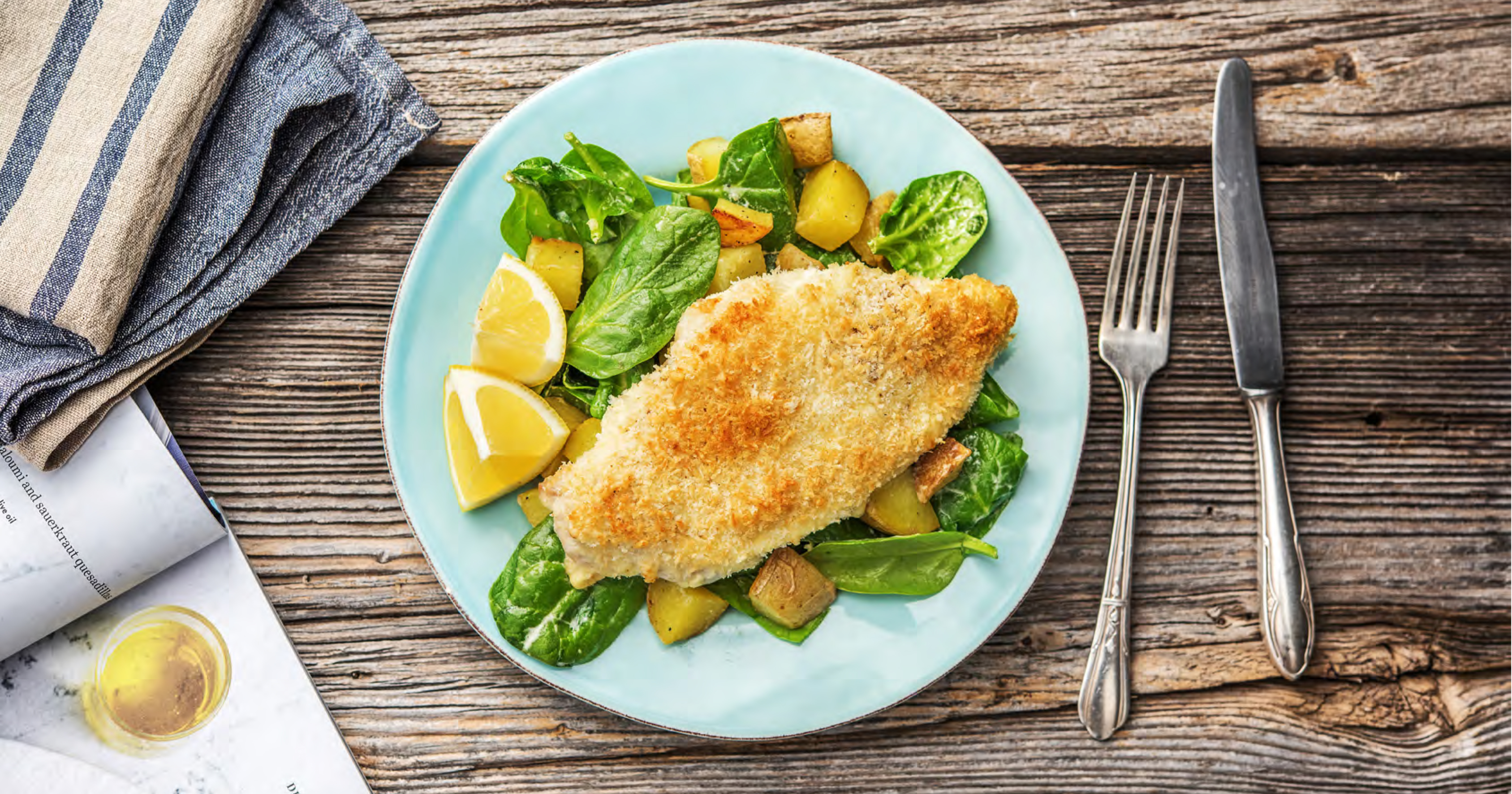
Chicken Recipe

By Hello Fresh


Cooking Time:  30 mins

Servings: 4

Nutrition: 540 Calories

Ingredients:

24 Oz. Yukon Gold Potatoes

1/2 Cup Panko Breadcrumbs

1/2 Cup Parmesan Cheese

2 Tsp. Garlic Powder

24 Oz. Chicken Breasts

6 Tbsp Sour Cream

1 Lemon

10 Oz. Baby Spinach


Preparation:

  1. Prep and roast potatoes. Wash and dry all produce. Preheat oven to 450 degrees. Cut potatoes into 3/4-inch cubes. Toss on a baking sheet with a drizzle of olive oil and a large pinch of salt and pepper. Roast in oven until lightly browned and tender, about 25 mins, tossing halfway through.
  2. Make crust. Meanwhile, combine panko, Parmesan, garlic powder, and a pinch of salt and pepper in a small bowl.
  3. Pound chicken. Place a chicken breast between two pieces of plastic wrap. Pound with a rolling pin, mallet, or heavy-bottomed pan until 1/2-inch thick. Season with salt and pepper. Repeat with remaining chicken breasts.
  4. Crust and bake chicken. Place chicken on a lightly oiled baking sheet and brush tops with 2 tbsp sour cream. Press panko mixture into sour cream. Bake in oven until chicken is cooked through and crust is crispy, 12-15 mins.
  5. Make salad. Halve lemon. Cut one half into wedges. In a large bowl, combine 1 tbsp sour cream (you’ll have some left over), a large drizzle of olive oil, a squeeze of lemon juice, and a pinch of salt and pepper. When potatoes are done, add to bowl along with spinach and toss to coat evenly. Season with salt and pepper.
  6. Plate and serve. Divide salad between plates and top with chicken. Serve with lemon wedges on the side for squeezing over.

How Everyday People Can Train Like Elite Athletes

By Dr. Greg Wells

Do you have dreams of becoming a professional athlete? Then you better lace up your skates.

Of the five most popular professional team sports in North America, those who play high school hockey have the best opportunity – a one in 598 chance – to play professionally. Unfortunately, people have better odds of being killed in a car accident – one in 113.

Just because your childhood dreams being a superstar have been dashed, doesn’t mean you can’t train like an elite athlete.

Dr. Greg Wells (www.DrGregWells.com), a scientist who specializes in extreme human physiology, and author of the book “The Ripple Effect: Eat, Sleep, Move And Think Better,” says that many people are starting to recognize their poor health habits and are taking action to change them.

“People are now understanding the necessity of being active, and that allows them to do their job better,” says Wells. “There is a definite link between movement and the brain.”

Some of the training methods elite athletes subscribe to include getting eight to 10 hours of sleep and waking early to work out. They like to lift heavy sets of weights, perform dynamic exercises and hire fitness coaches to motivate them.

On the other side of that coin, there is a world health crisis taking place and its being caused by three main factors:

• Poor Sleep
Drive by a large office complex and you can usually look up and see more than a few lights on in the building. In an effort to get ahead – or more likely just keep up – people are sacrificing sleep, a major component to performing at the highest level possible. Those who are able to get between seven and nine hours of sleep at night, reduce the risk of heart attacks, strokes and cancer. Good sleep helps strengthen the immune system, boost problem-solving and creativity, reduce stress, builds muscle, regulates appetite and helps us manage mental and emotional health.
• Lack Of Physical Activity
A lack of physical activity can affect the first topic – sleep – causing the harmful effects that go with it. Lack of sleep, however, could be the least of concern for those who don’t get enough exercise. A 2015 University of Cambridge study found that twice as many deaths may be attributable to lack of physical activity compared with the number of deaths attributable to obesity.
• Poor Nutrition
Poor nutrition habits – which include under- or over-eating, not having enough of the healthy foods we need each day, or consuming too many types of food that are high in fat, salt and/or sugar can lead to short-term and long term negative effects on the body. Short term effects include stress, fatigue and illness, while long term effects include tooth decay, high blood pressure, osteoporosis and even some forms of cancer.

April 7 is World Health Day and May is National Physical Fitness and Sports Month. These are great times to get moving on your physical fitness plans, while concentrating on maintaining a healthy sleeping pattern, getting physically active and incorporating healthy foods into your diet.

About Dr. Greg Wells

Athlete, expedition adventurer and physiologist to the world’s best athletes and business people, as well as an Olympic commentator for Canadian TV, Dr. Greg Wells (www.DrGregWells.com) is an authority on high performance and human physiology. Wells’ latest book, “The Ripple Effect: Eat, Sleep, Move And Think Better,” hit shelves earlier this year. Dr. Wells is an assistant professor of kinesiology at the University of Toronto where he studies elite sport performance. He also serves as an associate scientist of physiology and experimental medicine at The Hospital for Sick Children, where he leads the Exercise Medicine Research Program.

Easy Goals for a Healthier You

Photo courtesy: State Point

By StatePoint

Setting big health goals can be a double-edged sword. While many of us feel inspired to improve our health, happiness and wellbeing, we often find the changes hard to sustain, and sometimes end up reverting back to old practices.

Check out these tips for starting and maintaining a healthier lifestyle.


Baby Steps

Many people hoping to improve their fitness routines and eating habits quickly become discouraged when results aren’t immediate. Instead of cancelling your new gym membership and opting for a box of chocolates, set achievable and realistic goals to stay on track.

If losing weight is the objective, aim for 10 pounds instead of 50. If you succeed at losing the first 10, celebrate and make a new goal.

Instead of adopting an extreme diet, cut back on one snack a day or incorporate a smoothie as a healthy meal replacement. Use ingredients like fresh fruit, dark leafy greens, flax or chia seeds — even savory vegetables like beets — the possibilities are endless.


Fuel Up to Get Fit

Sticking to fitness goals takes the right fuel. Eating whole foods instead of processed foods will give you more and longer-lasting energy. Plus, a whole-food diet is more simple and sustainable than restrictive calorie counting or elimination diets.

Powering your body with snacks like low-fat yogurt topped with granola, fresh hummus and whole-grain pita, or an apple and peanut butter, will carry your body through a workout and help you feel fuller longer. To make delicious homemade nut butter, throw three cups of roasted, unsalted peanuts or cashews into a high-powered blender like a Vitamix machine and blend for a minute or so. The result is a gooey, good-for-you treat that will provide ample energy for healthy pursuits.

While grocery shopping, stick to the outer perimeter of the store and pick up nutrient-rich and versatile ingredients like avocados, chickpeas, bananas, nuts and spinach, that can stand alone or be mixed into everything from healthy salads to frozen desserts.


Indulge Your Sweet Tooth

Being healthy and eating whole foods doesn’t mean you have to sacrifice your sweet tooth. Before you plunge into a tub of cookie dough, consider other ways to curb cravings. Make your own, customized whole-food ice cream without artificial colors, flavors or preservatives using a blender. Varieties like apple pie and spiced strawberry will delight without guilt.

Or try a simple sorbet: blend two peeled oranges, two tablespoons sugar and four cups of ice. Use a blender with special settings for this purpose, such as the Vitamix Professional Series 750. Its Frozen Dessert program, one of the machine’s five pre-programmed settings, allows you to make an easy, healthy dessert in minutes.

Looking for something that feels even more decadent? Find recipes like chocolate hazelnut spread and more at vitamix.com/Find-Recipes.

For a healthier you, focus on small, attainable goals, and use whole foods to get creative with your diet.

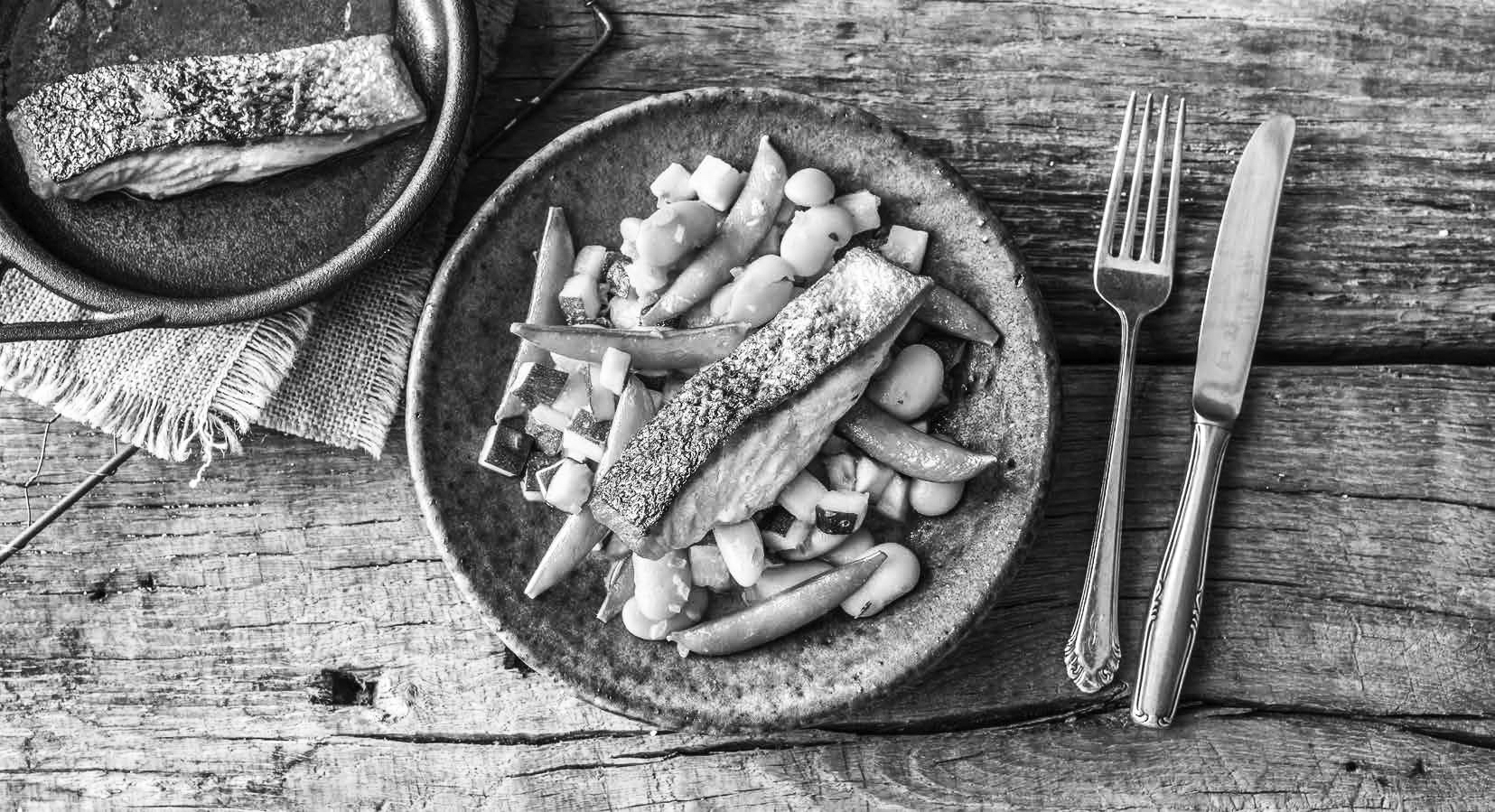
Slammin Lemon Salmon

Photo courtesy: Hello Fresh

By Hello Fresh


Cooking Time: 30 min.

Servings: 4

Nutrition: 690 Calories

Ingredients:

Butter Beans- 2 boxes

Red Onion- 1

Garlic- 4 Cloves

Zucchini- 2

Lemon- 2

Cilantro- 1/4 oz.

Sugar Snap Peas- 8 oz.

Salmon- 24 oz.

Dijon Mustard- 2 tsp

Coriander- 2 tsp

Veggie Stock Concentrate- 2


  1. Prep. Wash and dry all produce. Drain and rinse butter beans. Finely chop onion. Mince or grate garlic. Chop zucchini into 1/2-inch pieces. Halve lemon. Roughly chop cilantro.
  1. Cook veggies. Heat a large drizzle of olive oil in a large pan over medium-high heat. Add onion and cook, tossing, until softened, about 5 minutes. Add snap peas and zucchini. Cook until snap peas are tender but still crisp and zucchini has softened, about 3-4 minutes. Remove from pan and set aside.
  1. Cook salmon. Heat another large drizzle of olive oil in same pan. Season salmon all over with salt and pepper. Place in pan skin-side down. Cook until almost opaque in center, 2-3 minutes per side. Add 1 TBSP butter to pan and juice of half the lemon. Spoon butter and lemon over salmon continuously until cooked through, 1-2 minutes. Remove salmon from pan and set aside.
  1. Warm veggies and beans. Lower heat under pan to medium and add garlic. Cook until fragrant, about 30 seconds. Add 1 tsp mustard (we sent more) and coriander and cook, stirring, another 30 seconds. Add butter bean and veggie mixture. Cook, tossing, until warmed through, 1-2 minutes. Season with salt and pepper.
  1. make sauce Add stock concentrate and ¼ cup water to pan. Simmer until slightly reduced, about 3 minutes. Stir in half the cilantro.
  1. plate and serve Divide butter bean and veggie mixture between plates, then top with salmon. Squeeze lemon over plates and sprinkle with remaining cilantro.

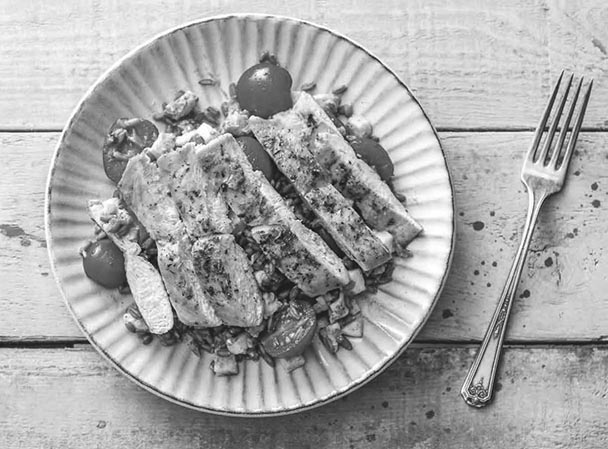
Pan-Seared Chicken With Herbs De Provence

Photo courtesy: Hello Fresh

Over a Warm Farro, Mozzarella, and Tomato Jumble

Courtesy of HelloFresh

Ingredients 2-person | 4-person

Shallot • 1 | 1

Farro • ½ Cup | 1 Cup

Grape Tomatoes • 4 oz | 8 oz

Fresh Mozzarella • 4 oz | 8 oz

Chicken Breasts • 12 oz | 24 oz

Herbs de Provence • 1 TBSP | 2 TBSP

Balsamic Vinegar • 1 TBSP | 2 TBSP

Honey • 2 tsp | 4 tsp

  1. Cook farro Halve, peel, and mince shallot. Bring 2⅓ cups water and a pinch of salt to a boil in a medium pot. Once boiling, add farro and shallot. Lower heat and reduce to a simmer. Cook until tender, 25-30 minutes. TIP: If there is still water in pot after cooking, drain farro and return to pot.
  2. Prep Wash and dry all produce. Halve tomatoes lengthwise. Cut mozzarella into small cubes.
  3. Butterflychicken With your hand on top of one chicken breast, cut ¾ of the way, parallel to cutting board, stopping before you slice through completely. Open it up like a book. Season all over with salt, pepper, and herbs de Provence. Repeat with remaining chicken breast
  4. Make dressing In a small bowl, whisk together 1 TBSP balsamic vinegar (we sent more), honey, and a large drizzle of olive oil. Season with salt and pepper.
  5. Cook chicken Heat a drizzle of oil in a large pan over high heat. Add chicken in a single layer. Cook until browned and no longer pink in center, 3-4 minutes per side.
  6. Finish and plate Add tomatoes, mozzarella, and half the dressing to pot with farro and toss. Season with salt and pepper. Slice chicken into strips. Divide farro mixture between plates, then top with chicken. Drizzle with remaining dressing.

Getting Fit

3864.jpgCourtesy Women’s Health Mag.com

Getting stronger is a beautiful thing. It’s what helps you see more definition and build more metabolism-boosting muscle. But according to new research in Current Biology, it also causes you to burn fewer calories during each workout.

For the study, researchers examined 300 men and women, specifically their levels of physical activity and the number of calories they burned each day. They found that while moderately active people burned about 200 more calories per day than the most sedentary participants, the most physically active people didn’t burn any more calories than those who were only moderately active.

“Think about your job. When you first started, there were some learning curves, it took more energy and more time, but you became more efficient,” he says. Exercise works the same way. Your body adapts to a specific demand. So you naturally become more efficient, and use less energy [a.k.a. calories] to meet that demand.” says California-based trainer Mike Donavanik, C.S.C.S.

But that’s no reason to forgo exercise in the name of weight loss or, more importantly, fat loss. After all, you want to lose fat, not muscle. Right? One obesity study of 439 women found that those who ate healthy and exercised lost considerably more body fat than those who stuck with dieting alone.

So how do you make sure every sweat session helps you burn more? Follow these rules of exercising for weight loss

Get FIIT
When it comes to making sure your body never gets too comfy with your workout, you’ve got to cozy up to the FIIT principle. It stands for frequency, intensity, time, and type—the four factors that determine the exact stress you put on your body during a given workout, says Donavanik. Changing up any one of them “surprises” and challenges your body in a new way. Remember, as long as your body is forced to adapt to progressively challenging workouts, it’s going to burn more calories during every workout. It’s when your body gets used to your current workouts that things start to plateau. “Look to change one to two of these variables every four to six weeks and you’ll keep losing weight,” he says.

And HIIT
In one 2013 study from Human Performance Laboratory at the University of Wisconsin-La Crosse, people who performed a 20-minute HIIT workout torched 15 calories per minute—about twice as many as they did during long runs. Plus, with HIIT workouts, you benefit from the “after burn” effect, which a steady-state cardio just won’t give you. “So instead of burning 250 calories from your 30-minute session, you can burn up to 40 percent more throughout the next day or so as your body recovers,” says Donavanik. Follow the study’s lead: Perform all-out effort for 20 seconds, rest for 10 seconds, and repeat until you’ve hit four minutes. Rest one minute, then repeat to complete a total of four rounds.

Prioritize Clean Eating
Eating junk can make your workouts feel more difficult, so even if you think you’re pushing yourself to the max, you’re not, he says. And sub-max workouts, as you might have guessed, burn fewer calories. He recommends limiting added sugar and focusing on eating lean protein, healthy fats, and whole carbs from fruits, veggies, and whole grains.

Don’t Forget to Fuel
While everyone thrives on a slightly different pre-and post-workout nutrition plan, research published in Sports Medicine shows that eating carbs before you hit the gym improves your performance during HIIT and endurance workouts alike. And tougher workouts burn more calories—both during and after your workout, Donavanik says.

That explains why recent research published in the International Journal of Sport Nutrition and Exercise Metabolism found that downing coffee (or any caffeine) an hour before your workout can boost your post-workout caloric burn by 15 percent. After your workout, Donavanik recommends eating a meal that’s about 40 percent carbs, 40 percent protein, and 20 percent fat. The combination will help your muscles recover, get your energy levels up, and have you burning more calories as your body repairs…and, yes, adapts.

Lean Mean Chicken And Greens

with Rosemary Potatoes and Gremolata


By HelloFresh

Cooking Time: 30 min.

Servings: 2

Nutrition: Calories: 659

Ingredients:

  • Lemon- 1
  • Garlic- 2 Cloves
  • Shallot- 1
  • Rosemary- ¼ oz.
  • Parsley- ¼ oz.
  • Yukon Gold Potatoes- 12 oz.
  • Chicken Breasts- 12 oz.
  • Arugula- 4 oz.
  • Dried Cranberries- 1 oz.
  • Walnuts- 1 oz.

Preparation:

  1. Prep and Boil potatoes. Wash and dry all produce. Cut potatoes into ¾-inch cubes. Place in a medium pot with enough salted water to cover by 2 inches. Bring to a boil and cook until tender, 10-12 minutes, then drain. Meanwhile, zest and halve lemon. Mince garlic. Halve, peel, and mince shallot. Strip rosemary from stems. Chop leaves until you have 1 tsp. Finely chop parsley.
  2. Butterflychicken. With your hand on top of one chicken breast, cut ¾ of the way, parallel to the cutting board, stopping before you slice it completely. Repeat with other breast. Place chicken in a medium bowl with juice of one lemon half, half the garlic, and a large drizzle of olive oil. Season with salt and pepper. Toss to coat and set aside to marinate.
  3. Make gremolata. In a small bowl, combine parsley, lemon zest, and a pinch of the remaining garlic. Stir in a large drizzle of olive oil. Season with salt and pepper.
  4. Cook chicken. Heat a drizzle of olive oil in a large pan over medium-high heat. Remove chicken from marinade, shaking off excess, and add to pan. Cook until browned and no longer pink in center, 3-4 minutes per side. Remove from pan and set aside to rest 5 minutes. TIP: Cover chicken with aluminum foil to keep warm.
  5. Crisp potatoes. While chicken rests, toss together potatoes, rosemary, shallot, remaining garlic, and a drizzle of olive oil in same pan over medium-high heat. Cook until fragrant and starting to brown at edges, 3-4 minutes, stirring occasionally. Season generously with salt and pepper.
  6. Make salad and serve. In a medium bowl, whisk together a squeeze of lemon juice and a large drizzle of olive oil. Add arugula, cranberries, and walnuts. Toss to coat. Season with salt and pepper. Divide salad between plates, then add chicken and potatoes. Spoon gremolata over chicken.

Meatballs On Top of Cavatappi

With Broccoli and Pesto Cream Sauce

By Hello Fresh

30 min.

Cooking Time: 30 min.

Servings: 4

Nutrition: 880 Calories

Ingredients:

Lemon- 1 whole

Ground Turkey- 16 oz.

Pesto- 6 oz.

Panko Breadcrumbs- 1/2 Cup

Cavatappi Pasta- 12 oz.

Broccoli Florets- 8 oz.

Sour Cream- 8 Tbsp.

Parmesan Cheese- 1/2 Cup

Preparation:

  1. Preheat and Prep. Wash and dry all produce. Preheat oven to 425 degrees. Bring a large pot of salted water to a boil. Zest lemon until you have 1 tsp zest, then cut lemon into wedges.
  1. Shape meatballs. In a large bowl, mix together turkey, 2 TBSP pesto, panko, and a pinch of salt and pepper until just combined. Gently shape mixture into golf-ball-sized meatballs with hands- you should have about 12. TIP: Splash a little water on your hands to keep meat from sticking.
  1. Bake meatballs. Place meatballs on a lightly oiled baking sheet. Bake in oven until fully cooked through and no longer pink in center, 12-15 minutes, flipping halfway through.
  1. Boil pasta and broccoli. Meanwhile, add cavatappi to pot of boiling water. Cook 6 minutes, stirring occasionally, then add broccoli to pot. Continue cooking until cavatappi is al dente and broccoli is tender, about 3 minutes more. Carefully ladle out and reserve 1 cup pasta cooking water, then drain. Return cavatappi and broccoli to pot.
  1. Drain and combine. Add sour cream, remaining pesto, and meatballs to pot. Stir to combine, adding enough pasta cooking water to create a thick sauce that coats everything.
  1. Plate. Divide pasta mixture between plates. Sprinkle with Parmesan and lemon zest (to taste). Serve with lemon wedges on the side for squeezing over.

Great Tips to Get in Shape and Stay in Shape

By StatePoint

Losing weight and living a healthier lifestyle top millions of people’s list of goals. Unfortunately, it’s a lot easier to set a goal than it is to actually achieve it, so it’s important to have a game plan if you want to see results. Here are some sustainable tips to help you lose weight and feel great! 

Set Goals Mindfully

Setting a goal to “lose weight” sounds great, but it is pretty vague. It’s hard to achieve a goal without a specific plan or focus. Remember to think about your health beyond just the number on the scale. Whether it’s deciding to train for a 5k race or choosing to reduce your sugar intake by half, getting specific and setting realistic goals helps you get a clear sense as to whether you were successful.

Get Hydrated

One simple way to cut back calories and sugar is to make water your drink of choice. Eliminate high-calorie beverages like juice and soda from your diet. Get started by setting a simple goal of drinking at least five 12-ounce glasses of water a day.

Sustainable Meal Planning

A sustainable diet is not about deprivation, it’s about eating nutritious, enjoyable meals. For example, a Mediterranean diet, which focuses on fresh fruits and vegetables, whole grains, lean meats and healthy fats like olive oil; often offers better nutrition, better flavors and better results than a fad diet.

In fact, people who followed a Mediterranean diet lost 52 percent more weight than those with a standard low-fat diet says a study published in a peer reviewed journal. Over a period of two years, the Mediterranean diet group lost 9.7 pounds while the low fat diet group only lost 6.3 pounds.

Make Exercise Fun

Exercise is critical for a healthy body and mind. Whether it’s taking the dog out for a daily walk, signing up for a dance class or committing to hitting the gym three to four times a week, find a workout routine you love and can commit to so you don’t think of movement and exercise as a chore.

Seek Support

Even a well-balanced diet combined with exercise can use extra support. One great program that works in conjunction with a Mediterranean diet is the M3 system by Modere, an innovative weight management system combining credible products with real food and flexible lifestyle behaviors to help users detox.

The plan includes a thermogenic fat-burning supplement taken in the morning, a protein-rich shake for lunch, and an evening fiber drink to help control dinner portions. These statements have not been evaluated by the Food and Drug Administration. According to Modere, this product is not intended to diagnose, treat, cure or prevent any disease.

“The lifestyle-based approach to dieting can mean better and more sustainable results than fads that require you to eat only from limited list of foods,” says Greg Horn, formulator of Modere M3.

The plan also requires you to make key changes that support health and weight management by letting you pick three of the five healthy lifestyle behavior options such as committing to walking 7,500 steps a day, cutting out fried foods and sugary drinks, or avoiding refined flour and white rice. To learn more about how M3 can help you, visit http://www.TakeM3.com.

Make now the time you set a goal and stick with it!


Flu Facts and Places to Avoid

By Nancy Bostrom

Widespread flu is reported in our state and nearly half the country right now and health officials say that means you can expect more people to get sick in the next few weeks.

The best way to fight the flu is to get vaccinated, but it takes two weeks for the shot to become effective.  In the meantime, the best protection is good hygiene. That’s why physicians at American Family Care, with urgent care clinics in our area, have identified the top five germiest places and how to protect yourself from them.

Top 5 Germiest Places to Avoid During Flu Season:

  1. Debit card machine.   Get into the habit of punching in your debit card pin with a knuckle instead of a fingertip.  This way if you rub your eye or mouth with your fingertip, you’re not transferring germs.
  1. Community pens. Whether at work or signing a credit card receipt at a store, never pick up a public pen because they’re covered with other people’s germs.  Keep a pen handy for any situation that could pop up.
  1. Shaking hands.   People are more germ-conscious these days so avoiding a handshake is not as rude as once thought, especially during flu season.  If you must do it, wash or sanitize your hands immediately.
  1. Cell phones, tablets.  We are constantly using our phones or computer tablets to show friends and coworkers pictures or videos. This means other people are putting their germs on something you are constantly touching.  Get into the habit of wiping your phone down with a disinfecting wipe to cut down on spreading germs.
  1. Gas pump.  Drivers must get gas no matter what, sick or not. Protect yourself at the pump, grab a paper towel by the pump before picking up the gas nozzle.  You can also use the paper towel as a barrier when punching in your debit/credit card info.

FAST FLU FACTS:

  • Children under the age of 6, pregnant women and adults 65 or older are at high risk for serious flu complications like inflammation of the heart, brain or muscle tissues or multi-organ failure.
  • Most experts think flu viruses spread mainly by droplets made when someone with flu coughs, sneezes or talks. They can infect you from six feet away.
  • People can carry the virus and risk exposing others when they show little symptoms.
  • Frequently touched surfaces at work or school should be cleaned and disinfected especially if someone is ill.


6 Ways to Boost Women’s Health

By  Beth Orenstein  , Medically Reviewed by Lindsey Marcellin, MD, MPH

Women’s health concerns are a little different from those of men. If you’re a woman, these tips will soon have you feeling fit and energetic.

To look and feel your best at every age, it’s important to make smart lifestyle and health choices. Here are six simple things that women can do every day (or with regularity) to ensure good health:

Health Tip #1: Eat a healthy diet. “You want to eat as close to a natural foods diet as you can,” says Donald Novey, MD, an integrative medicine physician with the Advocate Medical Group in Park Ridge, Ill. That means a variety of fresh fruits and vegetables and fewer processed foods. Eat whole grains and high-fiber foods and choose leaner cuts of meat, fish, and poultry. Include low-fat dairy products in your diet as well — depending on your age, you need between 800 and 1,500 milligrams of calcium daily to help avoid osteoporosis, Dr. Novey says. Avoid foods and beverages that are high in calories, sugar, salt, and fat.

Healthy eating will help you maintain a proper weight for your height, which is important because being overweight can lead to a number of illnesses. Looking for a healthy snack? Try some raw vegetables, such as celery, carrots, broccoli, cucumbers, or zucchini with dip made from low-fat yogurt.

If you’re not getting enough vitamins and nutrients in your diet, you might want to take a multivitamin and a calcium supplement to make sure you’re maintaining good health.

Health Tip #2: Exercise. Heart Disease is the leading cause of death among women in America, but plenty of exercise can help keep your heart healthy. You want to exercise at least 30 minutes a day, five days a week, if not every day. Aerobic exercises (walking, swimming, jogging, bicycling, dancing) are good for women’s health in general and especially for your heart, says Sabrena Merrill, MS, of Lawrence, Kan., a certified personal trainer and group fitness instructor and a spokeswoman for the American Council on Exercise.

Health Tip #3: Avoid risky habits. Stay away from cigarettes and people who smoke. Don’t use drugs. If you drink alcohol, do so in moderation. Most women’s health studies show that women can safely consume one drink a day. A drink is considered to be about 12 to 14 grams of alcohol, which is equal to 12 ounces of beer (4.5 percent alcohol); 5 ounces of wine (12.9 percent alcohol); or 1.5 ounces of spirits (hard liquor such as gin or whiskey, 80-proof).

Health Tip #4: Manage stress. No matter what stage of her life — daughter, mother, grandmother — a woman often wears many hats and deals with a lot of pressure and stress. “Take a few minutes every day just to relax and get your perspective back again,” Novey says. “It doesn’t take long, and mental health is important to your physical well-being.” You also can manage stress with exercise, relaxation techniques, or meditation.

Health Tip #5: Sun safely. Excessive exposure to the sun’s harmful rays can cause skin cancer, which can be deadly. To protect against skin cancer, wear sunscreen with a sun protection factor (SPF) of at least 15 if you are going to be outdoors for more than a few minutes. Even if you wear sunscreen faithfully, you should check regularly for signs of skin cancer. Warning signs include any changes in the size, shape, color, or feel of birthmarks, moles, or freckles, or new, enlarging, pigmented, or red skin areas. If you spot any changes or you find you have sores that are not healing, consult your doctor.

Health Tip #6: Check for breast cancer. The American Cancer Society no longer recommends monthly breast self-exams for women. However, it still suggests them as “an option” for women, starting in their 20s. You should be on the lookout for any changes in your breasts and report any concerns to your doctor. All women 40 and older should get a yearly mammogram as a mammogram is the most effective way of detecting cancer in its earliest stages, when it is most treatable.

A woman’s health needs change as she ages, but the basics of women’s health remain the same. If you follow these six simple healthy living tips, you will improve your quality of life for years to come.

Skin care: 5 tips for healthy skin

By Mayo Clinic Staff

Don’t have time for intensive skin care? You can still pamper yourself by acing the basics. Good skin care and healthy lifestyle choices can help delay the natural aging process and prevent various skin problems. Get started with these five no-nonsense tips.

  1. Protect yourself from the sun

One of the most important ways to take care of your skin is to protect it from the sun. A lifetime of sun exposure can cause wrinkles, age spots and other skin problems — as well as increase the risk of skin cancer.

For the most complete sun protection:

  • Use sunscreen.Use a broad-spectrum sunscreen with an SPF of at least 15. Apply sunscreen generously, and reapply every two hours — or more often if you’re swimming or perspiring.
  • Seek shade.Avoid the sun between 10 a.m. and 2 p.m., when the sun’s rays are strongest.
  • Wear protective clothing.Cover your skin with tightly woven long-sleeved shirts, long pants and wide-brimmed hats. Also consider laundry additives, which give clothing an additional layer of ultraviolet protection for a certain number of washings, or special sun-protective clothing — which is specifically designed to block ultraviolet rays.
  1. Don’t smoke

Smoking makes your skin look older and contributes to wrinkles. Smoking narrows the tiny blood vessels in the outermost layers of skin, which decreases blood flow. This depletes the skin of oxygen and nutrients that are important to skin health.

Smoking also damages collagen and elastin — the fibers that give your skin strength and elasticity. In addition, the repetitive facial expressions you make when smoking — such as pursing your lips when inhaling and squinting your eyes to keep out smoke — can contribute to wrinkles.

If you smoke, the best way to protect your skin is to quit. Ask your doctor for tips or treatments to help you stop smoking.

  1. Treat your skin gently

Daily cleansing and shaving can take a toll on your skin. To keep it gentle:

  • Limit bath time.Hot water and long showers or baths remove oils from your skin. Limit your bath or shower time, and use warm — rather than hot — water.
  • Avoid strong soaps.Strong soaps and detergents can strip oil from your skin. Instead, choose mild cleansers.
  • Shave carefully.To protect and lubricate your skin, apply shaving cream, lotion or gel before shaving. For the closest shave, use a clean, sharp razor. Shave in the direction the hair grows, not against it.
  • Pat dry.After washing or bathing, gently pat or blot your skin dry with a towel so that some moisture remains on your skin.
  • Moisturize dry skin.If your skin is dry, use a moisturizer that fits your skin type. For daily use, consider a moisturizer that contains SPF.
  1. Eat a healthy diet

A healthy diet can help you look and feel your best. Eat plenty of fruits, vegetables, whole grains and lean proteins. The association between diet and acne isn’t clear — but some research suggests that a diet rich in vitamin C and low in unhealthy fats and processed or refined carbohydrates might promote younger looking skin.

  1. Manage stress

Uncontrolled stress can make your skin more sensitive and trigger acne breakouts and other skin problems. To encourage healthy skin — and a healthy state of mind — take steps to manage your stress. Set reasonable limits, scale back your to-do list and make time to do the things you enjoy. The results might be more dramatic than you expect.


Magnesium the Magnificent!

By Clark’s Nutrition of Chino

Medieval Latin named it “magnesia”, a white lodestone mineral that was highly magnetic and very highly prized by the 15th century alchemists. This group of protoscientists aimed to purify base metals into gold and craft elixirs of mortality, and believed magnesium deposits could be used to craft the mythical “philosopher’s stone”. While unsuccessful in their pursuit, this historically significant movement produced many writings that would eventually be of benefit to geologists, architects, physiologists and biochemists. Today, we know magnesium to be one of the most important, most studied, and most dynamic nutrients in our bodies. As a major mineral, magnesium assists the body in carrying out over 300 enzymatic reactions, stabilizing our cell’s energy currency, and helping our muscles and nerves relax. Individuals with physiological appropriate levels of magnesium tend to suffer less from conditions such as diabetes, kidney disease, and hypertension. But the benefits do not end there, magnesium may also improve short and long term working memory by improving the density and strength of our nerve network. Luckily, nature has made magnesium ubiquitous and easy to ingest, no matter the eating philosophy, dietary needs, or food selection of even the most finicky eater. Good sources of magnesium are green leafy vegetables, nuts and seeds, dairy, fish, and legumes (magnesium is mostly synonymous with high fiber foods). As easy as finding and ingesting magnesium should be, there are still large swaths of the population that are in deficiency states. Individuals in chronic unmitigated high-stress lifestyles, alcoholics, caffeine abusers, those engaging in long periods of sweating without proper hydration (exercisers), and individuals eating a highly refined “fiber-less” diet are most at risk for a magnesium deficiency.

Inadequate magnesium may also exacerbate the following conditions:

  • Depression- by reducing serotonin levels. Serotonin positively affects almost all of our 40 million brain cells by regulating sleep, mood, sexual desire, appetite, and learning and social behavior.
  • Heart health- low levels of magnesium may lead to heart arrhythmia (irregular heart beat) in combination with calcium.
  • Diabetes- magnesium helps to regulate the effects of blood sugar by improving insulin sensitivity.
  • Osteoporosis- 50-60% of our body’s magnesium (~25 grams total) are found in our bones.

Magnesium recommendations are 310 milligrams for women and 420 milligrams for men. This dose may be increased in times of acute deficiency with one caveat, high doses of magnesium may cause loose and watery stools (which may be the desired effect for those suffering constipation). Upper tolerable levels for daily use are between 800-1200 milligrams for up to three months. Magnesium can interfere with some medications therefore it is imperative that individuals currently taking any medication discuss magnesium dosing with their doctor.

Magnesium is found in powder form, which can easily be mixed into a drink as well as capsules and liquid. Taking 100 milligrams (up to 250 mgs may be well tolerated after a ramp up period) an hour before bed may help to relax muscles and increases the function of GABA receptors (GABA is a calming “inhibitory” neurotransmitter). If the alchemists taught us one thing, it is our interaction with minerals may greatly influence our longevity and health span. As always, have a healthy day.

C Doussett MPH, RDN

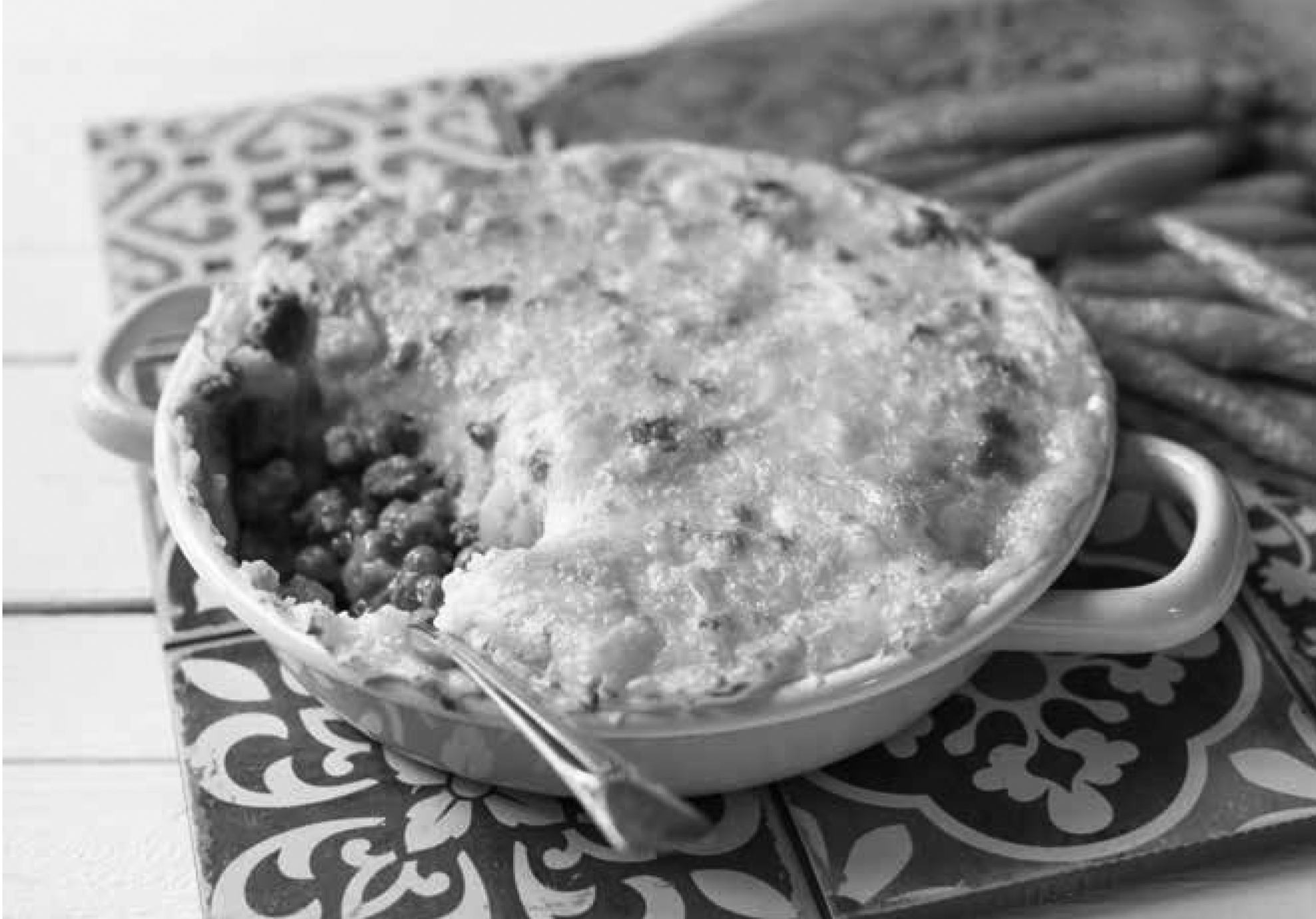
EASY AS (SHEPHERD’S) PIE

with Caramelized Onions and Roasted Carrots


By Hello Fresh  recipe-cropped-bw

START STRONG. Potato skins are a rich source of vitamins and minerals like iron and potassium, so don’t waste time peeling them! A quick chop is all the potatoes need before being tossed in the boiling water.

Cooking Time: 35 min.

Servings: 2

Nutrition: 703 cal, Fat: 33 g, Sat. Fat: 14 g, Protein: 44 g, Carbs: 59 g, Sugar: 14 g, Sodium: 573 mg, Fiber: 12 g

Ingredients:

  • Yukon Potatoes- 16 oz.
  • Baby Carrots- 8 oz.
  • Yellow Onion- 1
  • Garlic- 2 Cloves
  • Thyme- ¼ oz.
  • Ground Beef- 10 oz.
  • Flour- 1 TBSP
  • Chicken Stock Concentrate- 1
  • Peas- 4 oz.
  • Reduced-Fat Milk- ¼ Cup
  • Parmesan Cheese- ¼ Cup

Preparation:

  1. Preheat oven and roast carrots. Wash and dry all produce. Preheat oven to 420 degrees. Toss carrots on a baking sheet with a drizzle of olive oil and pinch of salt and pepper. Roast until starting to brown, about 20 minutes.
  2. Cook potatoes. Cut potatoes into ½-inch cubes. Place in a large pot of salted water. Bring to a boil and cook until fork tender, about 15 minutes. Drain and return to pot.
  3. Prep remaining ingredients. Halve, peel, and thinly slice onion. Mince garlic. Strip thyme leaves off stems. Discard stems.
  4. Brown beef and onions. Heat a drizzle of olive oil in a large ovenproof pan over medium-high heat. Add beef and thyme. Cook until browned, 3-4 minutes. Remove from pan and set aside. Add another drizzle of olive oil and onions to pan. Cook until softened, about 6 minutes. Add garlic and ¼ cup water.
  5. Make sauce and mash potatoes. Sprinkle flour over onions and stir 1 minute. Add stock concentrate, ½ cup water, and peas. Stir until sauce thickens, 2-3 minutes. Add beef and stir to combine. Use a fork or potato masher to mash potatoes with ¼ cup milk and 1 TBSP butter until smooth. Season with salt and pepper.
  6. If your pan isn’t ovenproof, transfer beef mixture to a medium baking dish. Spread mashed potatoes over top. Sprinkle with Parmesan cheese, and bake until melted and bubbly, about 5 minutes. Serve with roasted carrots on the side.

Ask Clark’s

I heard that calcium causes heart disease, is that true?

A Question from an anonymous reader

By Clark’s Nutrition

Calcium consumption from foods and supplementation has become somewhat controversial in the last few years. Osteoporosis prevention has centered on the consumption of calcium from foods and supplementation. Recently, (in October 2016) the Journal of the American Heart Association (JAHA) released a research article that suggested higher consumption of calcium from supplementation might increase the risk of coronary artery calcification (also known as CAC). The information contained in this article helped many individuals see a different view of calcium supplementation. Although it is important to note the JAHA study also suggested that total atherosclerosis was less with individuals who consumed more total calcium via foods and supplementation but suggested the food group was best.  There are also some other responses have come out in support of calcium supplementation. The National Osteoporosis Foundation and American Society for Preventive Cardiology convened an expert panel to look at research to determine other positions for calcium supplementation. These two groups concluded that supplemental calcium with or without vitamin D have no relationship either good or bad to the risk of cardiovascular disease and cerebralvascular disease mortality. They also found that generally there was no cause of mortality in healthy adults when using calcium supplementation. They also recommend that individuals consume no more than the upper daily limits for calcium at 2000-2500mg per day including foods and supplementation. Additionally the NOF suggested that calcium is a nutrient that is lacking in many individuals. Although there is a lot of negative press about the use of calcium, the Council for Responsible Nutrition also reported that the American Heart Association’s Multi-Ethnic Study of Atherosclerosis suggests that there is proof of safety in supplementation because of the positive association with total calcium consumption and reduction in lower rates of atherosclerosis. As always, if you have any questions about the use of supplementation, please consult with your doctor before using any products.

References

  1. Lack of Evidence LinkingCalcium With or Without Vitamin D Supplementation to CardiovascularDisease in Generally Healthy Adults: A Clinical Guideline From the National Osteoporosis Foundation and the American Society for Preventive CardiologyKopecky SL, Bauer DC, Gulati M, Nieves JW, Singer AJ, Toth PP, Underberg JA, Wallace TC, Weaver CM.Ann Intern Med. 2016 Oct 25. doi: 10.7326/M16-1743 https://www.ncbi.nlm.nih.gov/pubmed/2777636
  2. Calcium supplements could increase risk of heart disease, new study findsByAndrea K. McDaniels October 17https://www.washingtonpost.com/national/health-science/calcium-supplements-may-raise-risk-of-heart-disease/2016/10/17/a80285fe-9215-11e6-9c52-0b10449e33c4_story.html
  3. http://www.crnusa.org/CRNPR16-NewStudyAffirmsCalciumSafetyHeartHealth101116.html
  4. oRIGINAL RESEARCHOpen AccessCalcium Intake From Diet and Supplements and the Risk of Coronary Artery Calcification and its Progression Among Older Adults: 10‐Year Follow‐up of the Multi‐Ethnic Study of Atherosclerosis (MESA)John J.B. Anderson,Bridget Kruszka, Joseph A.C. Delaney, Ka He, Gregory L. Burke, Alvaro Alonso, Diane E. Bild, Matthew Budoff and Erin D. Michoshttp://jaha.ahajournals.org/content/5/10/e003815


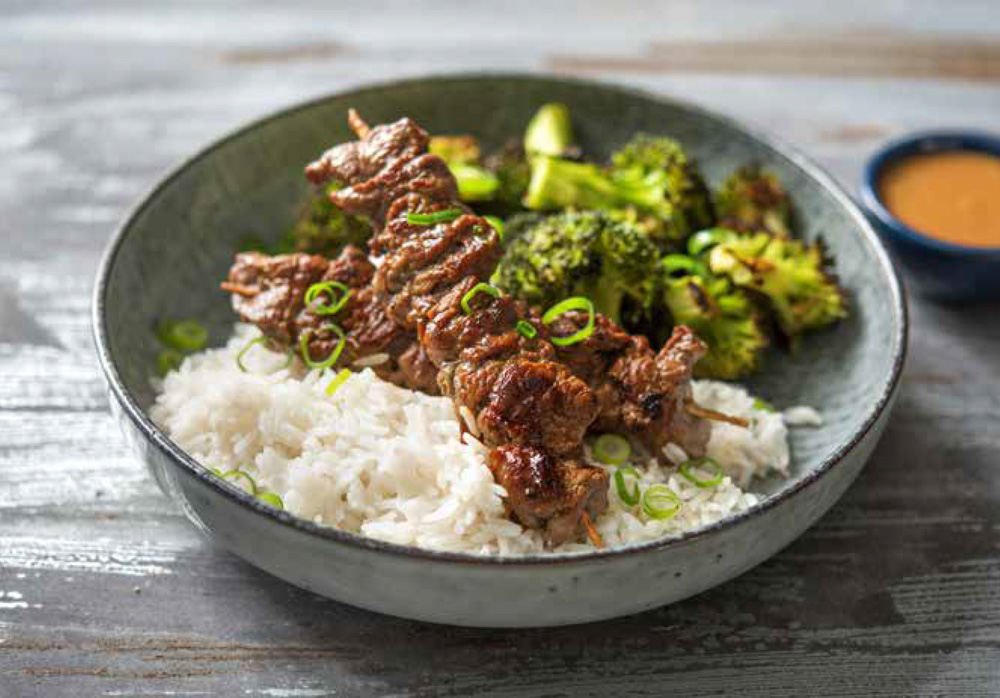
Thai Beef Skewers (aka Satay)

With Peanut Dipping Sauce, Broccoli, and Jasmine Rice  recipe-steak-satay-with-1-web

By Hello Fresh

Cooking Time: 30 min.

Servings: 2

Nutrition: 657 cal, Fat: 23 g, Sat. Fat: 5 g, Protein: 48 g, Carbs: 62 g, Sugar: 12 g, Sodium: 654 mg, Fiber: 5 g

Ingredients:

  • Garlic- 2 Cloves
  • Lime- 1
  • Scallions- 2
  • Jasmine Rice- ½ Cup
  • Broccoli Florets- 8 oz.
  • Sirloin Tips- 12 oz.
  • Soy Sauce- 4 tsp.
  • Peanut Butter- 2 TBSP
  • Skewers- 4

Preparation:

  1. Preheat oven and cook rice. Wash and dry all produce. Preheat oven to 400 degrees. Mince garlic. Zest and halve lime. Thinly slice scallions, keeping greens and whites separate. Bring 1 cup salted water to a boil in a small pot. Once boiling, add rice. Cover and simmer until tender, about 15 minutes. Keep covered.
  2. Roast broccoli. Toss broccoli on a baking sheet with a drizzle of olive oil and a pinch of salt and pepper. Roast until golden brown and slightly crispy, 15-20 minutes.
  3. steak Combine sirloin tips, 1 TBSP soy sauce, 2 tsp sugar, half the garlic, ½ tsp lime zest, and a large drizzle of olive oil in a medium bowl. Season with salt and pepper.
  4. Make peanut sauce. Heat a drizzle of olive oil in a medium pan over low heat. Add scallion whites and remaining garlic, and toss until fragrant, 1-2 minutes. Stir peanut butter, 1 tsp soy sauce, and 2 tsp sugar into pan. Slowly stir in ¼ cup water until incorporated. Remove pan from heat, and stir in a squeeze of lime. Season to taste with salt and pepper.
  5. Broil skewers. Preheat broiler to high (or increase oven to 500 degrees). Rinse skewers under water, then thread steak onto them. Place on baking sheet and broil, flipping over halfway through, until slightly charred and cooked to desired doneness, 5-10 minutes.
  6. Serve satay on a bed of rice alongside broccoli. Garnish with scallion greens, and serve with peanut sauce for dipping.